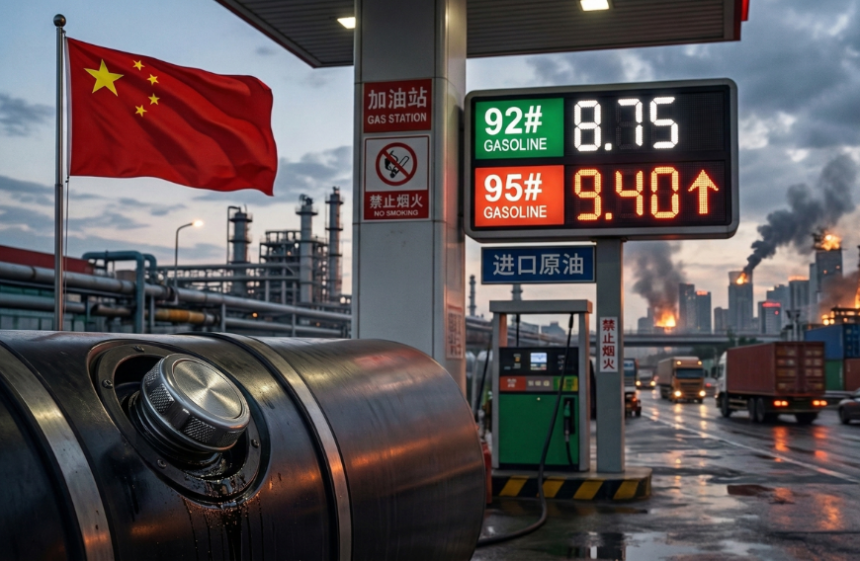
China has announced a fresh increase in retail fuel prices beginning May 9 as rising global crude oil prices and continuing tensions in West Asia place renewed pressure on energy markets across the world. The decision reflects growing concerns over supply disruptions linked to the Iran conflict and instability surrounding the strategically important Strait of Hormuz, through which a major portion of global oil shipments passes every day.
According to China’s state economic planner, retail gasoline prices will rise by 320 yuan per metric ton while diesel prices will increase by 310 yuan per metric ton starting Friday. The revision marks a significant shift after Chinese authorities had earlier reduced domestic fuel price caps in April in an attempt to cushion consumers and industries from sharp international oil price fluctuations.
The latest increase comes at a time when global energy markets remain highly volatile due to geopolitical tensions involving Iran, the United States and Israel. Concerns regarding maritime security and possible disruption of oil shipments through the Strait of Hormuz have triggered uncertainty across international crude markets, affecting both importing and exporting economies.
China’s fuel pricing mechanism operates through periodic government reviews linked to international crude oil trends. When global oil prices rise sharply over sustained periods, domestic retail fuel prices are adjusted accordingly. The new price revision therefore reflects the direct impact of international geopolitical instability on China’s domestic economy and transportation sector.
The decision is expected to influence transportation costs, logistics expenses and industrial operations across China, which remains the world’s largest crude oil importer. Rising fuel prices could also impact inflationary trends in sectors dependent on freight movement and energy-intensive manufacturing activities.
The increase comes after China had temporarily lowered fuel price caps during April to reduce pressure on businesses and consumers as oil prices surged due to fears surrounding the Iran conflict and possible closure of the Strait of Hormuz. However, with crude prices continuing to remain elevated, authorities have now reversed that decision and returned to raising domestic fuel rates.
Global oil prices have remained extremely sensitive to every diplomatic and military development emerging from West Asia. The Strait of Hormuz continues to serve as one of the world’s most critical maritime energy corridors, handling nearly one fifth of global oil trade. Any threat to shipping routes in the region immediately affects international crude benchmarks and energy market sentiment.
China’s energy security calculations are particularly important because the country imports substantial amounts of crude oil from the Gulf region. Stable shipping routes and uninterrupted maritime movement remain essential for maintaining industrial output, transportation networks and broader economic growth within China.
The latest fuel price increase may also affect global commodity markets because higher fuel and transportation costs often influence manufacturing and export pricing. China’s industrial sector plays a central role in global supply chains, meaning domestic energy cost adjustments can eventually impact international trade and production economics.
Chinese authorities have so far emphasised the importance of maintaining stable energy supplies despite external geopolitical pressures. Beijing has simultaneously increased diplomatic engagement regarding the West Asia crisis while urging all sides to prioritise ceasefire efforts and avoid escalation that could threaten global economic stability.
Energy analysts believe the fuel price hike also signals Beijing’s recognition that prolonged geopolitical uncertainty may continue to keep crude oil prices elevated for the foreseeable future. Instead of relying solely on temporary subsidies or price controls, authorities appear to be gradually aligning domestic pricing with international market conditions.
The move is likely to be closely monitored by transportation companies, manufacturing firms and logistics operators across China. Rising diesel costs especially can directly affect freight operations and supply chain expenses, potentially influencing retail prices in multiple sectors.
International financial markets are also watching China’s energy decisions carefully because the country’s fuel demand and import patterns significantly influence global oil consumption trends. Any major adjustment in Chinese energy policy often carries broader implications for commodity markets worldwide.
The latest revision therefore highlights how geopolitical conflict in one region can rapidly create economic ripple effects across major global economies. As tensions in West Asia continue to shape oil market behaviour, countries dependent on imported energy supplies remain vulnerable to sudden price fluctuations and supply chain disruptions.