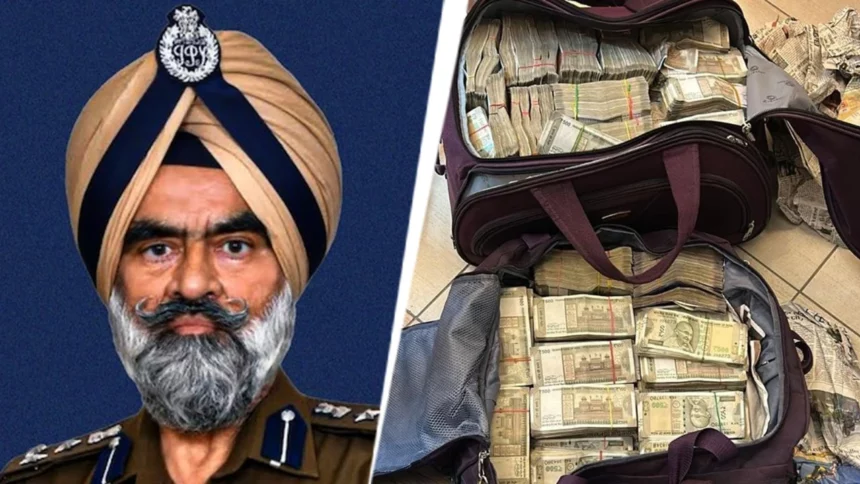
Deputy Inspector General (DIG) Harcharan Singh Bhullar, once considered a prominent figure in Punjab Police, saw his career abruptly interrupted after his arrest by the Central Bureau of Investigation (CBI) on allegations of demanding an ₹8-lakh bribe from a scrap dealer. Harcharan Singh Bhullar, whose career spanned more than three decades, had long been viewed as an officer whose rise through the ranks was marked by privilege, legacy, and political connections. He was currently posted in the Ropar range, holding one of the senior positions in Punjab Police, and his trajectory had been carefully shaped by his father, Mehal Singh Bhullar, a former Director General of Police (DGP) who played a crucial role during the peak of terrorism in the state. The arrest has sent shockwaves across the state, highlighting the rare and dramatic fall of a senior police officer who had been widely regarded as competent, effective, and politically astute. His story is as much about opportunity and legacy as it is about the vulnerabilities that accompany power within law enforcement institutions.
A Privileged Entry and Rapid Ascent in Punjab Police
Harcharan Bhullar’s career began under extraordinary circumstances. In 1993, during the tenure of then Chief Minister Beant Singh, Bhullar was recruited as a Deputy Superintendent of Police (DSP) under a special provision that bypassed conventional recruitment procedures. Traditionally, DSPs are selected either through direct recruitment via the Punjab Public Service Commission (PPSC) exam or through promotion from within the force. Harcharan Singh Bhullar’s selection was considered exceptional and widely attributed to the legacy and influence of his father, Mehal Singh Bhullar, who at the time was Inspector General (IG) and heading the operations wing at the height of Punjab’s terrorism crisis. His father’s proximity to the Congress leadership and instrumental role in counter-terrorism operations had earned him recognition and elevated him later to the position of DGP. Harcharan’s special recruitment was publicly seen as a reward for his father’s contributions, cementing the perception that his career would follow a path of privilege and accelerated promotions.
Within less than a decade of this special recruitment, Harcharan Singh Bhullar rose to the position of Superintendent of Police (SP) in 2001. Even before officially attaining this rank, he was posted as SP in Mohali while still holding the DSP designation, a move that attracted attention due to the concurrent role of his father as state police chief. This early elevation set the tone for a career characterized by high-profile postings, rapid promotions, and extensive networking across political and administrative circles. Over the years, Harcharan Singh Bhullar served in key districts including Barnala, Jagraon, Fatehgarh Sahib, Gurdaspur, Ropar, and Mohali, building a reputation among peers as both effective in his duties and pliable in navigating political environments. His ability to cultivate cordial relationships with successive governments, whether led by Congress, Shiromani Akali Dal, or the Aam Aadmi Party, further reinforced his status as a well-connected officer capable of balancing administrative responsibilities with political exigencies.
During his tenure in various districts, Harcharan Singh Bhullar faced certain allegations, including a high-profile claim of harassment while posted as DSP in Dera Bassi. The Punjab and Haryana High Court intervened to restrain him from entering Ropar district in response to these allegations, signaling early challenges to his otherwise smooth career trajectory. Nevertheless, these incidents did not significantly impede his rise, and he continued to occupy senior positions, culminating in his promotion to DIG in 2023. He served as zonal DIG for Patiala overseeing law and order, and later took charge in Ropar. Notably, he also led the Special Investigation Team (SIT) probing the drug smuggling case involving SAD leader Bikram Singh Majithia, a politically sensitive and high-profile investigation that positioned Harcharan Singh Bhullar as a key figure in Punjab’s law enforcement landscape.
Legacy, Influence, and the Abrupt Fall
Harcharan Singh Bhullar’s career illustrates the interplay of legacy, influence, and opportunity within the police establishment. His father’s standing provided him with advantages, including preferential postings and recognition that accelerated his progression through ranks that might otherwise have taken longer to achieve. His brother, Kuldeep Singh Bhullar, is a Congress leader in Patiala, further embedding the family within Punjab’s political and administrative elite. This combination of familial influence and personal capability allowed Harcharan to navigate complex political terrains, maintain relevance across multiple administrations, and secure plum positions throughout his career.
However, this trajectory came to an abrupt halt with his arrest by the CBI on charges of soliciting an ₹8-lakh bribe from a scrap dealer. The arrest is significant not only for its rarity but also for the timing — occurring towards the end of a long, largely unblemished career that had positioned him for further elevation to Inspector General (IG) next year, prior to his planned retirement in October 2026. For the first time, a central investigative agency has acted decisively against a senior Punjab Police officer, underscoring the accountability pressures that even the most well-connected and experienced officers can face. The case raises broader questions about corruption, misuse of authority, and the oversight mechanisms governing law enforcement in Punjab.
Harcharan Singh Bhullar’s story is also reflective of the broader institutional dynamics in India’s police forces, where familial legacy and political connections often influence recruitment and career progression. His early advantage due to his father’s stature illustrates how systemic factors can shape opportunities and create conditions for both professional success and potential ethical lapses. His peers often described him as “effective” in operational matters, yet his pliability in political contexts allowed him to remain in favor across different governments, highlighting the delicate balance officers maintain between administrative duties and political navigation.
The arrest of Harcharan Singh Bhullar has been widely discussed in political and administrative circles, given its implications for Punjab Police and governance in the state. It marks a rare instance where a senior officer’s long-standing career, built on a combination of legacy, merit, and connections, has been publicly challenged by legal action. It also underscores the increasing vigilance of central agencies in pursuing allegations of corruption against high-ranking officials, signaling a shift in the oversight landscape of law enforcement institutions in India.
Harcharan Singh Bhullar’s case is likely to influence discussions about recruitment reforms, the role of legacy and privilege in policing, and mechanisms to ensure accountability at senior levels. It serves as a cautionary tale that despite decades of service, recognition, and political capital, the misuse of authority can have sudden and dramatic consequences. Observers have noted that his arrest may prompt internal reviews within Punjab Police and other state forces regarding ethical compliance, oversight, and monitoring of senior officers.
As a figure who rose rapidly due to a combination of merit, political alignment, and familial influence, Harcharan Singh Bhullar’s career trajectory reflects the complex realities of policing in India. His professional achievements, high-profile postings, and apparent effectiveness were overshadowed by allegations of corruption that have ultimately defined his legacy. The case provides insight into the vulnerabilities inherent in systems where personal connections and political networks intersect with institutional responsibilities, and it emphasizes the importance of ethical conduct and transparency in maintaining public trust.
Over a span of more than 32 years, Harcharan Singh Bhullar navigated Punjab’s challenging law-and-order environment, handled politically sensitive cases, and developed a network that positioned him for further elevation. His abrupt arrest serves as a stark reminder that no amount of legacy, connections, or administrative success can fully shield individuals from accountability. The unfolding developments surrounding his case will be closely monitored by police officials, political observers, and the public, as it not only impacts one officer’s career but also reflects on the integrity and functioning of the state’s law enforcement apparatus.
Through this lens, Harcharan Singh Bhullar’s story is more than a personal fall; it is a reflection of the pressures, opportunities, and ethical dilemmas inherent in policing in politically complex environments. It illustrates how early privilege, familial legacy, and effective political navigation can create a career trajectory that appears nearly unassailable, yet remains vulnerable to oversight mechanisms and legal scrutiny. The episode highlights the critical need for robust ethical standards, transparent processes, and impartial accountability in ensuring that law enforcement institutions serve the public interest while minimizing opportunities for misuse of authority.
The arrest has also drawn attention to the broader implications for governance and institutional trust in Punjab, raising questions about how political influence intersects with administrative responsibilities and the ways in which legacy can shape professional trajectories. Analysts suggest that this incident may trigger discussions on reforming recruitment practices, enhancing internal vigilance, and strengthening accountability frameworks within the police.
Harcharan Singh Bhullar’s tenure, spanning high-stakes assignments such as handling the SIT investigating drug smuggling and overseeing law and order in multiple districts, reflects both his operational capabilities and the influence of political networks in shaping career outcomes. Yet, despite his achievements and visibility, the allegations have cast a long shadow, signaling that ethical lapses can outweigh decades of service and recognition.
This development underscores a turning point in the career of a senior officer, illustrating that the trajectory of even the most privileged and connected individuals is contingent upon ethical conduct and adherence to legal and institutional norms. It also serves as a case study for the interplay between political influence, legacy, operational effectiveness, and accountability in India’s policing environment, providing lessons for both current and future officers navigating similar systems.