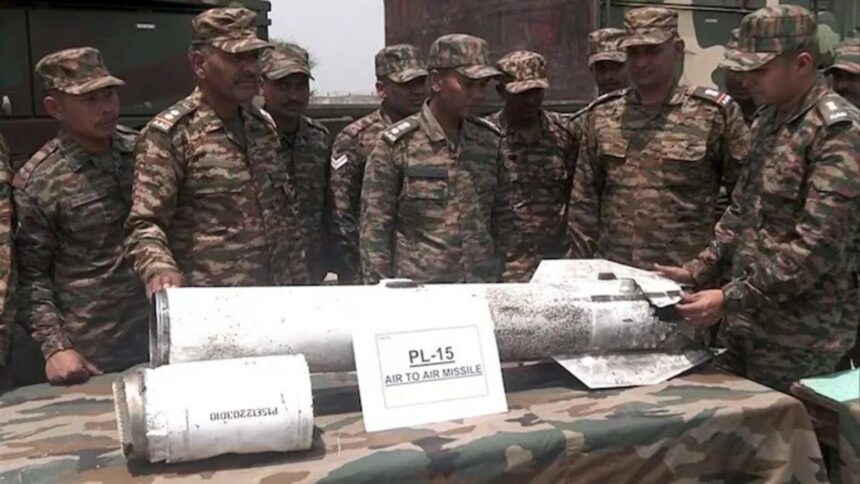
The Defence Research and Development Organisation (DRDO) is undertaking a detailed technical analysis of a recovered Chinese PL-15E missile to incorporate advanced technologies into India’s indigenous Astra Mark-2 air-to-air missile programme. The missile, fired by a Pakistani jet during Operation Sindoor in May, landed unexploded in Punjab due to its lack of a self-destruct mechanism. Its recovery has provided Indian defence scientists a rare opportunity to study and adapt superior features, including next-generation radar systems and anti-jamming capabilities, strengthening India’s strategic air combat capabilities against evolving threats.
Analysis of the Recovered PL-15 Missile and Technological Insights
The PL-15E missile recovered near Hoshiarpur on May 9 represented a rare intelligence windfall for India. The missile, fired by either a JF-17 or J-10C fighter of the Pakistan Air Force, failed to strike its target during Operation Sindoor, falling approximately 100 kilometers within Indian territory. As an export variant of China’s beyond-visual-range missile, it boasts a range of around 145 kilometers and advanced capabilities including a miniature active electronically scanned array (AESA) radar, high-speed propulsion capable of exceeding Mach 5, and sophisticated anti-jamming features. Unlike Indian air-to-air missiles, it lacked a self-destruct mechanism, which allowed the weapon to remain intact after impact and facilitated its recovery.
The technical evaluation conducted by DRDO, though confidential, has identified several features that could significantly enhance India’s Astra missile programme. The AESA radar system offers superior target tracking and guidance capabilities, while the advanced propellant system allows for sustained supersonic speeds, enhancing the missile’s effectiveness against agile fighter jets and reducing interception chances. Anti-jamming technology is another critical enhancement, ensuring operational effectiveness even in highly contested electromagnetic environments. Indian defence experts are particularly focused on integrating the radar system and propulsion technology into the Astra Mark-2, thereby creating a next-generation missile with extended range, improved guidance, and enhanced lethality.
The recovery and analysis of the PL-15 missile underscore India’s strategic focus on indigenization of defence technology. By studying and assimilating advanced foreign weapon systems, Indian scientists are bridging capability gaps and accelerating the development of homegrown solutions that can counter evolving threats along its borders. Operation Sindoor, which was launched in response to the April 22 Pahalgam terror attack, has not only tested India’s operational readiness but also provided critical insights for the future modernization of air combat systems.
Strategic Implications for India and Future Defence Developments
The incorporation of PL-15 technologies into the Astra Mark-2 programme is part of a broader strategic shift in India’s defence posture. Analysts note that Pakistan is actively seeking to enhance its aerial and missile capabilities, acquiring longer-range PL-17 missiles from China and kamikaze drones from Turkey. Reports indicate that Pakistan has also approached the United States with a list of advanced weapons requirements, reflecting an intention to bolster its operational reach and aerial combat capabilities. In response, India is not only advancing indigenous missile development but also supplementing its air combat arsenal with additional Meteor missiles for Rafale fighters, ensuring that operational readiness is maintained even during prolonged engagements.
During Operation Sindoor, India effectively deployed BrahMos, Rampage, and SCALP missiles, demonstrating precision, range, and operational efficiency. The next-generation BrahMos, under development, is expected to achieve an extended range of 800 kilometers, effectively covering nearly the entire breadth of Pakistan. This missile, combined with Astra-II equipped with PL-15-derived technologies, will enable Indian air forces to operate from beyond enemy air defence envelopes, launching supersonic, long-range strikes with enhanced accuracy and survivability. Such capabilities are increasingly vital given the evolving threat landscape, which now includes Pakistan’s deployment of Chinese HQ-9 air defence systems along its borders.
Ceasefire violations by Pakistan during and after Operation Sindoor have further highlighted the need for enhanced preparedness. Kamikaze drones and rockets were fired in Jammu and Rajasthan even after a ceasefire was communicated at 5 pm on May 10, with similar violations occurring in Spin Boldak, Afghanistan, despite a temporary no-fire agreement with the Taliban. While the Indian armed forces exercised restraint during these incidents, officials have indicated that future violations will likely elicit stronger operational responses. The evolving operational environment underscores the importance of developing missiles like Astra-II with advanced radar, guidance, and propulsion systems to maintain strategic advantage and deterrence.
The integration of PL-15 features into Astra-II is expected to significantly improve India’s beyond-visual-range engagement capabilities. The miniature AESA radar will allow the missile to detect, track, and engage multiple targets with high precision, while advanced propellant systems will enable higher speed intercepts, minimizing the adversary’s reaction window. Anti-jamming capabilities will ensure that electronic countermeasures employed by enemy forces are less effective, preserving operational effectiveness. Collectively, these advancements will enhance the Indian Air Force’s ability to maintain air superiority in both contested and contested-peripheral zones.
DRDO’s approach to assimilating foreign technology into indigenous programmes represents a pragmatic and strategic methodology. By carefully analyzing captured or recovered foreign systems, Indian scientists can identify key advancements, adapt them to local operational requirements, and accelerate domestic development cycles. This method of technology absorption reduces reliance on imports, strengthens self-reliance in defence capabilities, and positions India to respond more effectively to emerging threats. The recovery of the PL-15 missile serves as a textbook example of how operational intelligence can directly influence indigenous weapons development and strategic planning.
Looking forward, Astra Mark-2 is poised to emerge as a potent addition to India’s air combat arsenal. When combined with complementary systems such as BrahMos and Meteor missiles, it will allow for multi-dimensional air and ground strike capabilities, providing strategic depth and flexibility to Indian commanders. Furthermore, the technological advancements derived from PL-15 are likely to influence future iterations of Indian air-to-air missiles, creating a generational leap in capability that could redefine India’s approach to aerial engagements.
The case of the PL-15 recovery also demonstrates the interplay between operational events and technological advancement. A single missile that failed to self-destruct provided the Indian defence establishment with invaluable insights into foreign missile design, radar sophistication, propulsion efficiency, and electronic warfare resilience. Such real-world examples allow defence scientists to make informed design choices, enhancing indigenous systems while mitigating potential vulnerabilities. It also highlights the importance of maintaining high operational readiness during combat and counter-terror operations, as intelligence gained from field recoveries can have strategic implications far beyond the immediate mission.
Operation Sindoor, conducted in May in response to the terror attack in Pahalgam, exemplifies how tactical operations can yield long-term strategic advantages. While the immediate objective was to demonstrate India’s ability to respond decisively to cross-border aggression, the recovery of the PL-15 missile provides a lasting technological edge that will inform the design, development, and deployment of India’s air combat systems. Such integration of operational experience with scientific innovation ensures that Indian armed forces remain ahead in terms of both capability and strategic planning.
In addition to technological assimilation, India is actively upgrading its operational doctrines to account for long-range engagement scenarios. The combination of Astra-II with PL-15-derived features, Meteor missiles, and extended-range BrahMos will allow for high-speed, high-precision strikes launched from safe distances, minimizing exposure to enemy air defence and enhancing survivability. This doctrinal evolution is critical in maintaining deterrence and ensuring that India can respond decisively to any aerial threats while minimizing casualties and operational risk.
The strategic implications extend beyond immediate defence requirements. By integrating foreign advancements into indigenous platforms, India not only strengthens its military capabilities but also sends a clear signal regarding its technological and operational self-reliance. This approach underscores India’s commitment to maintaining a credible deterrent, ensuring national security, and achieving strategic autonomy in air combat operations. It also establishes a framework for continuous improvement, where operational experience informs technology development, creating a cycle of innovation that keeps India prepared for evolving threats.
DRDO’s work on Astra-II demonstrates the importance of leveraging both intelligence and scientific expertise to strengthen national security. The recovered PL-15 missile serves as a catalyst for technological assimilation, allowing India to adopt, adapt, and enhance capabilities previously only available in advanced foreign systems. This process ensures that India can field cutting-edge air-to-air missiles capable of countering sophisticated threats while maintaining operational self-reliance. It also highlights the broader strategic principle that technological superiority, combined with operational readiness and strategic foresight, remains central to effective national defence planning.
The evolving regional security environment, including Pakistan’s acquisition of advanced Chinese missiles and drones, underscores the importance of such initiatives. India’s proactive approach ensures that the Indian Air Force is not constrained by adversary capabilities and is equipped to maintain air superiority in both conventional and asymmetric conflict scenarios. By integrating PL-15 technology into Astra-II, Indian defence planners are effectively neutralizing potential technological advantages held by adversaries and strengthening India’s defensive posture.
The DRDO’s initiative also exemplifies the strategic advantage of operational learning and field intelligence. By capitalizing on recovered foreign systems, India reduces development time, improves indigenous capabilities, and ensures that future aerial engagements can be conducted with state-of-the-art weaponry. It also enhances confidence among Indian defence forces and policymakers, demonstrating the tangible benefits of combining frontline operational experience with domestic technological innovation.
Finally, the integration of PL-15 technology into Astra-II represents a milestone in India’s pursuit of advanced indigenous missile development. The programme exemplifies how operational experience, intelligence gathering, and scientific expertise can converge to deliver next-generation weaponry. With these advancements, India is set to field air-to-air missiles capable of outperforming adversary systems, maintaining air superiority, and ensuring strategic deterrence in the region. By continuously incorporating lessons learned from operational recoveries and foreign technology analysis, India strengthens its ability to respond to evolving threats and solidifies its position as a technologically advanced and strategically prepared nation.
This approach marks a shift in India’s missile development strategy, where operational intelligence directly informs technological innovation, and indigenous systems are continuously upgraded to meet contemporary and future security challenges. Astra-II, enhanced with PL-15 features, is expected to provide the Indian Air Force with a decisive edge in aerial combat scenarios and ensure readiness against evolving threats in South Asia.