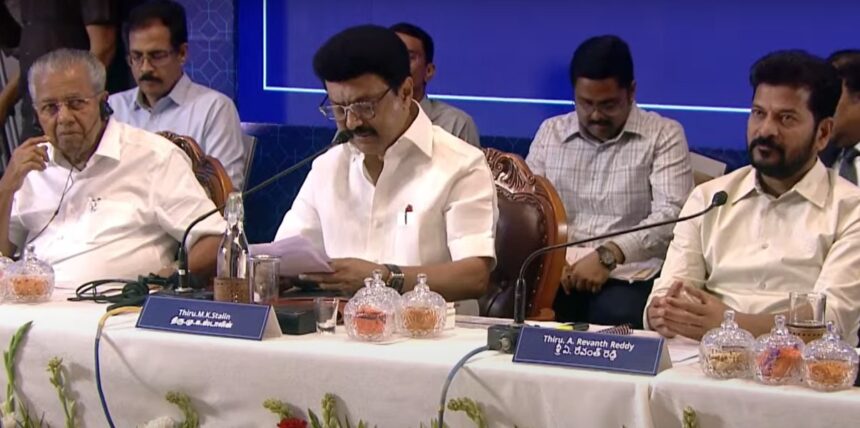
In a significant move to counter the proposed delimitation exercise by the Bharatiya Janata Party (BJP)-led central government, Tamil Nadu’s ruling Dravida Munnetra Kazhagam (DMK) is hosting a crucial opposition meeting in Chennai. The gathering, set for Saturday, aims to unify voices against a plan that many regional parties believe could diminish their parliamentary representation.
The meeting will see participation from senior leaders across various states, including the Communist Party of India (Marxist) from Kerala, the Yuvajana Sramika Rythu Congress Party (YSRCP) from Andhra Pradesh, and the Congress from Telangana and Punjab. Leaders from the Biju Janata Dal (BJD) in Odisha and the Bharat Rashtra Samithi (BRS) are also expected to attend. Notably absent from the lineup is West Bengal Chief Minister Mamata Banerjee’s Trinamool Congress (TMC), a party that has often taken a strong stance against central policies.
Sources indicate that Dravida Munnetra Kazhagam (DMK president and Tamil Nadu Chief Minister MK Stalin will emphasize the potential adverse effects of delimitation. He is expected to argue that states that have successfully controlled population growth may lose parliamentary seats if the exercise is solely based on population figures. This, he asserts, could penalize states that have effectively implemented family planning initiatives while rewarding those with higher population growth rates.
The opposition bloc plans to push for a resolution urging the central government to adhere to the 1971 census for determining parliamentary seat allocations from 2026 onward, maintaining stability for the next three decades. The demand stems from concerns that a population-based redistribution of seats could unfairly shift political power away from southern and eastern states that have met demographic control targets.
A joint press briefing is expected to follow the meeting, where leaders will outline their collective stance and the next steps in their opposition strategy.
In a video statement released on Friday, MK Stalin underscored the urgency of the issue, stating, “If delimitation proceeds based on population, Tamil Nadu’s representation in Parliament will be severely affected. This is not just about numbers; it is about our state’s rights. We have convened this meeting to rally all parties against this unfair move.”
The core argument against the proposed delimitation is twofold. First, critics argue that it could create a regional power imbalance, disproportionately favoring states with higher birth rates. Second, they contend that states that have adhered to national family planning objectives should not be disadvantaged in their political representation.
BRS working president KT Rama Rao echoed this sentiment, warning of lasting consequences if corrective measures are not taken. “If we remain silent now, history will not forgive us. This is not just a political battle but a fight for fairness, justice, and democracy,” he asserted.
While the immediate focus remains on securing assurances from the central government, the broader political ramifications of this opposition campaign could influence upcoming electoral strategies. Whether this will translate into a consolidated electoral front against the BJP remains to be seen, but the message from Chennai is clear: the battle for fair representation has begun.