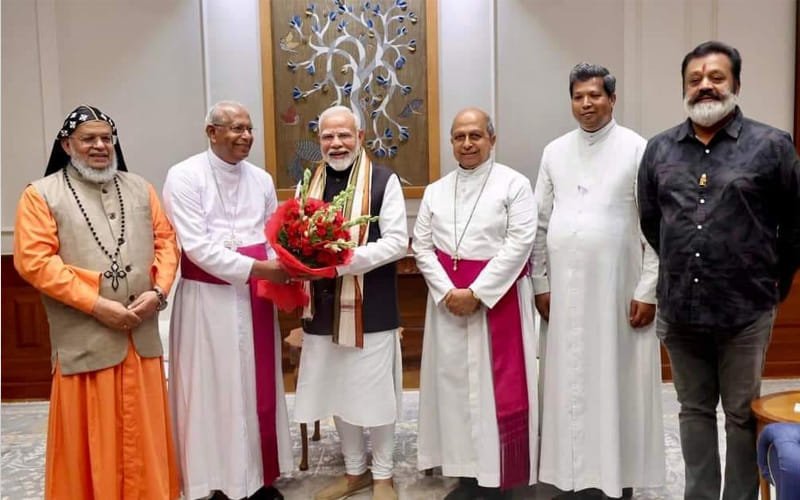
Prime Minister Narendra Modi held an extensive meeting with a delegation of bishops from the Syro-Malabar Church in New Delhi on Tuesday, reaffirming his government’s commitment to promoting community welfare, interfaith dialogue, and inclusive national development. The discussion, marked by warmth and mutual respect, highlighted the government’s outreach to Christian leaders and its focus on ensuring that the interests and welfare of minority communities are protected within the broader framework of India’s developmental agenda.
Focus on Church Concerns and Community Development
The meeting, which took place at the Prime Minister’s residence, was attended by senior representatives of the Syro-Malabar Church, one of India’s oldest and largest Eastern Catholic communities. The delegation was led by Major Archbishop Mar Raphael Thattil, the head of the Syro-Malabar Church, and included Archbishop Mar Kuriakose Bharanikulangara of the Faridabad Archdiocese, along with several other bishops who represent different dioceses across the country.
The discussions centered around various issues concerning the Church, the Christian community, and their role in India’s social and cultural fabric. The bishops raised points related to community welfare, education, healthcare, and social service initiatives that the Church has been undertaking for decades. They also spoke about the Church’s deep-rooted presence in Kerala and other parts of India, emphasizing its contributions to education, charity, and the promotion of communal harmony.
Prime Minister Modi, acknowledging the Church’s long-standing service to the nation, lauded its efforts in social work and community upliftment. He expressed appreciation for the Church’s contribution to education and healthcare, which has benefited millions, particularly in rural and marginalized areas. The Prime Minister reaffirmed that the government values every community’s role in nation-building and reiterated his vision of Sabka Saath, Sabka Vikas, Sabka Vishwas, Sabka Prayas — a philosophy that underlines inclusive governance and equal participation.
During the meeting, PM Modi stressed the importance of unity and dialogue among India’s diverse faiths and traditions. He assured the bishops that the government is committed to addressing genuine community concerns and ensuring an environment where all citizens can practice their faith freely while contributing to India’s progress.
The Prime Minister also highlighted the importance of collaborative social development projects between faith-based organizations and government institutions. Such partnerships, he noted, could be instrumental in addressing issues like poverty alleviation, education for underprivileged children, women empowerment, and healthcare in remote regions.
Kerala BJP leaders, including State President and former Union Minister Rajeev Chandrasekhar and Shone George, were also present during the meeting, signaling the growing engagement between the party leadership and the Christian community in Kerala. Their presence underscored the BJP’s continued efforts to build stronger ties with various religious and cultural groups in the state, where the Church plays a major socio-political role.
Syro-Malabar Church’s Role in India’s Socio-Religious Landscape
The Syro-Malabar Church, with over 5 million members, is one of the largest Eastern Catholic Churches in the world and a significant part of India’s Christian heritage. Tracing its roots back to the evangelization of Saint Thomas the Apostle in the first century, the Church has deep historical and cultural significance in Kerala and beyond. It operates hundreds of educational institutions, hospitals, and social welfare centers that have served communities irrespective of religion or background.
The Church’s leadership has often engaged in constructive dialogue with successive governments on matters of education policy, minority rights, and social development. Tuesday’s meeting with Prime Minister Modi reaffirmed this ongoing engagement and marked an important chapter in government-community relations.
PM Modi, in a post on social media platform X, described the interaction as “wonderful,” noting that he had meaningful discussions with Major Archbishop Mar Raphael Thattil, Archbishop Kuriakose Bharanikulangara, and other senior clergy members. The post reflected the cordial tone of the meeting and the mutual intent to continue working together for the common good.
The bishops reportedly conveyed their appreciation for the government’s recognition of Christian institutions’ contributions to nation-building and social welfare. They discussed potential areas of cooperation, particularly in sectors like education and healthcare, where the Church’s vast network and experience could complement governmental initiatives aimed at improving public service delivery.
The Prime Minister, in turn, encouraged the Church’s leadership to continue their efforts in fostering harmony, compassion, and social responsibility, values that are deeply embedded in India’s pluralistic ethos. He noted that faith-based organizations like the Syro-Malabar Church have a unique ability to bring communities together and play a crucial role in building bridges of trust and understanding.
The discussion also touched upon youth empowerment and skill development — two areas that have been central to PM Modi’s development agenda. The Church’s institutions, which have long been centers of learning and moral education, were identified as potential partners in expanding vocational and skill-based training programs to help young people secure meaningful employment opportunities.
Over the years, the Syro-Malabar Church has also been active in disaster relief, rural upliftment, and women’s welfare programs. The Prime Minister reportedly appreciated these initiatives and expressed the government’s readiness to support and collaborate in areas that align with national development goals.
The meeting also assumed significance against the backdrop of the government’s continued emphasis on Sabka Vishwas — winning the trust of every section of society. By engaging directly with leaders of one of India’s largest Christian denominations, PM Modi reaffirmed his administration’s approach of open dialogue and inclusivity in addressing minority concerns.
The bishops, on their part, highlighted the community’s desire to contribute positively to the nation’s progress. They conveyed that the Christian community remains committed to values of peace, service, and patriotism, and that it seeks to strengthen its role in India’s development story.
The dialogue is seen as part of the broader efforts to ensure that religious institutions remain active partners in shaping India’s social development framework. The Church’s emphasis on moral education, ethics, and compassion complements the government’s focus on holistic human development, thereby creating avenues for collaboration that transcend religious boundaries.
The Syro-Malabar Church has also been at the forefront of advocating interfaith dialogue in India, encouraging understanding and coexistence among different religious groups. PM Modi’s government, which has consistently emphasized “Ek Bharat, Shreshtha Bharat,” recognizes that such initiatives contribute significantly to maintaining national unity in diversity.
The meeting concluded on a note of mutual appreciation and optimism for continued engagement. While no formal agreements were announced, both sides reaffirmed their commitment to maintaining regular dialogue and exploring new areas of partnership that serve the larger interests of society.
Through this meeting, Prime Minister Modi once again demonstrated his proactive approach to reaching out to faith-based communities and fostering an inclusive national discourse. The Syro-Malabar bishops’ visit to the capital symbolized both respect for democratic engagement and the shared resolve to promote harmony, progress, and welfare for all sections of society.