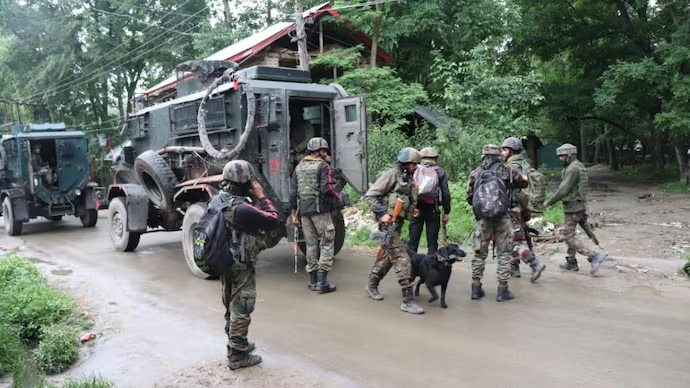
An intense gunfight erupted in Jammu and Kashmir’s Kishtwar district on Wednesday morning as security forces launched a major operation against terrorists in the remote Chhatru area. Acting on credible intelligence inputs, the Indian Army and Jammu and Kashmir Police initiated a coordinated search mission that quickly escalated into an encounter after contact was established with armed militants. The gunbattle, which began in the early hours, remains ongoing as security personnel continue to engage the terrorists entrenched in the region’s hilly terrain. The operation marks another significant step in the security forces’ ongoing efforts to eliminate terrorism from the Union Territory.
Army and police launch coordinated operation after intelligence inputs
The Indian Army’s White Knight Corps confirmed that the encounter was triggered following an intelligence-based operation jointly conducted with the Jammu and Kashmir Police. According to the official statement released by the Army on X, formerly Twitter, the troops of the White Knight Corps initiated contact with terrorists in the Chhatru area of Kishtwar after receiving specific information about their presence. “In an intelligence-based operation, in concert with the Jammu and Kashmir Police, alert troops of White Knight Corps have established contact with terrorists in the general area of Chhatru. Fire exchanged with terrorists. Operation is in progress,” the statement read.
The operation is being carried out in a dense forest zone, which makes visibility and movement extremely challenging for the forces. The Army, backed by local police units and special operations groups, has cordoned off the entire area to prevent the terrorists from escaping. Reinforcements have also been rushed to the site, while additional surveillance equipment and drone reconnaissance are being employed to track militant movement.
As of the latest reports, the exchange of fire continues, but there is no official confirmation yet of any casualties on either side. Given the difficult terrain and heavy foliage, operations in Kishtwar’s hilly regions often extend for several hours or even days before being concluded.
The security forces are also ensuring that no harm comes to civilians living in nearby villages. Local residents have been asked to stay indoors as precautionary measures are implemented to secure the area. The authorities have also tightened security in adjoining districts, including Doda and Ramban, to prevent militants from attempting to flee through interlinked forest routes.
The Chhatru region of Kishtwar has been a known hotspot for militant activity over the past few years. Owing to its rugged landscape and proximity to infiltration routes from across the Line of Control (LoC), it has occasionally provided shelter to small groups of terrorists seeking to establish local bases or transit further into the Valley. However, sustained counterterrorism efforts by the Army, police, and intelligence agencies have significantly reduced militant presence in the district.
Senior officials stated that Wednesday’s operation was launched based on actionable inputs from intelligence networks indicating that a small group of terrorists was moving through the area, possibly planning to target security installations or civilian zones. The forces acted swiftly, surrounding the location before the militants could disperse.
Meanwhile, the encounter comes amid heightened security measures across Jammu and Kashmir following multiple incidents of infiltration attempts and targeted attacks in recent months. Security forces have intensified anti-terror operations across Rajouri, Poonch, and Kishtwar districts, which fall close to the Pir Panjal mountain range, to dismantle remaining militant cells operating in the region.
Heightened vigilance after Amit Shah’s stern warning to Pakistan-backed terror groups
The ongoing operation in Kishtwar follows strong remarks from Union Home Minister Amit Shah, who on Tuesday issued a stern warning to Pakistan-backed terrorists. Addressing a public gathering, Shah asserted that any attempt to target India again would be met with a powerful and decisive response. “If they repeat the mistake, goli ka jawab goley se diya jayega,” he declared, underscoring the government’s zero-tolerance approach toward cross-border terrorism.
The Home Minister’s remarks reflected the Centre’s commitment to maintaining peace and stability in Jammu and Kashmir while ensuring that terror networks operating from across the border face a firm response. He also mentioned that explosives manufactured in Bihar’s upcoming defence corridor would be used to neutralize these threats, symbolizing India’s growing self-reliance in defense preparedness.
The encounter in Kishtwar, therefore, comes at a politically and strategically crucial time, reinforcing New Delhi’s message that India’s security forces are fully capable of tackling terrorism both within and beyond its borders. The operation also highlights the effectiveness of intelligence-led missions that aim to eliminate terrorist hideouts before they can regroup or plan attacks.
In a related development, a tragic incident occurred on Tuesday when a soldier was killed in Jammu and Kashmir’s Poonch district after his service rifle reportedly went off accidentally. Officials identified the soldier as Naik Amarjeet Singh, who was on sentry duty in his camp at Jhulass village. The accidental discharge of his weapon caused critical injuries, and despite being rushed to the Army’s field hospital, he succumbed to his wounds. Authorities have initiated an investigation into the incident.
The Indian Army continues to maintain a robust security presence along the 740-kilometre-long Line of Control (LoC) that runs through multiple districts, including Baramulla, Kupwara, and Bandipora in north Kashmir, and Poonch, Rajouri, and parts of Jammu division in the south. This extensive deployment is essential to counter infiltration attempts and to monitor the movement of militants and smuggling of arms and ammunition from across the border.
The region has witnessed a surge in counter-insurgency operations over the past year, with several encounters resulting in the elimination of top commanders of Pakistan-based terror outfits. The forces’ focus remains on dismantling sleeper cells and preventing the regrouping of militants who had previously been pushed out from Kashmir’s urban areas.
Security officials also note that terrorist groups operating under Pakistan’s patronage have been attempting to reestablish their networks in the Pir Panjal region, using it as an alternative route for infiltration. This strategy has prompted intensified military operations in Kishtwar, Doda, and Ramban — areas once considered relatively calm but now under closer surveillance due to their strategic relevance.
The encounter in Chhatru thus represents both a tactical operation and part of a larger counterterrorism framework designed to maintain stability in Jammu and Kashmir. Intelligence agencies believe that militant groups active in the region are increasingly fragmented, with limited resources and dwindling support from local populations. The continuous operations by the Indian Army and Jammu and Kashmir Police have further disrupted their communication lines and logistical networks.
Furthermore, the encounter underscores the growing synergy between the armed forces and local law enforcement agencies. Over the past few years, coordination between the Army, Jammu and Kashmir Police, and central security agencies has greatly improved, leading to faster response times and more efficient intelligence-sharing mechanisms. This has played a pivotal role in reducing militant activity in areas once dominated by insurgents.
The current operation in Kishtwar reflects the government’s ongoing focus on a multi-layered counterterrorism approach that combines intelligence operations, precision military action, and community outreach. Officials emphasize that the ultimate objective is not just to neutralize terrorists but also to restore long-term peace, development, and normalcy in the Union Territory.
As the encounter continues, the security establishment remains on high alert across the region. The Army’s specialized units, including the Rashtriya Rifles and local police task forces, remain engaged in active pursuit of the militants. The authorities are also maintaining communication with local residents to ensure their safety while monitoring for any signs of external assistance reaching the terrorists.
While the outcome of the current operation is still awaited, it underscores the persistent security challenges that India faces in Jammu and Kashmir. Despite significant progress in reducing militant numbers and improving the overall security situation, sporadic encounters continue to occur, reflecting the complex nature of the threat. Yet, with enhanced coordination, superior technology, and unwavering political will, security forces remain resolute in their mission to secure the region from terrorism and ensure lasting peace for its people.