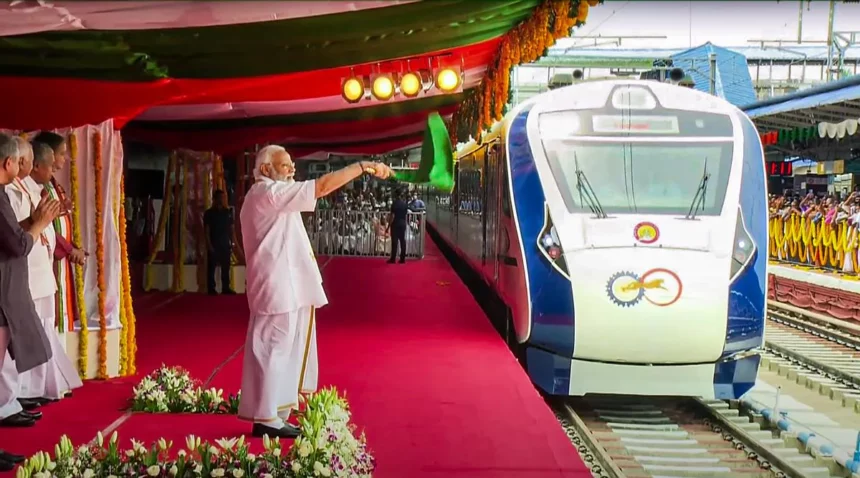
Prime Minister Narendra Modi on Saturday inaugurated India’s first Vande Bharat Sleeper train at Malda in West Bengal, describing it as a clear example of what infrastructure and public services in a “Viksit Bharat” should look like. The launch marked a major milestone in India’s railway modernisation drive, as the new-generation sleeper train was flagged off on the Howrah–Guwahati route alongside the inauguration and foundation-laying of multiple development projects worth more than ₹3,200 crore. The Prime Minister said these initiatives would accelerate growth in West Bengal, improve connectivity with the northeast, and strengthen India’s journey towards becoming a developed nation.
The event in Malda formed a key part of the Prime Minister’s two-day visit to West Bengal and Assam and was attended by senior officials, party leaders, and local representatives. During the ceremony, Mr Modi interacted with railway staff, met the train driver, and spoke with children travelling on board, underscoring the human dimension of large-scale infrastructure projects. The launch of the Vande Bharat Sleeper train not only introduced a new travel experience for passengers but also sent a broader message about India’s ambitions in technology, manufacturing, and public transport.
Vande Bharat sleeper train launch highlights railway modernisation and faster east–northeast connectivity
The inauguration of the Vande Bharat Sleeper train between Howrah and Guwahati is being seen as a landmark moment for Indian Railways. Designed to offer a modern, comfortable, and efficient long-distance travel experience, the fully air-conditioned sleeper train represents the next evolution of the Vande Bharat platform. According to officials, the train will reduce travel time on the Howrah–Guwahati route by approximately two and a half hours, bringing the total journey duration down from around 18 hours.
Addressing the gathering in Malda, Prime Minister Modi said the Vande Bharat train clearly demonstrates what trains in a developed India should be like. He highlighted how Indian Railways has entered a major phase of transformation, moving away from outdated systems towards cutting-edge technology and passenger-centric design. He recalled a time when Indians would look at videos and photographs of foreign trains and wonder whether such facilities would ever be available in the country. Today, he said, the situation has reversed, with people from other countries making videos of Indian trains and talking about the revolution underway in Indian Railways.
The Prime Minister emphasised that the Vande Bharat Sleeper train is a Made in India product, reflecting the country’s growing manufacturing capabilities and technological self-reliance. He said the train symbolically connects the land of Maa Kali in West Bengal to Maa Kamakhya in Assam, underlining not only physical connectivity but also cultural and spiritual ties between regions. The Howrah–Guwahati route is one of the most important rail corridors linking eastern India with the northeast, and faster, more comfortable trains are expected to significantly benefit passengers, traders, students, and tourists.
During his interaction with railway staff, Mr Modi took time to meet the train driver and learn about the train’s features and operations. He also spoke with children travelling on the inaugural journey, asking them about their experience and encouraging them to dream big in a rapidly developing India. These interactions were highlighted as examples of how large infrastructure initiatives ultimately serve ordinary citizens and future generations.
Alongside the train launch, the Prime Minister inaugurated and laid the foundation stone for several rail and road projects in West Bengal, collectively valued at over ₹3,200 crore. He said these projects would make travel easier for people, reduce logistical bottlenecks, and facilitate business and trade across the region. Improved rail connectivity and modern infrastructure, he noted, are essential for economic growth, job creation, and regional development.
Mr Modi also spoke about the broader modernisation of Indian Railways, pointing to upgraded stations, new trains, improved safety systems, and better passenger amenities. He said the transformation of the railways is not limited to major cities but is reaching smaller towns and districts as well, ensuring more balanced and inclusive development. According to him, initiatives like the Vande Bharat Sleeper train reflect the government’s commitment to building world-class infrastructure that serves both present and future needs.
Political messaging, development narrative, and West Bengal focus dominate Malda event
The Malda event also carried a strong political undertone, with Prime Minister Modi using the platform to criticise the ruling Trinamool Congress in West Bengal and position the Bharatiya Janata Party as a development-oriented alternative. Ahead of the event, the Prime Minister had posted on social media that he was looking forward to being among the people of Malda and neighbouring areas during a BJP rally. In the post, he alleged that instances of misrule by the Trinamool Congress were coming to light every day and claimed that the people of West Bengal were fed up with the current government.
During his address, Mr Modi said that the campaign to accelerate West Bengal’s progress had gained further momentum from Malda. He pointed to the inauguration and foundation-laying of development projects as evidence of the central government’s commitment to the state’s growth. According to him, new rail services and infrastructure initiatives launched from Malda would make travel more convenient and also support economic activity by improving connectivity for businesses and traders.
The Prime Minister contrasted what he described as the central government’s development-focused approach with what he called mismanagement and governance failures under the state government. He said people in West Bengal want a government that prioritises development, jobs, and modern infrastructure, and asserted that the BJP is prepared to meet those aspirations. While reiterating his criticism of the Trinamool Congress, he framed the launch of the Vande Bharat Sleeper train and other projects as examples of what a development-oriented vision can deliver.
Mr Modi also placed the West Bengal initiatives within the larger national narrative of Viksit Bharat. He said that infrastructure projects such as modern trains, highways, and logistics hubs are the backbone of a developed country and are essential for improving quality of life. By investing heavily in railways and transport, he said, the government is ensuring that growth reaches every region, including historically underserved areas.
The Prime Minister highlighted how eastern India and the northeast are becoming central to India’s growth story. Improved connectivity between Howrah and Guwahati, he said, will strengthen economic integration, promote tourism, and make it easier for people to travel for education, work, and business. He added that development in these regions is crucial for achieving balanced national progress and reducing regional disparities.
Throughout his speech, Mr Modi returned repeatedly to the theme of transformation, both in terms of physical infrastructure and governance mindset. He said the pace and scale of projects being launched today reflect a new confidence in India’s capabilities. According to him, initiatives like the Vande Bharat Sleeper train show that India is no longer content with incremental improvements but is aiming for global standards in public infrastructure.
The Malda programme concluded with the Prime Minister reiterating his belief that West Bengal stands at a turning point. He said the state has immense potential, rich culture, and hardworking people, and that with the right policies and leadership, it can play a major role in India’s development journey. The projects launched during the event, he said, are steps towards unlocking that potential and ensuring that the benefits of growth reach every section of society.