Prime Minister Narendra Modi will undertake a two-day visit to West Bengal and Assam beginning January 17, 2026, with a packed schedule centred on infrastructure development, railway modernisation, and cultural engagement. The visit reflects the government’s continued emphasis on strengthening connectivity in eastern and northeastern India while simultaneously celebrating regional heritage. Over the course of the visit, the Prime Minister will inaugurate, lay foundation stones, and flag off several major rail, road, and logistics projects running into thousands of crores of rupees, alongside participating in a large-scale cultural programme highlighting the traditions of the Bodo community.
The tour is expected to underline the strategic importance of West Bengal and Assam as key gateways linking the northeast with the rest of the country. By combining large infrastructure announcements with cultural outreach, the visit aims to reinforce development goals while acknowledging the social and cultural fabric of the regions. Rail connectivity, in particular, will be a major focus, with the launch of new-generation trains and projects designed to improve passenger comfort, freight efficiency, and regional economic integration.
West Bengal engagements highlight rail modernisation, connectivity, and regional development
The Prime Minister’s visit will begin in West Bengal, where he will flag off India’s first Vande Bharat Sleeper Train connecting Howrah and Guwahati via Kamakhya. The train will be flagged off from Malda town railway station and virtually from Guwahati, marking a significant milestone in India’s railway journey. Designed to meet the evolving transportation needs of a modern economy, the fully air-conditioned Vande Bharat Sleeper train promises an airline-like travel experience at economical fares, making long-distance overnight journeys faster, safer, and more comfortable for passengers.
The introduction of the sleeper variant of the Vande Bharat train is expected to transform long-haul rail travel, particularly on busy inter-regional routes such as Howrah–Guwahati. By offering modern amenities, enhanced safety features, and reduced travel time, the train is positioned as a game-changer for passengers travelling between eastern and northeastern India. The route also holds strategic importance, as it strengthens connectivity with Assam and other northeastern states.
During a public function in Malda, the Prime Minister will lay the foundation stone of multiple rail and road infrastructure projects in West Bengal, collectively valued at over ₹3,250 crore. These projects are aimed at improving both passenger convenience and freight movement, while also generating employment and supporting regional economic activity. Infrastructure upgrades in this region are expected to have a multiplier effect, benefiting agriculture, trade, and small industries.
Among the key railway projects to be launched in West Bengal are four major initiatives. These include a new rail line between Balurghat and Hili, which is expected to enhance connectivity in southern parts of North Bengal. The Prime Minister will also lay the foundation stone for next-generation freight maintenance facilities at New Jalpaiguri, a critical logistics hub for the region. In addition, the upgradation of the Siliguri Loco Shed and the modernisation of Vande Bharat train maintenance facilities in Jalpaiguri district will be undertaken.
These railway projects are designed to strengthen both passenger and freight operations, improve logistics efficiency, and reduce turnaround time for trains operating in North Bengal. The focus on modern maintenance infrastructure reflects an effort to ensure long-term sustainability of new-generation trains while creating skilled employment opportunities in the region.
The Prime Minister will also virtually flag off four new Amrit Bharat Express trains from Malda. These trains are part of a broader initiative to provide affordable, reliable, and comfortable rail travel options across different parts of the country. By expanding the Amrit Bharat Express network, the government aims to improve connectivity for middle- and lower-income passengers while easing pressure on existing services.
Later during the visit, Mr Modi will travel to Singur in Hooghly district, where he will inaugurate, lay the foundation stone, and launch various development projects worth over ₹830 crore. These projects span multiple sectors and are intended to boost local infrastructure and economic activity. A key highlight in Singur will be the laying of the foundation stone for the Extended Port Gate System at Balagarh. This project includes the development of an Inland Water Transport terminal and a Road Over Bridge, aimed at enhancing multimodal logistics and improving connectivity between road, rail, and waterways in the region.
Assam visit combines infrastructure push with cultural celebration and regional connectivity
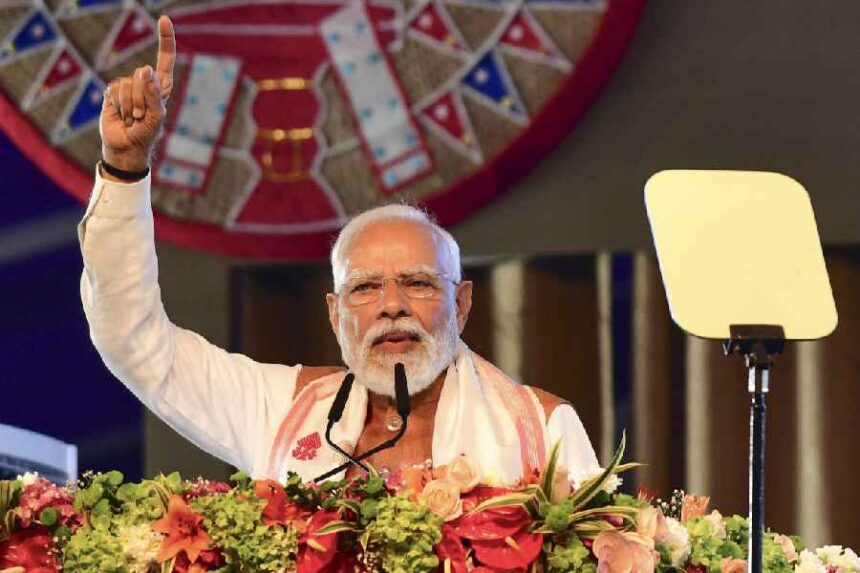
After completing engagements in West Bengal, the Prime Minister will proceed to Assam, where the focus will shift to both infrastructure development and cultural celebration. One of the most significant events of the visit will be his participation in Bagurumba Dwhou 2026 in Guwahati. This historic cultural programme celebrates the rich heritage of the Bodo community and is expected to feature more than 10,000 artists performing the traditional Bagurumba dance in a single, synchronised presentation.
The event is being positioned as a landmark cultural gathering, showcasing the vibrancy and unity of the Bodo community. By participating in Bagurumba Dwhou 2026, the Prime Minister’s visit underscores the importance of preserving and promoting indigenous cultures and traditions alongside development initiatives. The large-scale performance is expected to draw national attention to Bodo heritage and reinforce cultural pride within the community.
On the second day of the visit, infrastructure development will take centre stage in Assam. The Prime Minister will perform the Bhoomi Pujan for the Kaziranga Elevated Corridor Project in Kaliabor. Valued at over ₹6,950 crore, the project is designed to improve connectivity while addressing environmental and traffic concerns around the Kaziranga National Park region. The elevated corridor is expected to facilitate smoother movement of vehicles, reduce congestion, and enhance safety for both commuters and wildlife in this ecologically sensitive area.
The Kaziranga Elevated Corridor Project is seen as a critical intervention balancing development with conservation. By creating an elevated route, the project aims to minimise human-wildlife conflict and ensure uninterrupted movement along a key transport corridor in Assam. It is also expected to boost tourism and trade by improving access to the region.
In addition to the corridor project, the Prime Minister will flag off two new Amrit Bharat Express trains in Assam. These trains will operate between Guwahati and Rohtak, and between Dibrugarh and Lucknow, further expanding long-distance connectivity from the northeast to northern India. The new services are expected to provide faster and more reliable travel options for passengers, while strengthening economic and social ties between regions.
Together, the rail and road initiatives announced during the Assam visit are aimed at integrating the state more closely with the national transport network. Improved connectivity is expected to support trade, tourism, education, and employment, while also reinforcing Assam’s role as a key hub in the northeastern region.
Across both states, the Prime Minister’s two-day visit reflects a coordinated approach that links infrastructure development with cultural engagement. By combining major project launches with participation in a large cultural celebration, the visit seeks to convey a message of inclusive growth that respects regional identity while pursuing national development goals.