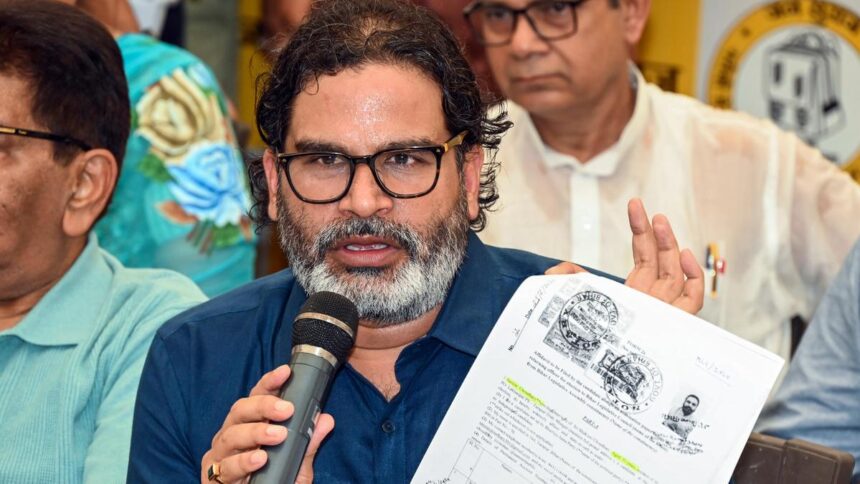
As Bihar gears up for a high-stakes assembly election, political strategist-turned-politician Prashant Kishor has stirred up the debate with a bold forecast about his party’s electoral debut. Kishor, the founder of Jan Suraaj, claimed that his party could either secure fewer than ten seats or cross the 150-mark in the upcoming Bihar polls. His statement, which combines both cautious realism and ambitious confidence, underscores his belief that Bihar’s electorate is now seeking a viable alternative to the state’s entrenched political alliances — the National Democratic Alliance (NDA) and the Mahagathbandhan.
From Political Strategist to Challenger: Kishor’s Evolution and Mission
Prashant Kishor, one of India’s most well-known political strategists, is no stranger to the complexities of electoral politics. Having played an instrumental role in shaping Prime Minister Narendra Modi’s landmark 2014 Lok Sabha campaign for the Bharatiya Janata Party (BJP), and later working with major political forces such as the Trinamool Congress (TMC), Dravida Munnetra Kazhagam (DMK), and the Congress, Kishor is now betting on himself and his vision for Bihar.
In 2022, Kishor launched the Jan Suraaj movement — an ambitious people-centric initiative aimed at redefining governance through grassroots participation. What began as a statewide outreach program soon transformed into a political platform that aspires to disrupt Bihar’s traditional power equations. Over the past two years, Kishor has toured villages, held extensive padyatras, and convened local-level consultations, engaging directly with citizens to understand their aspirations and grievances.
The upcoming Bihar elections, Kishor asserted that Jan Suraaj has emerged from the people’s demand for change rather than from political opportunism. “We are making contenders contest polls,” he said. “The only difference is that we have created a new formation to execute this. If we look at the PM Modi campaign in 2014 (which I took care of), it was a new format as the CM of a state became a national leader. There is no big difference.”
The strategist drew parallels between Modi’s rise in 2014 and the structure of Jan Suraaj, describing both as transformative political movements designed to challenge established narratives. His remarks hinted at his broader ambition — to position Jan Suraaj as not merely a political outfit but as an ideological alternative capable of reshaping Bihar’s political discourse.
According to Kishor, Jan Suraaj’s entry into the electoral field will trigger a triangular contest across at least 160 to 170 constituencies, challenging both the NDA and the Mahagathbandhan. He further claimed that a significant portion of Bihar’s electorate — nearly one-third, by his estimation — is disillusioned with the two dominant alliances and eager for a new political force.
Bihar’s Political Landscape and Kishor’s Calculated Gamble
Bihar’s political arena has long been defined by two poles: the NDA, led by Chief Minister Nitish Kumar, and the Mahagathbandhan, headed by the Rashtriya Janata Dal (RJD). The upcoming polls, however, might introduce a fresh dynamic if Kishor’s Jan Suraaj succeeds in converting its grassroots goodwill into electoral numbers.
As per the Election Commission’s announcement, Bihar will go to the polls in two phases — on November 6 and 11 — with results to be declared on November 14. The 243-member legislative assembly will once again witness a clash of ideologies, caste equations, and competing governance narratives. The NDA’s alliance includes the BJP, JD(U), Lok Janshakti Party (Ram Vilas), Hindustani Awam Morcha (Secular), and Rashtriya Lok Morcha. Meanwhile, the RJD-led Mahagathbandhan comprises the Congress, Left parties, and Mukesh Sahani’s Vikasheel Insaan Party (VIP).
For Kishor, this election is not just about securing seats but about testing whether Bihar’s political consciousness has matured beyond its entrenched binaries. During the NDTV event, he remarked, “When the results are counted on November 14, will the success be measured by Jan Suraaj winning seats or whether I contested or not? The perception is that there is no alternative to the Mahagathbandhan or the NDA in Bihar. Perception is one thing, fact is another. Numbers show one-third of people in Bihar neither want to vote for the alliance nor the NDA.”
This statement encapsulates the core of Kishor’s political experiment — to harness the latent dissatisfaction among voters who have oscillated between the same set of political actors for decades. By focusing on Jan Suraaj as a movement rather than merely a party, Kishor is attempting to project authenticity and grassroots connection in a state where caste identities, patronage politics, and personality cults traditionally dominate electioneering.
Kishor’s dual estimate — of either winning fewer than ten seats or crossing 150 — was not made lightly. It reflected his recognition of Bihar’s volatile political climate and his own awareness of the risks involved in launching a new party in a deeply entrenched ecosystem. While his critics dismissed the statement as political theatrics, Kishor insisted that the outcome, whatever it may be, would signify the beginning of a long-term transformation in Bihar’s political mindset.
The Jan Suraaj campaign’s structure itself bears the hallmarks of Kishor’s strategic acumen. Its emphasis on local participation, door-to-door engagement, and the use of modern communication tools is reminiscent of the methods he employed in national campaigns. However, unlike his previous roles where he crafted strategies for others, this time Kishor is on the front line — both as the architect and the face of the movement.
The strategist’s shift from consultant to contestant has been one of India’s most closely watched political transitions in recent years. His earlier attempts to re-enter active politics through partnerships with existing parties, including the Congress, did not materialize. Jan Suraaj, therefore, represents his independent leap into the electoral battlefield, driven by the conviction that Bihar deserves a new political culture rooted in accountability and participatory governance.
If Jan Suraaj manages to carve even a small foothold in this election, it could mark the beginning of a gradual realignment in Bihar’s politics. The state has historically been a cradle of political experimentation — from Jayaprakash Narayan’s 1974 movement that reshaped Indian democracy to Lalu Prasad Yadav’s era of social justice politics and Nitish Kumar’s development-driven governance narrative. Kishor’s entry adds another chapter to this evolving story, offering voters an option that merges data-driven politics with moral conviction.
The electoral field in Bihar remains crowded and competitive. The NDA banks on Nitish Kumar’s governance record and the BJP’s organizational machinery, while the Mahagathbandhan leans heavily on RJD’s grassroots appeal and caste arithmetic. Against this backdrop, Jan Suraaj’s challenge is monumental — to translate public goodwill and political curiosity into tangible votes.
Yet, if there is one strategist who understands the science behind political momentum, it is Prashant Kishor. His ability to read voter psychology, design outreach strategies, and craft narratives has repeatedly altered the course of Indian elections. Whether he can now replicate that success for himself will be one of the most intriguing storylines of Bihar 2025.