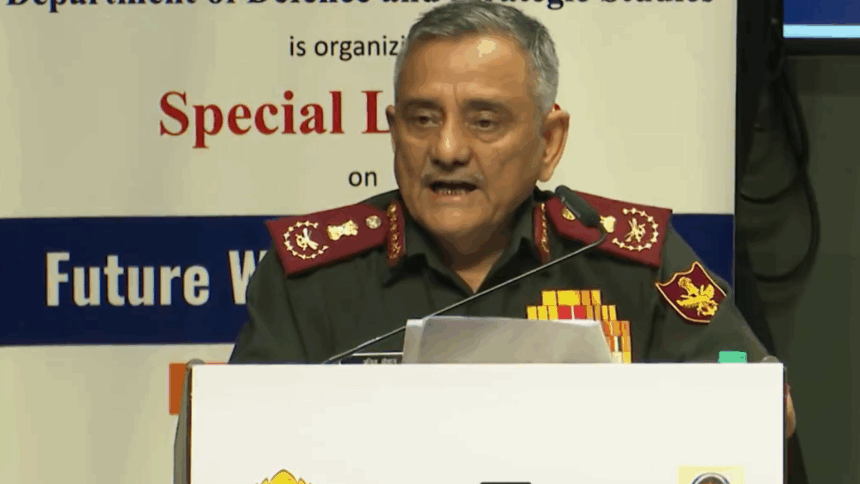
Chief of Defence Staff (CDS) General Anil Chauhan, speaking at the Ran Samvad conclave, emphasized that India’s response to evolving security threats must be coordinated, swift, and decisive. Addressing officers at the Army War College in Mhow, Gen Chauhan highlighted that the changing character of modern warfare, spanning land, sea, air, cyber, and space domains, demands unified action across all services. The conclave, a first-of-its-kind initiative bringing together the Army, Navy, and Air Force, provides a platform to strengthen collective military preparedness, discuss emerging threats, and showcase India’s commitment to maintaining peace backed by strength. Gen Chauhan underscored that India’s peace-oriented approach cannot be mistaken for pacifism and emphasized that preparedness, strategy, and integrated planning are essential for national security in a rapidly evolving global strategic environment.
Modern Warfare and the Need for Integrated, Coordinated Response
General Chauhan detailed that modern warfare is increasingly complex, requiring not only advanced technologies but also seamless coordination among all three services. The future battlefield does not recognize service boundaries; operations will increasingly demand joint thinking, joint planning, and joint execution. Gen Chauhan stressed that in an era marked by information warfare, grey zone conflicts, and rapid technological advancements, India’s military must maintain readiness through strategic foresight, rapid decision-making, and inter-service synergy. The Ran Samvad conclave, organized by Headquarters Integrated Defence Staff in collaboration with the Centre for Joint Warfare Studies and supported by the Army Training Command, aims to provide officers a platform to exchange operational insights, enhance understanding of integrated combat operations, and refine doctrines relevant to modern and future warfighting scenarios.
The CDS highlighted the importance of a joint approach to planning and execution, noting that no single service can address the full spectrum of challenges posed by future conflicts. With cyber and space domains emerging as critical theatres of war, Gen Chauhan emphasized that India’s preparedness must be holistic, ensuring that all arms of the military are aligned in strategy, technology adoption, and operational readiness. He noted that the conclave would unveil several joint doctrines and a technology and capability roadmap, aimed at integrating services’ capabilities for more effective response mechanisms. Serving officers, defence industry leaders, and global security experts are expected to participate, sharing insights on the evolving nature of warfare and reinforcing the need for unified, decisive action in safeguarding national security.
India’s Commitment to Peace Must Be Backed By Strength
While reiterating India’s longstanding commitment to peace, CDS Gen Chauhan made it clear that peace without power is unrealistic. India, he said, has always sought peace but recognizes that the preservation of national security requires a strong, prepared military. Drawing on the Latin maxim, “If you want peace, prepare for war,” Gen Chauhan emphasized that India’s strategic posture must combine diplomatic engagement with robust defence preparedness. He asserted that the Ran Samvad conclave is not a showcase of military might but a platform for clarity of purpose, unity of effort, and operational understanding among the armed forces. By fostering dialogue on contemporary battlefield realities, next-generation combat technologies, and integrated operational strategies, the conclave aims to ensure that India remains capable of responding decisively to both conventional and emerging threats.
Gen Chauhan pointed out that technological advancements in warfare—ranging from cyber operations to next-generation missile systems—require India to constantly update doctrines, refine operational procedures, and invest in cutting-edge capabilities. The conclave’s discussions on integrated operations and information warfare highlight the changing nature of global conflicts, emphasizing that the military must be agile, informed, and capable of rapid response. Furthermore, the participation of defence industry leaders and international security experts provides a broader perspective on global security trends and innovations, enabling India to adopt best practices and enhance its military resilience.
The CDS reiterated that India’s approach to security is rooted in the principle that a peace-loving nation must be prepared to defend itself. The Ran Samvad conclave, by fostering joint exercises, seminars, and strategy discussions, equips officers with the knowledge and skills required to navigate complex, multidomain operational environments. General Chauhan emphasized that such preparedness is crucial for India’s continued strategic autonomy and its ability to maintain peace, deter adversaries, and protect its citizens. He noted that while the conclave facilitates operational insights, it also serves as a platform for senior officers to mentor the next generation of military leaders, ensuring continuity in leadership, strategic thinking, and national defence priorities.
Through discussions on integrated combat operations, emerging threats, and advanced technologies, the Ran Samvad conclave demonstrates India’s commitment to ensuring that its armed forces are not only reactive but proactively prepared. CDS Chauhan highlighted that joint doctrines, coordinated operational planning, and inter-service collaboration will form the foundation for India’s future military strategies. By emphasizing that the nation’s security posture must be both decisive and swift, the CDS reinforced that India will continue to strengthen its capabilities across land, sea, air, cyber, and space domains, ensuring that peace is maintained through strength.
The conclave also underscored the importance of collaboration between military, technological, and industrial sectors. By engaging with global experts and leveraging advancements in defence technologies, India aims to enhance its operational readiness and maintain a competitive edge in modern warfare. Gen Chauhan stressed that readiness is not merely about manpower or hardware but about fostering a culture of strategic foresight, inter-service cooperation, and rapid adaptability to dynamic threats. The Ran Samvad conclave, with its focus on joint military learning, doctrine development, and technology integration, serves as a critical platform for building India’s future defence architecture and reinforcing the nation’s commitment to a secure and resilient defence posture.
Overall, CDS Gen Anil Chauhan’s address at the Ran Samvad conclave highlighted the critical need for India to respond to future threats with coordinated, swift, and decisive action. By blending technological preparedness, integrated operational strategies, and a commitment to peace backed by strength, India seeks to maintain strategic stability, deter adversaries, and safeguard its sovereignty. The conclave’s deliberations reflect a forward-looking approach, ensuring that India’s armed forces remain prepared for the evolving nature of global conflict and capable of protecting the nation across all domains of modern warfare.