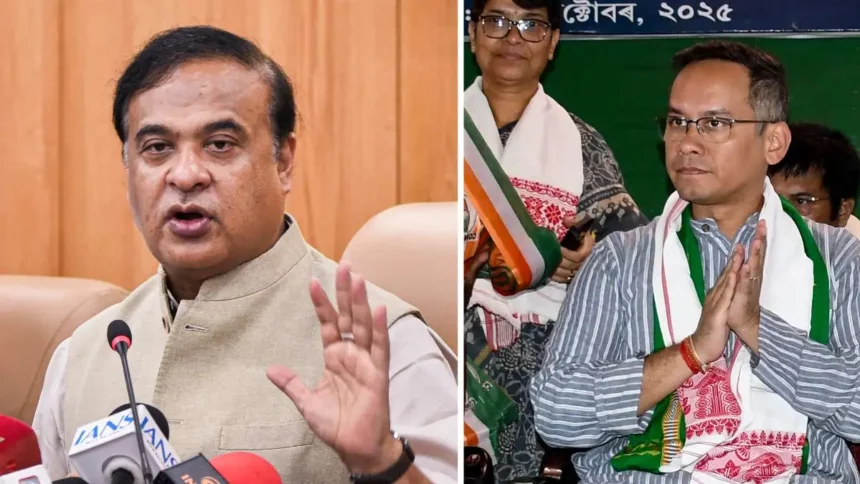
In a major escalation of political confrontation in Assam, Chief Minister Himanta Biswa Sarma has once again stirred controversy with explosive allegations against Congress MP Gaurav Gogoi. Himanta Biswa Sarma called Gogoi a “100% Pakistani agent” and claimed that he was “planted by foreign powers” to destabilize India. The Chief Minister made the statement during an interaction with the media, directly challenging Gogoi to file a defamation case against him if he had “the courage” to do so. The remarks mark a new low in the bitter feud between the ruling Bharatiya Janata Party (BJP) and the opposition Congress in Assam, as both parties trade sharp accusations ahead of the upcoming elections.
Himanta Biswa Sarma further linked his allegations to the ongoing controversy surrounding popular Assamese singer Zubeen Garg, stating that he would “prove” his claims against Gogoi once justice was delivered in Garg’s case. “Gaurav Gogoi is a Pakistani agent. He is a pure Pakistani agent. If he has the courage, lodge a defamation case against me. I have evidence that he is a 100 percent Pakistani agent. He has been planted by a foreign power in our country. He is a planted person. I am saying this with facts. As a Chief Minister, I am saying that he is a pure Pakistani agent. After giving justice to Zubeen Garg, I will prove it,” Himanta Biswa Sarma declared.
His comments have sparked intense political debate in the state, with opposition leaders accusing the BJP of spreading misinformation and engaging in character assassination to divert attention from governance failures and economic issues.
Bitter Political Rivalry and Controversial Allegations
The ongoing clash between Himanta Biswa Sarma and Gaurav Gogoi is rooted in Assam’s high-stakes political landscape, where both leaders represent influential political lineages. Himanta Biswa Sarma, once a Congress member himself, defected to the BJP in 2015 and has since become one of its most powerful leaders in the Northeast. Gogoi, on the other hand, is the son of former Assam Chief Minister Tarun Gogoi and a rising figure within the Congress. Their personal and political rivalry has intensified over the past few years, frequently erupting into public confrontations.
Himanta Biswa Sarma’s latest accusation centers on alleged “foreign links” involving Gogoi’s wife, Elizabeth Colburn, a British national. According to the Chief Minister, Colburn has “connections with Pakistan-based individuals and organizations,” a claim that both Gogoi and his wife have categorically denied. The allegations reportedly stem from what Himanta Biswa Sarma described as findings of a Special Investigation Team (SIT) report submitted to the Assam Cabinet. However, he refused to disclose the details of the report, citing its “sensitive nature.”
The Chief Minister’s comments have triggered sharp reactions from Congress leaders, who have condemned them as irresponsible and defamatory. They accused Himanta Biswa Sarma of using personal attacks to divert public attention from real issues such as unemployment, inflation, and the law-and-order situation in Assam. Party spokespersons have demanded that the Chief Minister either present credible evidence or issue an unconditional apology.
Gaurav Gogoi himself dismissed the allegations as “absurd, baseless, and politically motivated,” claiming that the BJP was resorting to smear tactics to distract from its failures. “These are cheap political gimmicks designed to malign my family’s reputation. The people of Assam can see through such propaganda,” Gogoi said in a statement. He added that his wife is an accomplished professional with no ties to any foreign organization, and that the allegations were part of a deliberate effort to tarnish his image ahead of the elections.
Political analysts suggest that Himanta Biswa Sarma’s aggressive posture may be part of a broader strategy to discredit opposition figures by raising doubts about their loyalty. Assam, with its complex socio-political fabric and history of ethnic sensitivities, has often seen heated rhetoric around nationalism and foreign influence, themes that resonate strongly with certain sections of voters.
Congress Counters Allegations, Calls It a Political Diversion
The Congress party has responded to Himanta Biswa Sarma’s remarks with fierce criticism, accusing the Chief Minister of using inflammatory language to distract the public from governance challenges in Assam. Several senior Congress leaders have called his remarks “irresponsible” and “unbecoming of a chief minister.” They argue that such statements undermine democratic discourse and set a dangerous precedent for personal attacks in political debates.
Assam Pradesh Congress Committee President Bhupen Kumar Borah said that the BJP was “desperately trying to polarize the political environment” and “vilify opposition leaders through false narratives.” He added, “The Chief Minister should focus on improving Assam’s economic situation, which is worsening by the day, instead of making wild allegations against his opponents.”
The Congress has also hinted that it may take legal action against Himanta Biswa Sarma for defamation, though it has not yet filed any formal complaint. Meanwhile, opposition leaders across party lines have urged the Election Commission and central authorities to take note of Himanta Biswa Sarma’s remarks, arguing that they amount to hate speech and character assassination.
While Himanta Biswa Sarma insists he will soon present “proof” of Gogoi’s alleged connections with foreign entities, he has so far not provided any documentation or evidence to substantiate his claims. His repeated assertions about “classified evidence” have fueled speculation about whether the government actually possesses credible material or whether the allegations are purely political theater.
For Gaurav Gogoi, the controversy presents both challenges and opportunities. As a young leader who has consistently positioned himself as a voice of integrity and rational politics, he now finds himself in the center of a high-profile political storm. However, his calm response and refusal to engage in personal mudslinging could help him gain sympathy among voters tired of confrontational politics.
This latest episode also underscores the deepening polarization in Assam’s political landscape, where personal attacks, religious insinuations, and nationalist rhetoric increasingly dominate the discourse. Analysts note that while Himanta Biswa Sarma’s political style has often been combative, his latest comments may test the limits of political decency in a state known for its complex ethnic harmony and delicate communal balance.
The timing of Himanta Biswa Sarma’s statement is also significant, coming at a moment when the BJP is facing mounting criticism over governance issues, particularly in relation to flood management, unemployment, and rural distress. The opposition has accused the ruling party of trying to deflect attention by targeting individual leaders rather than addressing public grievances.
At the same time, the Chief Minister’s remarks have reignited discussions about the ethics of mixing personal life with political rivalry. Many observers believe that dragging Gogoi’s wife into the controversy has crossed a moral line, especially since she is a private citizen and not involved in politics. Women’s organizations and civil rights groups have condemned the language used by Himanta Biswa Sarma, calling it “sexist and xenophobic.”
Despite the uproar, Himanta Biswa Sarma appears unperturbed, maintaining his position that he will eventually reveal the “truth” behind Gogoi’s alleged connections. He has framed the controversy as a matter of national security, portraying himself as someone acting in the nation’s interest. “This is not about politics. This is about India’s safety and integrity. I will not back down,” he declared in a subsequent media interaction.
The controversy has spilled over onto social media, where supporters of both leaders have engaged in fierce debates. Hashtags supporting and opposing Himanta Biswa Sarma have trended across platforms, further deepening political divisions. While BJP loyalists have hailed the Chief Minister as a strong leader unafraid to speak his mind, critics have accused him of indulging in dangerous demagoguery that undermines democratic institutions.
Political observers believe that the row could have lasting implications for Assam’s political climate. It reflects the increasingly personalized nature of political discourse in India, where attacks on opponents often go beyond policy disagreements to question patriotism and personal character. For both Himanta Biswa Sarma and Gogoi, the stakes are high —Himanta Biswa Sarma seeks to consolidate his image as a nationalist strongman, while Gogoi must defend not only his reputation but also his political credibility as one of Congress’s key leaders in the Northeast.
As Assam gears up for the next round of electoral contests, this episode could shape public perceptions of both leaders. Whether Himanta Biswa Sarma eventually produces the promised evidence or the controversy fades as another episode of political mudslinging remains to be seen. But for now, his “Pakistani agent” remark has once again thrown Assam’s political discourse into turmoil, underscoring the intense polarization defining Indian politics today.