A political storm has erupted following remarks by Iltija Mufti, daughter of former Jammu and Kashmir chief minister Mehbooba Mufti, after an incident involving Bihar chief minister Nitish Kumar and a female doctor wearing a hijab. The controversy, which began with a public appointment ceremony in Patna, has rapidly expanded into a wider national debate on dignity, religious identity, women’s rights, and political accountability. Iltija Mufti, a leader of the People’s Democratic Party, has openly condemned Nitish Kumar’s actions and issued a sharp warning, while opposition leaders, ministers, and civil society voices have weighed in, deepening the fault lines around the issue.
The incident has triggered strong emotional and political reactions, particularly among Muslim women and minority groups, who view the act as an affront to personal dignity and religious freedom. At the same time, responses from ruling party leaders in Bihar and at the Centre have added fuel to the controversy, transforming what began as a single moment on a public stage into a broader confrontation over power, propriety, and respect in public life.
Iltija Mufti’s warning, police complaint and political escalation
Iltija Mufti, daughter of former Jammu and Kashmir chief minister Mehbooba Mufti, strongly criticised Nitish Kumar over the alleged removal of a female doctor’s hijab during an official function in Patna. Speaking in Srinagar, Iltija accused the Bihar chief minister of humiliating a Muslim woman in public and crossing a line that, according to her, no authority has the right to cross.
In a statement that quickly went viral, Iltija said that Nitish Kumar had no right to touch a woman’s niqab or hijab and warned that if such an act were repeated, Muslim women would respond forcefully. Her remarks, particularly the phrase that Muslim women would “teach a lesson” if the hijab was touched again, sparked intense political debate and media attention, with supporters describing her words as an expression of anger and resistance, while critics accused her of using inflammatory language.
Following her public comments, Iltija Mufti filed a formal complaint at the Kothibagh police station in Srinagar. In her complaint, she described the incident as deeply insulting to Muslim women and demanded legal action against Nitish Kumar. Police officials confirmed receipt of the complaint but did not immediately clarify whether a first information report had been registered. The lack of clarity on legal proceedings further intensified speculation and debate around the case.
The People’s Democratic Party, to which Iltija belongs, rallied behind her statements, framing the issue as one of constitutional rights and personal freedom. Party leaders argued that religious attire is a matter of personal choice and dignity, and that any physical interference, especially by someone holding constitutional office, sets a dangerous precedent. The party also accused sections of the political establishment of selectively defending or justifying the incident because the woman involved belonged to a minority community.
As the controversy spread, it became clear that the incident had moved beyond a regional issue, drawing attention from leaders across states and parties. The strong language used by Iltija Mufti ensured that the matter remained in the national spotlight, forcing political leaders to clarify their positions on the intersection of authority, religion, and women’s autonomy.
Patna ceremony incident, reactions from leaders and impact on the doctor
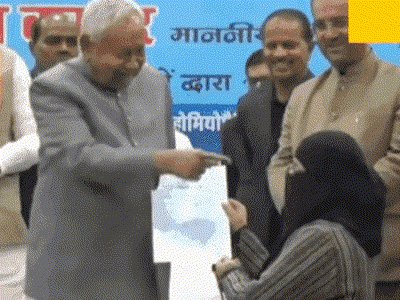
The controversy traces back to December 15 in Patna, where Nitish Kumar was presiding over an appointment ceremony for 1,283 AYUSH doctors. During the event, a female doctor, Nusrat Parveen, approached the stage wearing a hijab to receive her appointment letter. Video footage that later circulated widely on social media shows the chief minister handing over the letter, gesturing toward her hijab, and then pulling it, briefly revealing her face. The act, captured on camera, immediately triggered outrage once the video went viral.
The visuals prompted sharp criticism from opposition leaders and civil rights advocates, who described the act as inappropriate and disrespectful. Supporters of Nusrat Parveen argued that regardless of intent, touching a woman’s clothing without consent in a public setting amounted to a violation of personal dignity. Many also pointed out that the power imbalance between a chief minister and a newly appointed doctor made the incident even more troubling.
The issue drew a response from Omar Abdullah, who questioned the propriety of the act beyond religious considerations. Omar Abdullah stated that even if one were to set aside the fact that the doctor was a Muslim woman wearing a hijab, it was still unacceptable to touch any woman’s clothing in such a manner. He added that Nitish Kumar should acknowledge his mistake and apologise to the doctor, emphasising that respect and consent are non-negotiable in public life.
Meanwhile, the incident had a profound personal impact on Nusrat Parveen. Hurt and distressed by the public scrutiny and humiliation, she decided not to take up the government job she had been offered in Bihar. According to family members, she has been under severe mental stress since the incident and left for Kolkata shortly after the ceremony. Her brother, a professor at a government college in Kolkata, said that although she was scheduled to join her duties on December 20, she has made it clear that she does not wish to return to Bihar.
Accounts from those close to Nusrat reveal the emotional toll the incident has taken on her. A neighbour said that during a phone call with her brother, Nusrat was in tears and expressed discomfort with the laughter and reactions of people present at the ceremony. While she reportedly did not accuse the chief minister of deliberate intent, she felt deeply hurt by the situation and the public exposure that followed.
The political response within Bihar further polarised opinion. Union minister and BJP leader Giriraj Singh came out in defence of Nitish Kumar, stating that the chief minister had done nothing wrong and arguing that anyone accepting a government appointment should not hide their face. His remarks, including a controversial comment suggesting that it was up to the woman whether she accepted the job or “went to hell,” drew widespread condemnation and were seen by critics as dismissive and insensitive.
In contrast, Bihar minority welfare minister Jama Khan offered a different explanation, suggesting that Nitish Kumar may have intended for society to see the doctor’s face as a symbol of her achievement. Bihar health minister Mangal Pandey said he was unaware that Nusrat had decided not to join her duties, distancing himself from the controversy.
As reactions continue to pour in, the incident has become emblematic of broader debates around gender, power, and religious identity in India. The clash of perspectives, from Iltija Mufti’s warning to defences mounted by ruling party leaders, underscores how a single moment can ignite nationwide discussion on respect, accountability, and the limits of authority.