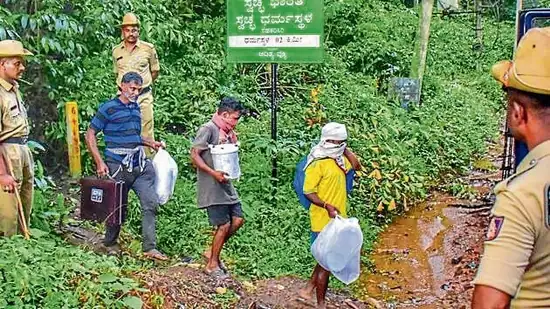
Karnataka is witnessing a heated political confrontation over allegations of mass burials and disappearances of women in the temple town of Dharmasthala. The controversy erupted last month when a former sanitation worker lodged a police complaint alleging that he had buried the bodies of multiple women who were reportedly raped and murdered. This complaint prompted the Congress-led state government to form a Special Investigation Team (SIT) tasked with exhumation and forensic analysis to verify the claims. While the BJP has accused the state government of attempting to cover up the issue and politicising it, the state administration claims the party is trying to create unrest by spreading misinformation. As the investigation progressed, the controversy has intensified into a major political dispute, raising questions about governance, media narratives, and the role of political parties in influencing public perception on sensitive issues.
BJP Accuses Congress of Political Opportunism
On Friday, BJP state president B Y Vijayendra launched a sharp attack on the Congress government, accusing Chief Minister Siddaramaiah and Deputy Chief Minister D K Shivakumar of performing a political show under the guise of investigation. Vijayendra alleged that the chief minister and his deputy were “running around wearing masks” and attempting to create the impression of a major scandal by overseeing exhumations that yielded nothing. “We welcomed the investigation. The Chief Minister imagined that by digging pits, some big scandal would be unearthed. But even after digging 15–16 pits, they found nothing,” Vijayendra was quoted as saying by news agency ANI.
Vijayendra further accused the state government of failing to respond to a wave of alleged propaganda targeting Dharmasthala. He claimed that malicious narratives were being circulated on social media, attempting to malign the temple town and hurt Hindu religious sentiments, yet the state authorities had not taken action against the perpetrators. He contrasted this inaction with the swift arrests of Hindu activists, saying that individuals promoting religious content online were arrested within 24 hours, while the creators of the anti-temple propaganda faced no consequences.
The BJP has repeatedly argued that the SIT investigation was ordered under pressure from Leftist forces, implying that political motivations are influencing the procedural aspects of the inquiry. The party’s stance has been that the narrative of mass burials and disappearances is being exaggerated to create fear and deflect attention from administrative failures. By framing the controversy as a politically engineered campaign, the BJP seeks to portray itself as a defender of religious sentiments and a critic of Congress’s governance practices in Karnataka.
Political analysts note that Vijayendra’s statements align with the BJP’s broader strategy of positioning itself as the guardian of cultural and religious institutions, while questioning the credibility of Congress-led investigations. The repeated emphasis on the alleged absence of findings despite numerous pits being dug is designed to create doubt about the SIT’s conclusions and the government’s transparency. This narrative underscores the tension between political messaging and the ongoing criminal investigation, highlighting how sensitive social issues are often leveraged for electoral and ideological advantage.
Congress Defends Investigation Amid Conflicting Claims
In response to BJP’s accusations, Deputy Chief Minister D K Shivakumar accused the BJP of attempting to politicise the matter and emphasized the legitimacy of the SIT probe. He stated, “BJP is a customer of this. What they are doing is politics. The investigation team, led by senior officer Mohanty, is doing its job neatly,” reinforcing the state government’s stance that the inquiry is proceeding in a professional and methodical manner. SIT chief Pranab Mohanty is overseeing the investigation, conducting exhumations, collecting skeletal remains, and performing forensic analysis to ascertain the validity of the allegations.
The state government has clarified that skeletal remains were indeed found at two locations, and these samples have been sent for further forensic examination. Karnataka Home Minister G Parameshwara informed the assembly that excavation and exhumation work has been temporarily suspended until forensic results are obtained. This measured approach reflects the procedural constraints and scientific rigor required in handling such sensitive investigations.
Adding a twist to the ongoing controversy, a woman who had previously claimed that her daughter went missing in 2003, triggering widespread attention and becoming a flashpoint in the Dharmasthala row, has now admitted that her claims were fabricated. Sujatha Bhat stated that her earlier allegations about her daughter, Ananya Bhat, were false and made under the persuasion of two activists who influenced her to lodge the complaint. Her retraction complicates the narrative and raises questions about the credibility of some of the allegations that initially fueled the political and media frenzy.
The conflicting claims and retractions have highlighted the challenges of separating fact from politically motivated narratives. Congress leaders maintain that the SIT investigation is proceeding based on evidence and forensic findings, not political pressure. By defending the inquiry, the state administration aims to assure citizens that the investigation is impartial and focused on justice rather than partisan agendas. Shivakumar’s remarks also underline the message that the BJP is attempting to exploit the situation to create unrest and influence public perception.
Political commentators observe that this confrontation reflects a broader trend in Indian politics, where sensitive issues related to crime, religion, or social unrest are often amplified in the media to serve political interests. In this case, Dharmasthala—a site of immense religious and cultural significance—became a battleground where both parties seek to control the narrative. The BJP’s focus on alleged failures and propaganda against the temple town is matched by Congress’s insistence on procedure, evidence, and professionalism in conducting the investigation.
The SIT’s methodology, including exhumations, sample collection, and forensic analysis, is central to maintaining credibility. Yet, in the court of public opinion, the interpretation of these steps is often filtered through political biases. BJP’s narrative of “nothing found” contrasts sharply with Congress’s position that skeletal remains were discovered and subjected to detailed investigation, demonstrating how the same set of facts can be presented in conflicting ways to suit political strategies.
Meanwhile, the involvement of activists and the role of social media have become critical factors in shaping public discourse. The case illustrates how social campaigns, misinformation, and fabricated claims can influence both political debate and investigative priorities. Sujatha Bhat’s admission of fabrication highlights the dangers of unverified claims being treated as factual evidence, and the responsibility of both political parties and media organizations in verifying information before amplifying it.
The Dharmasthala row is a complex mix of governance, politics, and social sensitivities. The BJP’s emphasis on religious sentiments and alleged inaction by the state government seeks to resonate with sections of the electorate concerned about cultural preservation. In contrast, Congress’s measured approach to the SIT investigation and its defense of procedural integrity aims to project the party as law-abiding, evidence-oriented, and resistant to politicization. The clash represents a classic scenario in Indian politics where accountability, perception, and political strategy intersect around a highly sensitive social issue.
Experts suggest that the unfolding controversy could have wider implications beyond Karnataka. How the investigation proceeds, the interpretation of forensic findings, and the management of political messaging may influence public trust in both the state administration and the BJP’s narrative. The case also underscores the need for transparency, independent verification, and careful handling of religiously sensitive issues to prevent escalation of social tensions.
In addition to political maneuvering, the Dharmasthala case has prompted discussions about the responsibilities of law enforcement, the role of SITs in handling complex investigations, and the mechanisms required to balance justice with social harmony. The involvement of multiple agencies, forensic experts, and oversight committees reflects the seriousness with which the allegations are being treated, even as political debates continue to dominate headlines.
Sujatha Bhat’s admission of false claims brings into focus the human factor in politicized controversies. Personal motivations, external influence, and activist intervention can transform isolated incidents into statewide political controversies. This aspect further complicates the narrative and highlights the challenge of distinguishing genuine investigative findings from politically or socially engineered stories.
As both parties continue to assert their positions, the people of Karnataka are left navigating conflicting narratives, uncertain about the truth behind the allegations. The Dharmasthala case exemplifies the intersection of crime investigation, political strategy, media reporting, and social discourse in contemporary India. It also illustrates the complexities faced by authorities when high-profile, culturally sensitive cases attract national attention and are used as tools in political debates.
The ongoing SIT investigation, combined with retractions and political commentary, suggests that the story of Dharmasthala will remain in public discourse for months to come. Both BJP and Congress are leveraging the issue to advance their narratives, appeal to constituencies, and influence public opinion, even as forensic evidence continues to emerge and define the contours of the investigation.
The Dharmasthala controversy is more than a local incident; it reflects the dynamics of governance, law, media, and politics in India. The conflicting claims, political accusations, and evolving investigation highlight the challenges of managing sensitive issues in a highly polarized environment. While the SIT works on verifying allegations and ensuring justice, the political debate over motives, accountability, and messaging continues unabated, demonstrating how factual investigations and political narratives often collide in India’s democratic landscape.