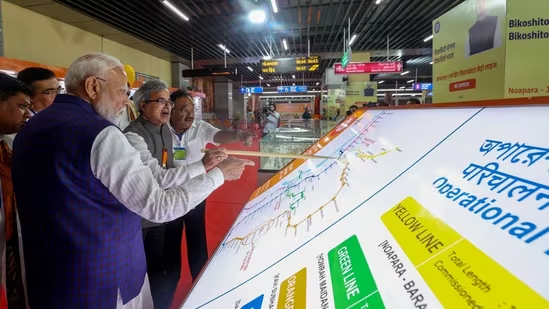
India has steadily transformed its urban transportation landscape over the past two decades, and nowhere is this more visible than in the growth of its metro rail systems. On Friday, Prime Minister Narendra Modi inaugurated multiple metro railway projects in Kolkata and declared with pride that India now possesses the third-largest metro network in the world. This milestone is not just an infrastructural achievement but also a reflection of the country’s larger journey toward becoming the world’s third-largest economy. The Prime Minister’s remarks and the new services inaugurated in Kolkata highlight how the government views metro rail as a crucial element in ensuring sustainable urban growth, reducing congestion, and offering greener modes of public transportation for millions of commuters across India.
Metro Expansion and India’s Urban Transformation
Addressing the gathering after flagging off the new services, Prime Minister Modi underscored the significance of metro rail in shaping the future of Indian cities. “Today, when India is moving towards becoming the third largest economy, the role of Dum Dum and Kolkata increases further. This program is a proof that today’s India is working for the development of every city,” he said. He noted that green mobility efforts—ranging from the expansion of metro rail networks to the increasing use of electric buses and charging points—are being intensified across the country. His assertion that India now boasts the third-largest metro network in the world received loud applause, as it symbolizes both national pride and progress toward modern, sustainable living.
The projects inaugurated in Kolkata, a city that was home to India’s first metro service in 1984, hold symbolic importance. Kolkata, often seen as the cultural capital of India, has historically been a city of firsts. By adding new corridors and expanding connectivity within the metropolis, the government aims to not only ease daily travel for lakhs of citizens but also ensure that the city remains at the forefront of India’s transport modernization. For the Prime Minister, this expansion is as much about paying tribute to the pioneering history of Kolkata’s metro as it is about meeting the demands of a growing urban population.
Modi also highlighted the environmental benefits of metro rail projects. Urban mobility has become a pressing concern in India, where cities are grappling with pollution, traffic congestion, and unplanned growth. By emphasizing the green mobility aspect, the Prime Minister sought to connect metro expansion with the country’s broader climate goals. With India committing to ambitious targets under global climate frameworks, expanding sustainable transportation options remains a key policy priority. The Kolkata metro projects, therefore, were presented not only as urban infrastructure but also as symbols of a greener, more sustainable future.
During his address, Modi congratulated the people of Kolkata, expressing happiness that the city’s public transport is witnessing significant progress. “Today once again I got the opportunity to accelerate development in West Bengal. Everyone is happy that Kolkata’s public transport has progressed. I congratulate the people of Kolkata for these development projects,” he said. The inauguration ceremony also witnessed the Prime Minister being felicitated by Union Ministers Ravneet Singh and Shantanu Thakur, underlining the central government’s emphasis on the role of metro connectivity in West Bengal’s development.
Transformative Impact of Kolkata’s New Metro Corridors
Prime Minister Modi’s visit to Kolkata included the inauguration of several crucial sections of the metro network. At Jessore Road Metro Station, he launched the Noapara–Jai Hind Bimanbandar metro service, an eagerly awaited connection that strengthens access to the airport. He also flagged off the Sealdah–Esplanade metro service and the Beleghata–Hemanta Mukhopadhyay metro service, both of which are expected to bring substantial relief to daily commuters.
One of the most significant outcomes of the Sealdah–Esplanade metro service is the dramatic reduction in travel time. Previously, traveling between these two points took nearly 40 minutes; with the new service, this has now been cut down to just 11 minutes. For daily passengers, students, and professionals, this change is not merely about saving time but about enhancing quality of life, productivity, and efficiency. It represents how infrastructural upgrades directly impact the day-to-day experiences of citizens.
The Beleghata–Hemanta Mukhopadhyay metro service is equally important, as it enhances connectivity with Kolkata’s IT hub. With more professionals commuting to the city’s rapidly growing technology sector, this corridor is expected to play a vital role in sustaining the growth of the digital economy. Strengthening connections to IT zones also positions Kolkata more firmly within the national narrative of India as a rising global hub for technology and innovation.
During his visit, Prime Minister Modi also undertook a metro ride himself, traveling from Jessore Road Metro Station to Jai Hind Bimanbandar and back. This gesture was more than symbolic; it conveyed the Prime Minister’s commitment to personally endorsing public transportation systems and experiencing what millions of citizens will benefit from daily. The ride also demonstrated the government’s focus on promoting metro rail not as a luxury but as an everyday necessity for urban India.
The metro corridors inaugurated will connect some of Kolkata’s busiest areas, reduce travel times, and strengthen multimodal connectivity by integrating with other modes of transport, such as buses and suburban rail. This integration is vital for achieving seamless mobility in metropolitan areas, where fragmented transport systems often add to congestion rather than reducing it. By enabling lakhs of daily commuters to save time and avoid traffic bottlenecks, the new metro routes represent a tangible step toward modernizing Kolkata’s infrastructure and aligning it with global urban transport standards.
Beyond immediate benefits to commuters, the metro projects are expected to contribute significantly to economic growth. Infrastructure development of this scale creates jobs during the construction phase and has long-term effects on urban economies by improving accessibility, reducing pollution, and enhancing real estate values in connected areas. These factors together form part of what the Prime Minister referred to as India’s path toward becoming the third-largest economy in the world.
Political Context and Competing Narratives
While Prime Minister Modi’s inauguration of metro projects was presented as part of his government’s larger vision of world-class infrastructure, the event also reflected the complex political dynamics of West Bengal. Notably, Chief Minister Mamata Banerjee did not attend the unveiling ceremony. Instead, she took to social media platform X to highlight her own role in shaping Kolkata’s metro expansion.
Her post read: “Allow me to be a little nostalgic today. As the Railways Minister of India, I was fortunate in planning and sanctioning a series of Metro Railway corridors in metropolitan Kolkata. I had drawn the blueprints, arranged the funds, initiated the works and ensured that the different ends of the city (Joka, Garia, Airport, Sector V, etc) were connected by an intra-city Metro grid. Later, as the Chief Minister of West Bengal, I had the additional privilege of taking part in the execution of the projects.”
Banerjee’s comments reflect a competing narrative over the legacy of metro development in Kolkata. As a former Union Railways Minister, she played a crucial role in sanctioning and initiating several of the corridors that are now coming to fruition. By reminding citizens of her contribution, Banerjee sought to ensure that the political credit for Kolkata’s metro expansion is shared between the central government and the state leadership.
This interplay of narratives highlights how infrastructural achievements in India often serve as both developmental milestones and political battlegrounds. For the Modi government, presenting the projects as part of a larger vision of urban transformation strengthens its national narrative of progress. For Mamata Banerjee, reclaiming her role in the metro’s expansion helps consolidate her position as a leader who has long invested in Bengal’s infrastructural growth.
Nevertheless, the absence of the state’s Chief Minister from the Prime Minister’s event did not overshadow the excitement among citizens. For Kolkata’s residents, the addition of new metro corridors is a practical improvement to daily life, irrespective of political narratives. The enthusiasm of commuters, transport experts, and the general public has demonstrated that the demand for efficient urban transportation transcends political differences.
The developments in Kolkata form part of a much broader national story. From Delhi and Bengaluru to Mumbai, Chennai, and Hyderabad, metro rail has become central to the transformation of Indian cities. With dozens of new projects in progress, India’s metro network continues to expand at a rapid pace, underlining why Prime Minister Modi could confidently announce that the country now holds the position of the world’s third-largest metro system.