Actor-politician Vijay’s recent statements at his second state conference in Madurai have sparked widespread criticism from Tamil Nadu’s major political parties, reflecting growing tensions as the state prepares for the 2026 Assembly elections. Vijay, who launched his political party TVK earlier this year, used the platform to criticize the ruling DMK, its allies, Prime Minister Narendra Modi, and the AIADMK. His remarks have triggered sharp reactions from leaders across the political spectrum, who have vowed to respond decisively in the upcoming elections. The controversy underscores the delicate balance between celebrity influence in politics and traditional party structures in Tamil Nadu, highlighting how Vijay’s rise is challenging established political hierarchies. As Vijay continues to position himself as a formidable challenger to the DMK, the state’s political landscape is increasingly witnessing a clash of personalities, ideologies, and strategic narratives ahead of next year’s polls.
Party Leaders Condemn Vijay’s Remarks
Political leaders from DMK, AIADMK, and BJP have strongly condemned Vijay’s statements, interpreting them as disrespectful and politically motivated. K N Nehru, municipal administration minister and senior DMK leader, criticized Vijay for allegedly undermining the stature of experienced political figures, particularly the incumbent Chief Minister, whom he referred to as ‘uncle’. Nehru described Vijay’s comments as falling to “a low standard” and asserted that the DMK, backed by popular support, would ensure a “fitting reply” during the 2026 Assembly elections. The remarks reflect the DMK’s intent to position Vijay as an emerging but untested political figure who is attempting to influence voter sentiment through media attention rather than long-standing political work.
Former Governor and BJP leader Tamilisai Soundararajan expressed disapproval over Vijay’s criticism of Prime Minister Narendra Modi. She remarked that Vijay’s statements resembled scripted movie dialogues rather than serious political discourse, describing his conference speech as “a one-day film show.” Tamilisai emphasized Modi’s global stature and popularity, asserting that the Prime Minister is respected internationally, and Vijay’s comments undermined the dignity of established political authority. This criticism from a national party leader underscores the perception that Vijay’s political approach relies heavily on celebrity appeal and dramatized rhetoric rather than conventional policy-based politics.
AIADMK representatives also expressed strong opposition to Vijay’s attack on their party and its alliance with the BJP. Spokesperson C Vaigaiselvan predicted that Vijay and TVK would fade following the 2026 Assembly elections, portraying his party as lacking the organizational depth to sustain political momentum. R B Udayakumar, the AIADMK deputy leader of opposition, emphasized that both national and regional parties recognize the need to unite behind AIADMK to counter the DMK, framing Vijay’s challenge as an additional layer of competition but unlikely to disrupt the existing power structures. The statements from AIADMK highlight the party’s strategy to marginalize emerging celebrity-led political movements by reinforcing traditional political alliances and voter bases.
Vijay’s Conference and Political Positioning
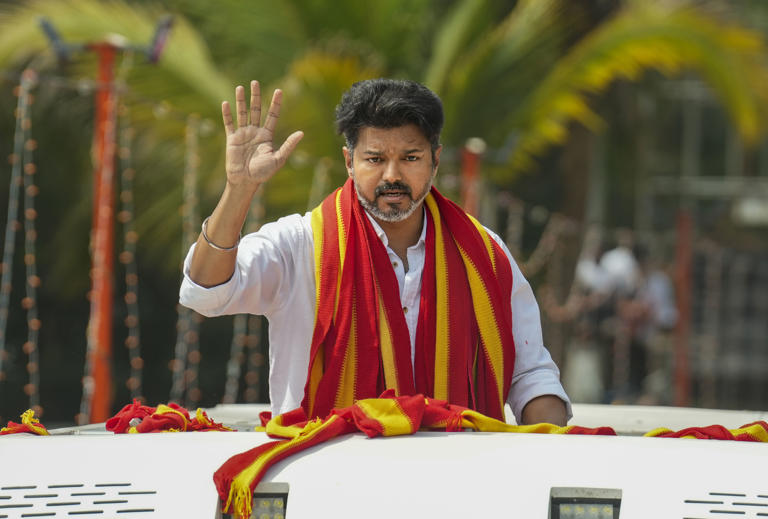
Vijay’s second state conference, held on Thursday in Madurai, drew a massive crowd and was marked by his direct criticism of the ruling DMK, Prime Minister Modi, and the AIADMK. The actor-politician, leveraging his celebrity influence, positioned his party TVK as the principal challenger to the DMK in the 2026 Assembly elections. He highlighted perceived failings of the incumbent government and cast the upcoming election as a direct confrontation between his party and the DMK. Vijay’s public addresses have increasingly emphasized his role as a new political force capable of challenging long-standing party structures and providing an alternative to traditional political leadership in Tamil Nadu.
The conference was also an opportunity for Vijay to consolidate support among his followers and signal to voters that TVK intends to contest aggressively in next year’s elections. By invoking both popular and nationalist rhetoric, he aimed to appeal to a broad demographic, including younger voters drawn to his celebrity persona. Vijay’s comments regarding Modi and the AIADMK were framed as part of a larger narrative to question established political authorities while projecting his party as a grassroots-driven alternative.
Analysts note that Vijay’s entry into politics represents a broader trend in Tamil Nadu and India, where film personalities increasingly leverage mass appeal to gain political traction. His remarks at the conference illustrate the blending of entertainment culture with political discourse, where rhetorical flourishes and public spectacle become instruments to attract attention and mobilize voters. While this approach has been successful in generating media coverage and public debate, it has also invited sharp criticism from seasoned politicians who view such methods as undermining traditional democratic processes and experienced leadership.
The controversy surrounding Vijay’s statements has intensified debates over the role of celebrity politicians in Tamil Nadu’s political ecosystem. Parties such as DMK, AIADMK, and BJP are attempting to frame Vijay’s rise as more spectacle than substance, arguing that electoral success requires decades of organizational experience, policy knowledge, and voter outreach. Meanwhile, Vijay continues to emphasize his commitment to challenging perceived corruption, inefficiency, and unresponsiveness among established leaders, framing his intervention as necessary for political renewal in the state.
The 2026 Assembly elections are increasingly being shaped by these competing narratives, where celebrity influence, historical party strength, and ideological positioning intersect. Vijay’s direct criticism of Prime Minister Modi has also attracted attention beyond the state, signaling that his political ambitions may involve a broader national dimension, even as he focuses on consolidating a regional base. The reactions from Tamilisai Soundararajan and other BJP leaders underline the sensitivity of celebrity interventions in matters that involve national figures, highlighting how regional political activity can quickly assume national relevance.
Vijay’s positioning as a political challenger is further reinforced by the AIADMK’s defensive response. By framing his party as transient and lacking organizational depth, AIADMK leaders aim to preserve their own voter base while emphasizing traditional party hierarchies. This interaction between emerging celebrity-led parties and established political organizations is illustrative of the evolving dynamics in Tamil Nadu politics, where mass appeal and media visibility increasingly influence electoral strategy.
The conference’s aftermath demonstrates how political discourse in Tamil Nadu is adapting to the rise of non-traditional political actors. Vijay’s statements have prompted seasoned leaders to clarify party positions, mobilize supporters, and articulate strategies for countering emerging challenges. Both DMK and AIADMK leaders are employing rhetoric to reassure voters of their credibility and experience while attempting to diminish the perceived legitimacy of celebrity politicians entering electoral competition.
While Vijay continues to build momentum through public rallies and media engagement, established parties remain confident that their organizational structures, historical presence, and political experience will provide resilience against new entrants. The next 12 months leading to the 2026 Assembly elections are expected to witness escalating public debates, political campaigns, and strategic positioning, with Vijay at the center of a highly polarized and media-focused contest.
Vijay’s second state conference has catalyzed a renewed political debate in Tamil Nadu, highlighting the tensions between celebrity influence and established political authority. His remarks against Chief Minister Stalin, Prime Minister Modi, and AIADMK have sparked a multi-party backlash, signaling the intensity of electoral politics ahead of 2026. The controversy exemplifies the complex interplay between media visibility, popular appeal, and traditional political structures, as Tamil Nadu prepares for a critical election that may redefine power dynamics in the state.