The evolving political atmosphere in New Delhi intensified today as news emerged that senior opposition leaders Rahul Gandhi and Mallikarjun Kharge were not invited to the state dinner being hosted for Russian President Vladimir Putin, prompting renewed debate over diplomatic traditions, political messaging and the government’s approach to engagement during high-level foreign visits.
Differing Invitations Spark Debate Over Tradition, Diplomacy and Domestic Political Messaging
In an unexpected development that stirred immediate political noise, sources confirmed that Congress leaders Rahul Gandhi and Mallikarjun Kharge were excluded from the guest list for the ceremonial dinner at the President’s residence. This came only a day after Rahul Gandhi publicly criticised the ruling government for breaking long-standing traditions under which the Leader of Opposition is formally included in high-profile engagements involving foreign dignitaries.
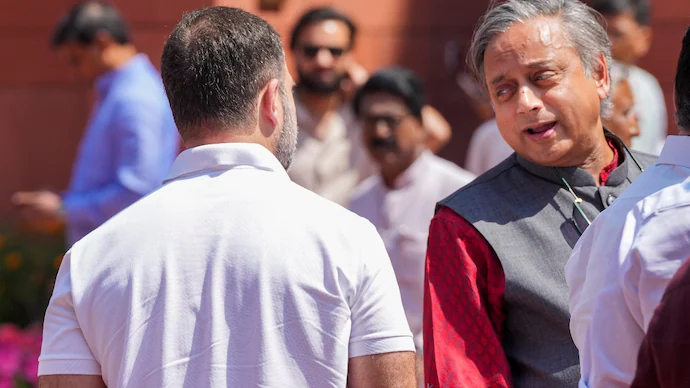
Against that backdrop, the revelation that Congress parliamentarian Shashi Tharoor was indeed extended an invitation drew further attention. Tharoor’s inclusion, contrasted with the omission of the party’s top leadership, created a wave of discussion both within political circles and across public platforms, raising questions about the criteria underlying such invitations and whether they represent a shift in established diplomatic conventions.
Congress spokesperson Pawan Khera expressed strong disapproval upon learning of the selective invitations. He argued that accepting such an invitation in the absence of the party’s senior-most leaders would contradict principles of internal unity and undermine the dignity of the party’s leadership. Khera suggested that political players must recognise when larger strategic motivations are at work, implying that the situation may represent a deliberate attempt to sow internal tensions within the opposition.
In contrast, Shashi Tharoor publicly stated that he would attend the dinner. While acknowledging that it was inappropriate for the Leader of Opposition not to be invited, he maintained that he did not know the basis on which invitations were decided. Tharoor’s response reflected both diplomatic sensitivity and personal accountability, emphasising that he would honour an invitation extended to him even as he recognised the broader implications.
Meanwhile, sources within the government rejected Rahul Gandhi’s criticism, noting that since he assumed the role of Leader of Opposition in June 2024, he has nevertheless met several visiting heads of state. They clarified that the decision regarding which Indian political leaders are engaged during such visits lies primarily with the visiting foreign delegation, not with India’s Ministry of External Affairs.
This clarification, however, did little to diminish the perception of a widening gulf between the government and the principal opposition, with questions emerging over whether such precedents will redefine the protocols surrounding future diplomatic engagements.
As debate unfolded, preparations continued swiftly for the grand state dinner in honour of President Putin. Officials indicated that more than 150 distinguished guests from the fields of politics, business, diplomacy and the arts would attend. The evening is designed as a high-symbolism display of the enduring India–Russia relationship, particularly in its 25th anniversary year of strategic partnership.
Detailed arrangements for the cultural components of the event revealed a carefully curated performance list expected to blend Indian and Russian heritage. A joint military band from the Indian Army, Navy and Air Force is preparing patriotic renditions including “Sare Jahan Se Accha” and “Qadam Qadam Badhaye Ja,” signalling the centrality of defence relations in bilateral ties. The band is also expected to perform Russian compositions, symbolising mutual respect and cultural exchange.
The dinner menu, crafted to represent both nations, will reportedly include dishes from Kashmiri Wazwan cuisine alongside classic Russian offerings such as borscht. The choice of culinary themes underscores the diplomatic intent of celebrating cultural identity through shared hospitality.
The timing of this political dispute is particularly significant. President Putin’s arrival in India comes amid heightened international attention on global alliances, defence cooperation, and shifting geopolitical dynamics. As India prepares to deepen strategic commitments with Russia, the political discourse surrounding internal representation highlights how domestic considerations intertwine with international diplomacy.
The absence of Rahul Gandhi and Mallikarjun Kharge from such a high-profile event inevitably influences public perception. It touches upon core debates—ranging from democratic inclusivity to the evolving nature of political communication between the ruling government and the opposition. It also raises broader questions about how political messaging during foreign visits may impact India’s image as a pluralistic democratic system.
*Government Position, Diplomatic Context and the Grand State Dinner’s Symbolism*
Government officials have stressed that no established norm has been breached, reiterating that visiting delegations often decide independently which individuals they meet or invite. The clarification was aimed at countering public speculation that the omission was designed to reduce the Opposition’s visibility during a major diplomatic engagement.
Yet, the optics remain powerful. Given the magnitude of Putin’s visit—one that showcases defence cooperation, energy partnerships and longstanding geopolitical alignment—the absence of the Leader of Opposition suggests a narrower representation of India’s political spectrum during key diplomatic exchanges.
The dinner’s elaborate arrangements reflect not only hospitality but also India’s intent to present unity, stability and cultural richness before the Russian delegation. The event’s guest list, drawn from influential sectors, showcases India’s soft power through art, food, military precision and ceremonial elegance.
The Tri-Services Band’s presence is especially symbolic. Given India and Russia’s deep defence partnership spanning decades—ranging from co-development of BrahMos missiles to procurement of S-400 missile systems—the band’s performance bridges ceremonial tradition with contemporary strategic alignment. It reinforces how cultural gestures reflect geopolitical commitments.
Meanwhile, diplomats describe the evening as an opportunity for high-level informal exchanges. Behind formal protocols, such dinners often serve as important forums for candid conversations, personal rapport building and reinforcement of long-term trust. Invitations therefore carry political meaning, which explains the opposition’s reaction to being left out.
Even as preparations unfold, the controversy surrounding invitations highlights a sensitive moment in Indian politics. It underscores how diplomatic events intersect with domestic political narratives and how symbolic gestures can shape perceptions of inclusion, institutional norms and democratic culture.