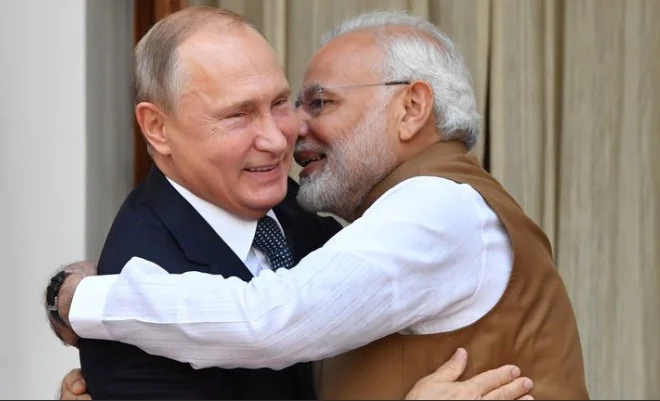
In a moment that blended symbolism, diplomacy and shared cultural appreciation, Prime Minister Narendra Modi presented Russian President Vladimir Putin with a Russian-language edition of the Bhagavad Gita during the latter’s two-day visit to India. The exchange, widely circulated through a photograph posted by PM Modi, underscored the continuing warmth in India–Russia relations and marked a gesture loaded with civilisational significance at a time when both countries are exploring deeper cooperation across political, economic and strategic domains.
A Symbolic Gift Amid Strategic Conversations and Renewed Diplomatic Warmth
Prime Minister Modi’s decision to present the Bhagavad Gita, described by him as a source of inspiration for millions, represented more than a ceremonial protocol. The text carries immense philosophical relevance and has been historically regarded as a bridge between Indian spiritual thought and the world’s intellectual traditions. For President Putin, receiving the scripture in his own language underlined India’s acknowledgement of long-standing ties and cultural outreach at the highest levels of leadership.
Their meeting began with PM Modi welcoming President Putin at Delhi’s Palam airport on Thursday evening. In a rare and telling gesture, both leaders shared a car ride to the Prime Minister’s residence at Lok Kalyan Marg, signalling not only diplomatic cordiality but also a level of personal rapport that has evolved over years of dialogue.
President Putin’s visit, the first in four years, carries considerable strategic weight as the two nations meet for the 23rd India–Russia Annual Summit. The agenda encompasses defence collaboration, energy partnerships, technological innovation, humanitarian cooperation and broader discussions on global geopolitical developments. The visit comes at a time of shifting international alliances and heightened global tensions, making India’s long-standing relationship with Russia a focal point of international attention.
Experts have noted that in many ways, this visit builds upon PM Modi’s 2024 trip to Moscow, during which both countries recalibrated their partnership and laid the groundwork for new areas of engagement. The Bhagavad Gita, therefore, becomes a symbolic carrier of stability and continuity—a reminder of the philosophical foundations of friendship even amid rapidly evolving world dynamics.
Former diplomat Arun Singh emphasised the historical depth of India–Russia ties while speaking to ANI. Drawing from decades of diplomatic experience, including two postings in Moscow, Singh highlighted the consistency with which Russia has extended political support to India. He noted that Moscow’s backing in the United Nations Security Council has been critical in multiple moments of diplomatic pressure.
Singh also pointed to Russia’s defence cooperation as a pillar of trust between the nations. Referencing Operation Sindoor—a military operation targeting terror sites in Pakistan and Pakistan-occupied Kashmir following the Pahalgam attack—he explained how Russian-origin systems such as the S-400 air defence system and the BrahMos missile played a crucial role.
According to Singh, these examples reveal that India–Russia defence ties go beyond transactional arrangements and constitute a deeper strategic alignment built on dependability and shared security priorities. Such cooperation, he noted, remains central even as India diversifies its defence partnerships.
Meanwhile, academics such as Lydia Kulik, Head of India Studies at the Moscow School of Management, described Putin’s visit as both “symbolic and a spectacle.” She argued that both countries are looking optimistically at their economic and geopolitical future. With sanctions altering Russia’s global trade patterns and India seeking diversified markets, the opening of Russian markets to Indian exporters has emerged as an immediate priority.
Kulik added that beyond trade, the summit is expected to include discussions on new defence deals, political cooperation and candid exchanges on the shifting global order. She highlighted that the visit revives momentum from PM Modi’s earlier meeting with Putin, allowing both sides to assess new opportunities and challenges.
The ceremonial elements of the visit are also significant. The state dinner hosted in Putin’s honour at Rashtrapati Bhavan is expected to feature a blend of Indian and Russian cuisine, including Kashmiri Wazwan and Russian borscht. A joint performance by India’s Tri-Services Band will present patriotic melodies from both nations, reinforcing cultural diplomacy alongside political dialogue.
Visibility of such ceremonial gestures is especially important in an era when global narratives can rapidly shift. Through hospitality, symbolism and cultural exchange, India projects the message that diplomatic friendship with Russia is not only strategic but also deeply rooted in history and shared mutual respect.
Cultural Diplomacy and Strategic Continuity Define India–Russia Engagement During High-Level Visit
President Putin’s visit comes at a moment when India occupies an increasingly critical position in global geopolitics. Balancing relations with the United States, the European Union and its Indo-Pacific partners while maintaining a robust partnership with Russia requires diplomatic agility. The Gita presentation is emblematic of India’s approach—anchoring relationships in cultural respect while navigating complex political landscapes.
The car ride shared between Modi and Putin shortly after the Russian President’s arrival added another layer to the visit. Such informal interactions often allow leaders to build personal rapport, which in turn influences strategic dialogue behind closed doors. Diplomatic observers noted that these quiet gestures contribute to trust-building in ways that formal speeches cannot.
Putin’s presence in New Delhi also revives conversations about Russia’s long-term position in the Asian region, particularly as its engagement with China deepens and its relationship with Western nations remains strained. India, as a strategic partner with an independent foreign policy, remains one of Russia’s key diplomatic anchors globally.
Within India, the visit has been widely discussed among strategic analysts. Many point out that the India–Russia partnership has repeatedly demonstrated resilience despite shifting global currents. Whether in defence procurement, space cooperation, nuclear energy or political alignment, the bilateral relationship has historically adapted to new realities without losing its structural foundation.
For example, Russia continues to play a crucial role in supplying defence systems to India even as New Delhi expands its domestic manufacturing and collaborates with partners like the United States, France and Israel. India’s diversified defence strategy does not diminish Russia’s importance; instead, it highlights India’s commitment to autonomy while valuing long-standing partnerships.
Economic cooperation is also expected to be a central theme. With Russian markets increasingly seeking non-Western avenues for trade, India emerges as a natural partner. Bilateral dialogue is likely to focus on improving market access for Indian exporters, diversifying trade beyond energy and defence, and strengthening financial mechanisms that circumvent global disruptions.
Cultural exchanges remain deeply significant, and the gifting of the Bhagavad Gita reflects this dimension powerfully. For centuries, the Gita has served as a philosophical bridge for India’s global cultural engagement. By presenting a Russian edition, PM Modi reinforced the message that India’s cultural heritage is universal and deeply valued in diplomatic relationships.
The significance of such symbolic gestures lies not just in the object exchanged but in what it represents—respect, continuity, shared values and a future-oriented partnership.
President Putin’s two-day visit will culminate in the annual summit, expected to produce new agreements and broaden cooperation across multiple sectors. As India continues to shape its role as a rising global power, its relationship with Russia remains an essential component of its diplomatic architecture.
The Gita, in this context, becomes a metaphor—illustrating how ancient wisdom continues to guide modern engagements and how cultural diplomacy can complement hard strategic interests.