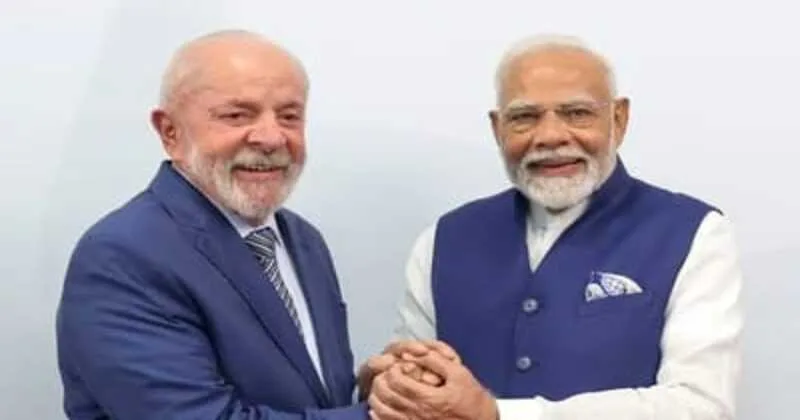
Prime Minister Narendra Modi is set to hold comprehensive bilateral discussions with Brazilian President Luiz Inacio Lula da Silva in New Delhi, marking a significant moment in India–Brazil strategic engagement. The meeting is expected to focus on securing critical mineral supply chains, strengthening defence manufacturing cooperation and accelerating bilateral trade growth toward the ambitious 20-billion-dollar target by 2030.
The summit comes at a time when global geopolitical shifts and supply chain vulnerabilities have prompted major economies to diversify sourcing of rare earth elements and critical minerals. India, aiming to reduce overdependence on dominant suppliers in East Asia, has intensified diplomatic and commercial outreach to resource-rich nations. Brazil, which possesses the world’s second-largest reserves of critical minerals, has emerged as a natural strategic partner in this effort.
Critical minerals are central to next-generation industries including electric mobility, renewable energy systems, semiconductors, aerospace manufacturing and advanced defence technologies. India’s expanding clean energy goals and rapid infrastructure development require stable access to lithium, cobalt, nickel and rare earth elements. The proposed memorandum of understanding on mineral cooperation is expected to establish institutional mechanisms for exploration partnerships, joint ventures, technology exchange and long-term supply assurances.
Strategic Minerals and Defence Manufacturing at the Core
One of the most anticipated outcomes of the visit is a framework agreement covering exploration, extraction, processing and value addition in the critical minerals sector. India has been investing in domestic mining reforms and recycling capabilities, yet overseas partnerships remain vital for securing uninterrupted access. Brazil’s geological advantage provides India with an opportunity to diversify import sources while building long-term resilience.
Beyond mining collaboration, defence and aerospace manufacturing is expected to gain fresh momentum. Brazilian aircraft manufacturer Embraer is reportedly moving toward an agreement with Adani Defense & Aerospace to establish a final assembly line for the E175 aircraft in India. If formalized, the project would significantly enhance India’s domestic aviation manufacturing base and contribute to employment generation, technology transfer and supply chain localization.
Defence cooperation between India and Brazil has historically remained limited compared to trade relations. However, both nations are seeking to expand industrial collaboration in aerospace engineering, unmanned systems and advanced platforms. The E175 assembly initiative could serve as a flagship project symbolizing deeper defence industrial alignment between Asia and Latin America’s major democracies.
The discussions are also expected to cover cooperation in multilateral institutions, including coordination on reforming global governance frameworks and amplifying the collective voice of emerging economies. Both countries are active participants in global forums such as BRICS and G20, where they advocate inclusive development, climate equity and balanced economic growth.
President Lula’s delegation includes approximately fourteen ministers and senior business executives, underscoring the economic dimension of the visit. Sector-specific ministerial meetings and a high-level business forum are scheduled to facilitate direct engagement between industry leaders. These interactions are expected to explore opportunities in renewable energy, agriculture technology, pharmaceuticals, digital innovation and infrastructure investment.
Expanding Trade Partnership and Global South Cooperation
India and Brazil have maintained a Strategic Partnership since 2006, built on shared democratic values, South-South cooperation and expanding economic linkages. Bilateral trade surpassed 15 billion dollars in 2025, reflecting sustained growth despite global economic uncertainties. Both governments have set a target of achieving 20 billion dollars in trade by 2030, signaling long-term commitment to economic expansion.
Brazil is among India’s key suppliers of sugar, crude oil, vegetable oils, cotton and iron ore. India’s rapid industrialization and infrastructure growth have driven rising demand for iron ore and energy inputs, reinforcing complementarities in bilateral trade. In turn, India exports pharmaceuticals, chemicals, machinery and refined petroleum products to Brazil.
The current summit also builds upon sustained diplomatic engagement between the two leaders over recent years. They previously met during international gatherings, including G20 summits and other multilateral platforms, maintaining regular communication on trade and geopolitical developments. Such continuity in leadership engagement has helped maintain strategic momentum despite shifting global alignments.
Energy transition remains another pillar of cooperation. Both countries are investing heavily in renewable energy expansion, biofuels and green hydrogen research. Collaboration in sustainable agriculture and climate-resilient development is expected to be discussed as part of broader Global South cooperation initiatives.
The New Delhi meeting is widely viewed as a recalibration moment in India–Brazil ties, with emphasis shifting from traditional commodity trade to technology-driven and value-added partnerships. As emerging powers navigating a rapidly evolving global order, both nations seek diversified partnerships that enhance economic security and geopolitical autonomy.
The agreements expected during the summit could shape long-term collaboration frameworks across mining, defence production and high-technology sectors. By aligning resource strength with industrial capability, India and Brazil aim to build a resilient bilateral corridor that supports energy transition goals, strengthens manufacturing ecosystems and expands strategic influence across continents.
The outcomes of this high-level engagement are likely to define the trajectory of India–Brazil relations for the remainder of the decade, positioning the partnership as a cornerstone of South-South cooperation and multipolar global governance.