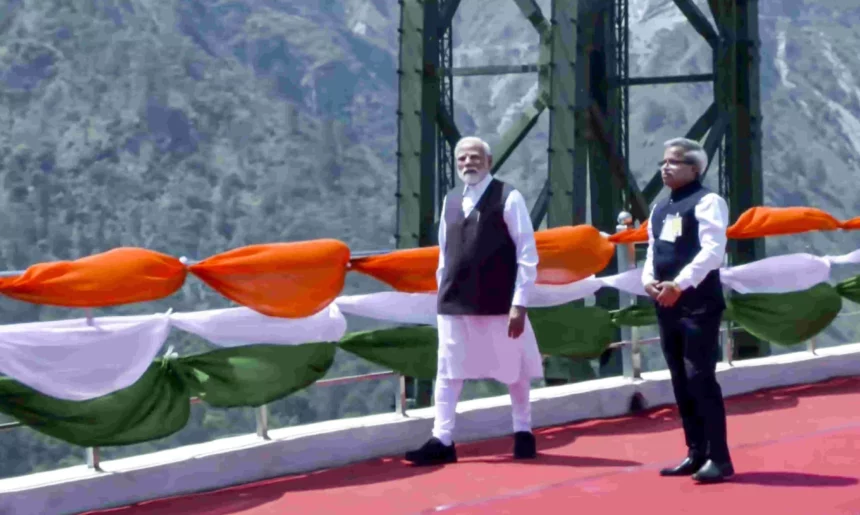
Prime Minister Narendra Modi marked a significant milestone in Jammu and Kashmir’s development by inaugurating the Chenab railway bridge, the world’s highest single-arch rail bridge, completing the long-awaited Udhampur-Srinagar-Baramulla Rail Link (USBRL) project. The event was also marked by the flagging off of the Vande Bharat train from Katra to Srinagar, symbolizing enhanced connectivity and economic opportunity for the region. Addressing the public, PM Modi assured that despite ongoing terrorism and recent terror attacks, the government’s commitment to J&K’s growth and youth empowerment remains unwavering.
The completion of the USBRL project, which began in the late 1990s and cost around ₹44,000 crore, is a landmark achievement that finally brings Srinagar onto India’s railway map. This 272-km link includes 38 tunnels and 943 bridges, with the Chenab bridge standing 359 meters above the river, alongside the Anji Khad bridge, India’s first cable-stayed railway bridge. The new rail route reduces travel time from Katra to Srinagar to three hours and from Delhi to Srinagar to 13 hours, greatly facilitating tourism and commerce in the region.
Security Challenges and National Resolve
PM Modi’s visit to Jammu and Kashmir was his first since Operation Sindoor, launched after the April 22 terror attack in Pahalgam that killed 26 tourists. The Prime Minister strongly condemned Pakistan, describing it as an enemy of humanity and peace in the region. He stated that Pakistan’s malicious intent was evident in its attempts to disrupt the economy and social harmony in Kashmir, citing the Pahalgam attack as a stark example of its strategy to incite communal violence and terror.
The Indian government responded decisively to the attack with Operation Sindoor, targeting terror camps in Pakistan and Pakistan-occupied Kashmir (PoK). This operation, spanning from May 7 to May 10, involved strikes by the Indian Army and Air Force that eliminated over 100 terrorists and destroyed multiple terrorist infrastructure sites. PM Modi highlighted the courage and resilience of J&K’s people, especially recalling the sacrifice of guide Syed Adil Hussain Shah, who confronted terrorists but lost his life.
Boosting Connectivity and Economic Prospects
PM Modi emphasized that the railway link is not just an infrastructure project but a symbol of India’s unity and determination. He recalled that before the Pahalgam attack, tourism in Jammu and Kashmir was gaining momentum, supporting livelihoods for many local communities. The Prime Minister reiterated the government’s promise to remove obstacles in the path of the youth and to foster development initiatives aimed at transforming the aspirations of J&K’s younger generation into reality.
Union Rail Minister Ashwini Vaishnaw praised the project as a dream nurtured by the nation and made possible through sustained effort and strong political will. Meanwhile, former Chief Minister Omar Abdullah acknowledged the achievement by noting that the British had once attempted but failed to connect Kashmir by rail—an endeavor now accomplished under PM Modi’s leadership, symbolizing a new chapter in Kashmir’s integration with the rest of India.