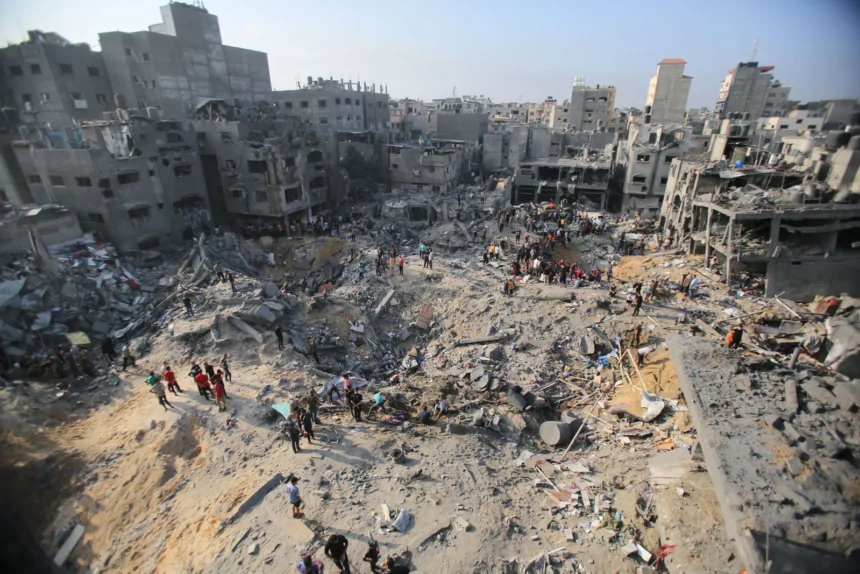
Gaza City has faced intensified bombing by Israeli forces, resulting in widespread destruction and civilian displacement, coinciding with U.S. Secretary of State Marco Rubio’s arrival to discuss the future of the ongoing conflict. Over 30 residential buildings were destroyed, thousands of Palestinians were forced to flee, and humanitarian conditions deteriorated sharply as Israel targeted Hamas positions in its declared mission to seize the city. The visit of the U.S. official underscores the international focus on the crisis, including discussions on hostage release, reconstruction, and the broader political ramifications for the region. The escalation has drawn global attention due to the scale of destruction and the deepening humanitarian crisis amid political maneuvering in Washington and the Middle East.
Gaza Bombing Intensifies as Israel Advances on Hamas Strongholds
Israeli forces have accelerated attacks on Gaza City, which remains home to nearly a million Palestinians seeking shelter from ongoing violence. The strikes have destroyed at least 30 residential buildings, displaced thousands of people, and worsened living conditions in an already fragile humanitarian environment. Local authorities report that Israeli forces have completed five waves of airstrikes targeting more than 500 sites, including Hamas reconnaissance positions, sniper nests, tunnels, and weapons storage facilities. The campaign, ongoing for nearly two years, has so far resulted in the destruction of 1,600 residential buildings and 13,000 tents in Gaza.
The airstrikes have intensified fears among the civilian population, many of whom remain in eastern suburbs under siege, while tens of thousands have fled south toward designated humanitarian zones. Despite Israel urging civilians to relocate, large numbers of displaced people remain reluctant to leave, citing insufficient shelter, safety concerns, and uncertainty about conditions in the south. Hamas has encouraged people to stay in their neighborhoods, further complicating evacuation efforts. Residents like Musbah al-Kafarna describe the chaos: “The bombardment intensified everywhere and we took down the tents, more than twenty families, we do not know where to go.”
International agencies report a significant humanitarian toll. The United Nations Relief and Works Agency for Palestine Refugees in the Near East (UNRWA) has halted services at the Beach camp clinic, Gaza’s only available healthcare facility in the northern enclave. Water and sanitation services are operating at half capacity, while ten UNRWA buildings have been struck in the past four days. The health ministry of Gaza reported that malnutrition and starvation have claimed the lives of at least 422 people, including 145 children, over recent weeks. Aid agencies warn that an Israeli takeover of Gaza City could produce catastrophic consequences for civilians already facing severe shortages.
Hamas’ political leadership continues to be a focal target. An airstrike in Doha on Tuesday targeted Hamas officials involved in on-and-off negotiations regarding a potential ceasefire and hostage release deal, an attack that drew widespread international condemnation. The U.S. and Qatar have been engaged diplomatically, with Secretary Rubio emphasizing the priority of securing the release of 48 hostages, of whom only 20 are believed to be alive. Rubio met with Israeli leadership and visited Jerusalem’s Western Wall, reaffirming U.S. recognition of the city as Israel’s capital, reflecting the broader geopolitical dimensions of the conflict.
Diplomatic Tensions and Regional Implications
The ongoing military escalation in Gaza has coincided with heightened diplomatic activity in the region. Qatar will host an emergency Arab-Islamic summit to discuss next steps and potential pressure on Israel to halt or moderate its offensive. The U.S. delegation, including Rubio, has sought to balance discussions on hostage release, reconstruction, and broader security concerns. Officials have voiced concerns that unilateral strikes, such as those targeting Hamas members in Qatar, do not serve the long-term interests of Israel or the U.S., instead potentially heightening regional tensions.
The conflict also threatens the broader political agreements in the region. Israeli Prime Minister Benjamin Netanyahu recently signed an agreement to advance settlement expansion in the West Bank, a move criticized for potentially undermining the U.S.-brokered Abraham Accords, which normalized relations between Israel and the United Arab Emirates. Meanwhile, humanitarian and aid organizations emphasize that the population of Gaza, already suffering from food insecurity, malnutrition, and infrastructure collapse, faces further risks if hostilities continue unabated. Tens of thousands of residents are displaced, and Israel’s continued blockade of food and essential supplies exacerbates the crisis, despite recent partial relaxations to allow aid entry.
Ground operations by Israel have advanced into at least four eastern suburbs of Gaza City, reducing them largely to wastelands, with the military closing in on central and western areas where most displaced populations are seeking shelter. The offensive strategy is framed around eliminating the last stronghold of Hamas within the city, with Israeli forces carrying out targeted airstrikes while urging civilian evacuation. However, obstacles to safe relocation, combined with limited space in southern zones, economic constraints, and fear of further violence, have left many civilians trapped in vulnerable positions.
The cumulative humanitarian impact has been severe. Gaza’s health infrastructure is under immense strain, with limited access to medical care, clean water, and sanitation. UNRWA officials report critical disruptions to basic services, emphasizing the urgent need for international support to prevent further casualties. The deaths of civilians, including children, from starvation and malnutrition, underscore the deadly combination of prolonged conflict and resource shortages. Aid groups continue to press Israel and international partners for immediate humanitarian corridors to reduce civilian suffering.
The Israeli military’s nearly two-year campaign against Hamas, prompted by the October 7, 2023 attack in which 1,200 Israelis were killed and 251 were taken hostage, has already claimed more than 64,000 lives in Gaza according to local authorities. The scale of destruction, particularly in Gaza City, has drawn widespread condemnation and raised concerns over potential violations of international law. Civilians remain highly vulnerable as the conflict intensifies, with tens of thousands caught between advancing Israeli forces and Hamas’ insistence on holding territory.
The presence of international figures such as Rubio underscores the geopolitical stakes of the conflict. Discussions focus not only on the release of hostages but also on reconstruction, regional stability, and long-term diplomatic arrangements. The visit reinforces the U.S. commitment to Israel while simultaneously addressing the humanitarian crisis. Discussions also extend to mitigating risks of broader escalation, including potential disruption of regional peace agreements and the impact on neighboring countries hosting Palestinian refugees.
As the offensive continues, analysts warn that prolonged conflict could exacerbate global instability. The destruction of infrastructure, displacement of civilians, and targeted attacks on political and military leadership within Hamas create both immediate and long-term consequences for Gaza. The humanitarian toll, coupled with geopolitical maneuvering, makes the situation increasingly complex, highlighting the challenges of balancing military objectives, civilian protection, and international diplomacy.
The airstrikes have targeted key strategic sites, including Hamas reconnaissance positions, weapons storage, tunnels, and leadership locations. Israeli officials have stressed the need for precise operations to eliminate militant threats while minimizing civilian casualties, though local authorities report extensive damage to residential areas. Thousands of families have lost their homes, and large-scale evacuations have not been fully implemented, leading to overcrowding in remaining safe zones. Many displaced residents face uncertain futures, with limited access to resources, shelter, and medical care.
The wider regional implications of the conflict extend to diplomatic and economic arenas. Benjamin Netanyahu’s settlement expansion plan threatens to destabilize the fragile agreements achieved under the Abraham Accords, eliciting concern from the UAE and other Arab nations. The international community continues to monitor developments closely, with Qatar and other countries pushing for a diplomatic resolution, including potential ceasefire agreements and humanitarian assistance. U.S. involvement, particularly Rubio’s visit, underscores Washington’s interest in shaping outcomes while managing regional tensions.
Meanwhile, local accounts paint a grim picture of daily life in Gaza. Civilians describe relentless bombardment, displacement, and uncertainty, with basic services such as healthcare, water, and sanitation severely disrupted. Aid agencies report that many neighborhoods have been rendered uninhabitable, leaving families with limited options. The ongoing siege, combined with previous blockades, has strained resources and heightened the vulnerability of already at-risk populations. The humanitarian crisis is further exacerbated by malnutrition, food shortages, and inadequate shelter, raising concerns over the survival and well-being of tens of thousands of residents.
Israel continues to press forward with its military campaign, while Hamas maintains control over certain areas and urges residents to remain. The intensity of airstrikes, combined with the logistical and security challenges of civilian evacuation, complicates the operational environment. Analysts warn that without significant international intervention, the humanitarian crisis is likely to deepen, and the potential for broader regional escalation remains high.
As the conflict persists, the focus on hostages remains central. The U.S. delegation, including Rubio, seeks to negotiate the release of remaining captives while coordinating with Israeli officials on security measures and humanitarian relief. The status of the hostages, coupled with the devastation of Gaza City, has intensified international scrutiny and placed pressure on both Israel and the U.S. to balance military objectives with humanitarian obligations.
Gaza’s health and infrastructure systems continue to face extreme strain. Hospitals operate under limited capacity, clinics have been forced to close, and essential services like water and sanitation are functioning at reduced levels. These conditions are compounded by widespread displacement and the destruction of residential buildings, leaving thousands of residents without shelter. Humanitarian organizations warn that without urgent intervention, the situation could deteriorate further, with escalating casualties, malnutrition, and disease posing serious risks.
The scale of destruction has prompted urgent calls for international diplomatic intervention. Regional actors, including Qatar and other Arab nations, are actively seeking mechanisms to mitigate civilian suffering and facilitate discussions on ceasefire, reconstruction, and broader political solutions. The diplomatic engagement underscores the intertwined nature of military action, humanitarian response, and political negotiation, highlighting the urgent need for coordinated international efforts to address both immediate and long-term consequences.
Israel has also emphasized the need for civilians to evacuate Gaza City to designated southern zones before sending in additional ground forces. Tens of thousands have relocated, but hundreds of thousands remain in the city and surrounding areas. Evacuation challenges, limited capacity in safer zones, and economic constraints contribute to civilian reluctance. Hamas’ directives for residents to stay further complicate the situation, leaving many trapped in conflict zones and increasing the likelihood of casualties.