The Reserve Bank of India (RBI) took a decisive step to stimulate economic growth by cutting the policy repo rate by 50 basis points to 5.5% and announcing a phased reduction in the Cash Reserve Ratio (CRR). This aggressive monetary easing move comes amid low inflation and hopes for a revival in domestic investment and consumption. With these measures, RBI aims to accelerate growth by making credit cheaper and more accessible, providing relief to households and businesses alike, and fostering a conducive environment for sustained economic expansion.
A Strong Monetary Push to Revive Growth
The RBI’s surprise move to slash the repo rate by half a percentage point, instead of the expected smaller cut, signals a strong commitment to jumpstart the economy. Alongside the rate cut, the central bank’s decision to lower the CRR will free up roughly ₹2.5 lakh crore of liquidity, enabling banks to increase lending and credit availability. This combination of easier borrowing costs and enhanced liquidity is expected to support mortgage payments and household budgets, further buoyed by the government’s recent upward revision of income tax slabs. Additionally, a good monsoon forecast is likely to boost rural incomes, while inflation remains manageable, with projections easing from 4% to 3.7% for 2025-26.
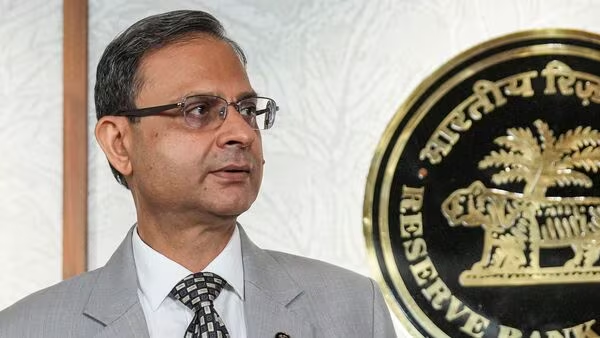
RBI Governor Sanjay Malhotra emphasized that maintaining price stability alone is insufficient for growth; a supportive monetary policy environment is essential. Consequently, while the repo rate cut marks a substantial easing move, the Monetary Policy Committee (MPC) shifted its stance from accommodative to neutral, indicating limited room for further rate reductions in the near term.
Economic Outlook and Market Response
The RBI’s actions reflect confidence in the structural strength of the Indian economy, highlighted by Governor Malhotra’s reference to a “5x3x3 matrix” of fundamentals encompassing balanced corporate, banking, household, government, and external sectors; stability in price, financial, and political domains; and growth drivers like demography, digitalization, and domestic demand. These factors are expected to shield India from global economic shocks while fostering faster growth.
Despite these efforts, RBI maintained its GDP growth forecast at 6.5% for the fiscal year 2025-26, with quarterly projections ranging between 6.3% and 6.7%. The move came against the backdrop of continuing global uncertainties, including geopolitical tensions such as the recent public feud between US President Donald Trump and Elon Musk. Market reaction was positive, with equities rising sharply on hopes that easier financial conditions will revive private investment cycles, which have lagged despite stable macroeconomic indicators.
Economists suggest that the RBI’s front-loaded policy easing and liquidity infusion place the onus on banks to accelerate the transmission of rate cuts to consumers and businesses. While further rate cuts may be limited, the current measures aim to sustain domestic demand and investment, reinforcing India’s position as a resilient and growing economy.