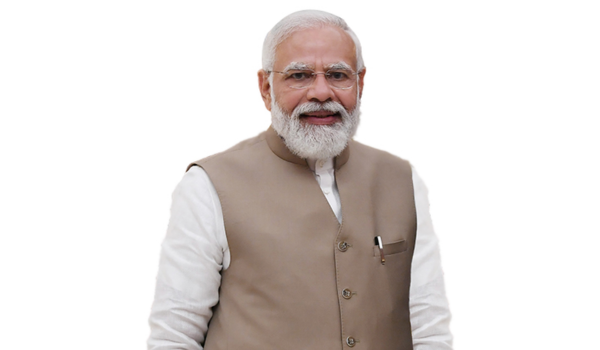
Prime Minister Narendra Modi inaugurates a grand international exposition of the sacred Piprahwa Buddha relics in New Delhi today, marking a significant cultural and spiritual moment that brings together archaeology, history, and India’s civilizational commitment to the teachings of Lord Buddha.
The exposition is being held at the Rai Pithora Cultural Complex, a space chosen to reflect both historical depth and contemporary engagement. It represents the first time that the Piprahwa relics, preserved across different national collections, are being displayed together in one comprehensive international showcase. According to the Prime Minister’s Office, the exhibition is not merely an event but a statement of intent, underscoring India’s role as the custodian of one of the world’s most influential spiritual traditions. The Piprahwa relics, discovered in 1898, are central to the archaeological study of early Buddhism and are regarded as among the most authentic material links to the historical Buddha.
The inauguration comes at a time when India is increasingly positioning its cultural heritage as a bridge between past and present, and between nations connected by Buddhist philosophy. The exposition is designed to engage scholars, spiritual practitioners, diplomats, and the wider public, presenting the relics not as static museum pieces but as living symbols of a tradition that continues to shape ethical and philosophical thought across Asia and beyond.
The Piprahwa relics and their place in early Buddhist history
The Piprahwa relics occupy a unique position in the narrative of Buddhism’s origins. Discovered in 1898 at the Piprahwa site in present-day Uttar Pradesh, the relics were found within a stupa structure that archaeological evidence strongly associates with ancient Kapilavastu. Kapilavastu is widely identified as the city where Siddhartha Gautama, who later became the Buddha, spent his early life before renunciation. This association gives the Piprahwa finds exceptional historical and emotional significance, distinguishing them from many other Buddhist relics discovered across South and Southeast Asia.
Archaeologists and historians have long emphasized that the Piprahwa relic deposit is among the earliest known relic assemblages directly connected to Lord Buddha. Inscriptions and structural features at the site suggest that the relics were enshrined with great care and reverence, likely by members of the Sakya clan, to which the Buddha belonged. This has reinforced scholarly consensus that Piprahwa represents one of the closest material links to the Buddha’s lifetime and immediate post-parinirvana period.
The current exposition brings together relics preserved in the National Museum in New Delhi and the Indian Museum, following their repatriation after more than a century. For decades, these collections were studied separately, limiting the ability of scholars and the public to appreciate the full scope of the Piprahwa discovery. Their reunion allows for a more holistic presentation, combining relic caskets, inscriptions, and associated archaeological materials into a single narrative of early Buddhist devotion.
Beyond their archaeological value, the relics carry profound symbolic meaning. For millions of Buddhists worldwide, relics are not simply historical artifacts but sacred objects that embody the presence and teachings of the Buddha. By presenting these relics in an international exposition, India is reaffirming its role as the spiritual homeland of Buddhism while also embracing a global audience that spans cultures, languages, and traditions. The exhibition design emphasizes contextual storytelling, tracing the journey of the relics from their ancient enshrinement to their modern rediscovery and preservation.
The exposition also highlights the meticulous conservation work undertaken to ensure that the relics are displayed with dignity and scholarly integrity. Advanced museological techniques, climate-controlled displays, and interpretive installations have been employed to balance accessibility with preservation. This approach reflects a broader shift in how India presents its heritage, combining traditional reverence with contemporary standards of cultural stewardship.
Cultural diplomacy, repatriation, and India’s civilizational continuity
The international exposition of the Piprahwa relics is also a significant exercise in cultural diplomacy. The recent repatriation of these relics, achieved after sustained efforts by the government, represents a broader commitment to reclaiming and safeguarding India’s dispersed heritage. Through institutional cooperation and innovative public–private partnerships, the relics have been brought back into a shared national framework, enabling their display in a manner that aligns with both scholarly research and public engagement.
Prime Minister Narendra Modi’s involvement in inaugurating the exposition underscores the importance the government places on cultural heritage as a pillar of national identity and international outreach. Over the past decade, India has increasingly leveraged its Buddhist legacy to strengthen ties with countries across Asia, including those where Buddhism remains a major cultural force. The Piprahwa exposition fits into this larger vision, offering a platform for dialogue that transcends politics and focuses on shared values of peace, compassion, and wisdom.
The exhibition narrative draws a direct line between ancient India and the contemporary world, emphasizing the continuity of Buddhist thought as a living tradition. Through curated displays, visitors are invited to explore how the teachings of Bhagwan Buddha emerged from specific historical and social contexts, yet evolved into a universal philosophy that continues to inspire ethical conduct and inner transformation. This civilizational perspective is central to the exposition’s message, presenting India not only as the birthplace of Buddhism but as an active guardian of its legacy.
The choice of New Delhi as the host city further amplifies the exposition’s global resonance. As India’s capital, the city serves as a diplomatic hub, making the exhibition accessible to international delegations, cultural envoys, and scholars from around the world. The Rai Pithora Cultural Complex, with its historical associations and modern infrastructure, provides a fitting setting that mirrors the exposition’s theme of continuity between past and present.
In addition to its spiritual and diplomatic dimensions, the exposition also contributes to public education. By situating the Piprahwa relics within a broader historical framework, the exhibition encourages visitors to engage with questions of archaeology, heritage preservation, and historical interpretation. It highlights how scientific inquiry and spiritual tradition can coexist, each enriching the other. This integrated approach reflects a modern understanding of heritage as both a source of knowledge and a foundation for cultural identity.
The exposition is expected to draw significant interest from both domestic and international audiences, reinforcing India’s image as a country deeply rooted in its past while confidently engaging with the global community. Through the Piprahwa relics, the exhibition tells a story that is at once ancient and contemporary, local and universal, scholarly and devotional.