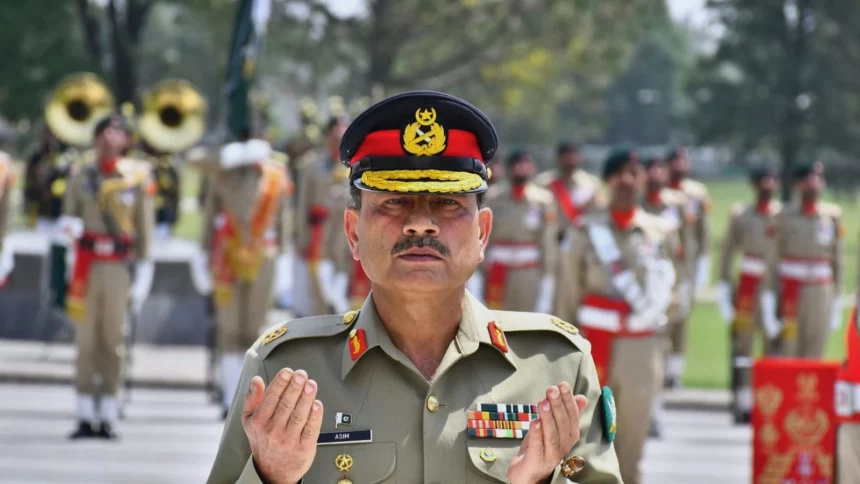
The United States has reiterated that its relationships with both India and Pakistan remain “unchanged” despite Pakistan Army chief General Asim Munir’s recent high-profile visit to Washington. The assurance came from the US State Department following questions about whether Asim Munir’s engagements with American leaders, including President Donald Trump, might influence the strategic balance in South Asia or impact ties with Indian Prime Minister Narendra Modi.
US Emphasises Balanced Approach Toward India and Pakistan
During a regular press briefing, State Department spokesperson Tammy Bruce stressed that Washington’s diplomatic commitment to both New Delhi and Islamabad remains equally strong. Her remarks were in response to queries about the implications of Asim Munir’s meetings in the US, particularly a private luncheon with President Trump in June and subsequent high-level discussions in Washington this week.
“We had an experience with Pakistan and India, when there was a conflict, that could have developed into something quite horrible,” Bruce recalled, referencing past tensions between the two nuclear-armed neighbours. She highlighted the swift diplomatic intervention led by then Vice President JD Vance, President Trump, and Secretary of State Marco Rubio to de-escalate the situation at that time.
When asked if Asim Munir’s meetings could pave the way for increased US military assistance or arms sales to Pakistan, potentially at the expense of Washington’s ties with New Delhi, Bruce dismissed the notion. “The US relationship with both nations remains unchanged – good. The diplomats are committed to both nations,” she said.
This reaffirmation is significant given the long-standing strategic competition between India and Pakistan, as well as the deepening India-US defence partnership in recent years. It signals Washington’s continued attempt to balance its security cooperation and diplomatic engagement in South Asia, even as it confronts shifting geopolitical realities and intensifying US-China rivalry.
Counter-Terrorism Cooperation and Regional Stability
Bruce also used the briefing to underscore the outcomes of the recent US-Pakistan counter-terrorism dialogue held in Islamabad. “The United States and Pakistan reaffirmed their shared commitment to combat terrorism in all its forms and manifestations during the latest rounds of talks in Islamabad,” she said.
The discussions, according to her, focused on ways to enhance intelligence sharing, operational coordination, and counter-terrorist financing measures. Washington and Islamabad also explored avenues to strengthen border security, disrupt terrorist networks, and build capacity within Pakistan’s law enforcement and judicial institutions.
“For the region and for the world, the US working with both those nations is good news and will promote a future that’s beneficial,” Bruce added, framing the US engagement with India and Pakistan not as a zero-sum game but as a dual-track strategy to promote regional stability.
Asim Munir’s latest visit marks his second trip to the US in less than two months. In June, he held a private luncheon with President Trump, a meeting that raised speculation in diplomatic circles about Pakistan’s efforts to recalibrate ties with Washington. This week, he arrived in the American capital on Sunday for a series of meetings with senior US political and military officials, including discussions at the Pentagon and State Department.
While official readouts of Asim Munir’s engagements remain limited, Pakistani media have reported that the agenda included bilateral defence cooperation, regional security dynamics, and Pakistan’s counter-terrorism initiatives. The meetings also come at a time when Pakistan is seeking to revive economic ties with the US and attract foreign investment, amid an ongoing economic crisis and negotiations with international lenders.