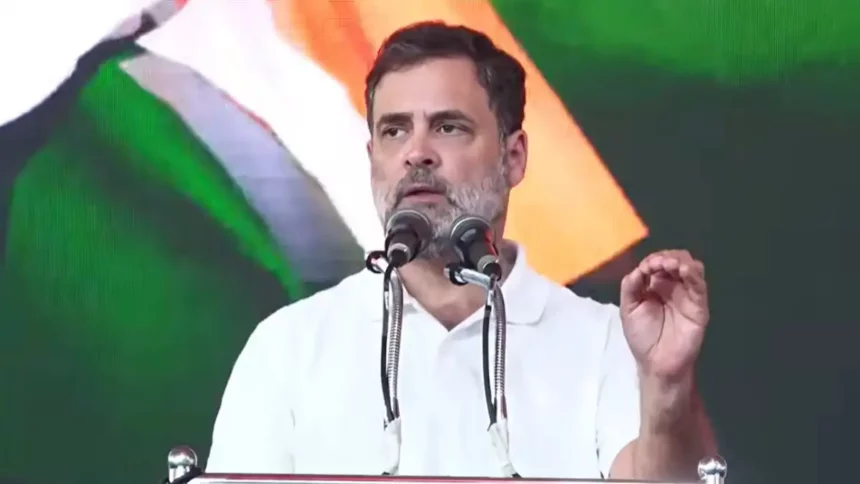
Senior Congress leader Rahul Gandhi delivered a sharp critique of the ruling establishment while addressing a large gathering of newly elected local body representatives in Kochi, asserting that Indian democracy is under sustained attack due to increasing centralisation of power. Speaking at a Mahapanchayat organised by the Congress and its allies, Gandhi accused the Bharatiya Janata Party and the Rashtriya Swayamsevak Sangh of systematically weakening grassroots institutions and undermining the constitutional vision of decentralised governance. His remarks framed the political contest in India as an ideological struggle between participatory democracy and concentrated authority, placing local self-government at the heart of the debate.
Attack on centralisation and defence of grassroots democracy
Addressing elected representatives from municipalities and panchayats across Kerala, Rahul Gandhi stressed that the foundation of Indian democracy lies in the empowerment of people at the local level. He recalled the role of the Congress in shaping India’s decentralised governance framework, particularly through the 73rd and 74th Constitutional Amendments, which institutionalised panchayats and urban local bodies as a third tier of government. According to Gandhi, these amendments were not merely administrative reforms but a deliberate attempt to transfer power closer to citizens, enabling them to participate directly in decision-making processes that affect their daily lives.
Gandhi argued that this constitutional vision is being steadily diluted under the current political dispensation. He accused the BJP-led government of centralising authority in New Delhi, reducing the autonomy of state governments and local bodies alike. In his view, such concentration of power weakens democratic accountability by distancing governance from the people it is meant to serve. He said democracy cannot survive if elected representatives at the grassroots are stripped of authority and reduced to implementers of centrally designed policies without meaningful consultation.
Highlighting social welfare schemes, Gandhi pointed to what he described as deliberate attempts to undermine programmes that operate through local institutions. He cited the Mahatma Gandhi National Rural Employment Guarantee Act as an example, claiming that curbs on funding and implementation weaken not only economic security for rural households but also the democratic role of panchayats that administer the scheme. For Gandhi, defending welfare programmes and defending democracy are inseparable, because both rely on empowering local communities rather than controlling them from the centre.
Gandhi also contrasted what he described as the ideological approaches of the Congress and the BJP-RSS combine. While the Congress, he said, believes in listening to people and allowing diversity of opinion, the opposing ideology seeks uniformity and unquestioned obedience. He argued that democracy thrives on disagreement, debate, and decentralisation, whereas authoritarian tendencies attempt to silence dissent and impose a single narrative. Kerala, with its long tradition of social reform, literacy, and participatory politics, was cited by Gandhi as an example of how pluralism and grassroots empowerment strengthen democratic culture.
Throughout his speech, Gandhi emphasised that democracy is not confined to elections alone but is reflected in everyday governance. When villagers decide development priorities, when municipal councillors shape urban policy, and when local representatives respond directly to citizens, democracy becomes tangible. He warned that eroding these institutions hollows out democracy from within, even if formal electoral processes continue to exist.
Political messaging, Kerala context, and wider national implications
Rahul Gandhi’s remarks in Kochi were also closely linked to the broader political context in Kerala, where local self-government institutions play a central role in governance and development. Addressing representatives who had recently secured victories in local body elections, he sought to reinforce their political legitimacy and underscore their importance in defending democratic values. By choosing Kochi as the मंच for his message, Gandhi highlighted Kerala’s distinct political culture, where decentralisation, social inclusion, and community participation have long been part of public life.
The speech also fit into a wider national narrative that Gandhi has consistently articulated over recent years, warning of what he sees as institutional weakening across democratic pillars. From Parliament and independent institutions to media and civil society, he has argued that concentration of power poses long-term risks to India’s constitutional framework. In Kochi, however, his focus remained firmly on grassroots democracy, framing local bodies as the first line of defence against authoritarian drift.
Politically, the address served multiple purposes. It energised party workers and elected representatives by placing them at the centre of a larger ideological struggle. It also positioned the Congress and its allies as defenders of decentralisation and constitutional values, in contrast to the BJP, which Gandhi accused of hollowing out institutions in the name of efficiency and control. This messaging aligns with the Congress strategy of framing upcoming electoral contests as choices between competing visions of governance rather than mere power struggles.
Gandhi’s comments are likely to draw sharp responses from the BJP, which has consistently rejected accusations of undermining democracy and instead argues that centralised decision-making ensures faster development and uniform implementation of policies. The contrasting narratives reflect a deeper ideological divide over how India should be governed in a complex, diverse society. For Gandhi, diversity requires decentralisation; for his critics, strong central authority is portrayed as necessary for national coherence.
Beyond immediate political reactions, the speech contributes to an ongoing national conversation about the future of Indian democracy. As economic, technological, and social changes reshape governance, questions about where power should reside and how citizens can meaningfully participate remain central. Gandhi’s intervention in Kochi sought to reassert the idea that democracy is strongest when power flows upward from villages and towns, not downward from distant centres of authority.
By foregrounding local representatives and constitutional principles, Rahul Gandhi attempted to anchor abstract debates about democracy in concrete institutional realities. His message was clear: weakening grassroots governance weakens democracy itself. As India’s political discourse continues to polarise, such arguments are likely to remain central to opposition strategy and public debate in the months and years ahead.