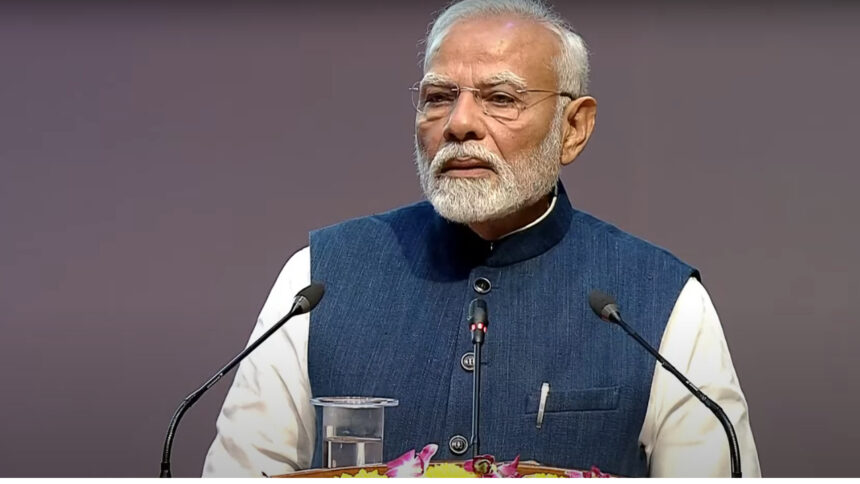
Prime Minister Narendra Modi, in his message on Samvidhan Diwas, hailed India’s Constitution as a sacred and guiding document that has steered the nation’s progress for decades. He underlined the responsibility of every citizen to honour the vision of the framers of the Constitution, ensuring that every action contributes to national development, unity, and social welfare. PM Modi reflected on how the Constitution’s principles have empowered individuals from humble beginnings, like himself, to serve the nation at the highest level of governance, illustrating its transformative role in promoting equality, justice, and opportunity. Marking the 75th year of the Constitution and 2025 as a year commemorating the 150th birth anniversaries of key national leaders, PM Modi emphasized the enduring significance of upholding democratic values, fulfilling civic duties, and advancing collective social and economic progress.
Celebrating Constitution Day and Honouring Founding Visionaries
Samvidhan Diwas, according to PM Modi, is a day of immense pride for every Indian, representing both the historical journey of India’s democracy and the aspirations of its founders. In his message, PM Modi recounted the contributions of the Constituent Assembly members, led by Dr Rajendra Prasad, and the Drafting Committee chaired by Dr Babasaheb Ambedkar, whose foresight and dedication created a document that continues to shape governance and rights in the nation. PM Modi described earlier commemorative efforts, including the 60th anniversary in 2010 and the 75th-year special session of Parliament, highlighting public participation and national engagement in celebrating the Constitution. He noted how programmes like the Samvidhan Gaurav Yatra in Gujarat, which involved placing the Constitution on an elephant during a public procession, symbolized collective respect and gratitude toward the document. The Prime Minister also emphasized the importance of remembering freedom fighters and national leaders, such as Sardar Vallabhbhai Patel, whose political vision unified India, and Bhagwan Birsa Munda, whose dedication continues to inspire tribal empowerment and social justice. These commemorations, Modi stressed, reinforce the moral and civic responsibilities enshrined in the Constitution, emphasizing that citizens must uphold its principles while contributing actively to the nation’s progress.
Constitutional Duties, Citizen Responsibility, and National Development
PM Modi highlighted the Constitution’s role in defining citizen duties, particularly through Article 51A, which outlines the Fundamental Duties that guide social and civic responsibility. He stressed that individual commitment to these duties not only strengthens democracy but also ensures the nation’s sustained social and economic advancement. Reflecting on the teachings of Mahatma Gandhi, PM Modi reminded citizens that rights arise from the diligent performance of duties, emphasizing that a citizen’s active participation in democracy, including voting, embodies respect for the Constitution and commitment to collective welfare. He also drew attention to the contemporary relevance of constitutional provisions, citing the integration of Jammu & Kashmir under Articles 370 and 35(A) as an example of the Constitution’s enduring applicability in securing rights and equality for all citizens, particularly women and marginalized communities. PM Modi urged citizens to cultivate a deep, intrinsic sense of gratitude for the opportunities provided by the Constitution, calling for dedication, capability, and consistent effort in all endeavors to ensure that every action reinforces national goals. He linked this responsibility to India’s future milestones, noting the approaching centenary of freedom from colonial rule and the 100th anniversary of the Constitution’s adoption in 2049, emphasizing that decisions and policies made today will shape the prosperity, democratic stability, and rights of generations to come. Through these reflections, PM Modi positioned the Constitution as both a symbol of India’s democratic achievements and a roadmap for collective citizen action, linking historical reverence with present-day civic engagement and national progress.
The Prime Minister further underscored the importance of inspiring the youth to embrace democratic values, highlighting that fostering a sense of responsibility, pride, and awareness among young citizens ensures the continuity of India’s democratic ethos. By adhering to constitutional duties and participating actively in civic life, including exercising the right to vote, PM Modi argued, citizens contribute to nation-building and safeguard democratic principles. He emphasized that constitutional awareness is intertwined with societal progress, stressing that education, public engagement, and ethical governance are essential for realizing the vision laid out by the Constitution’s framers. PM Modi’s message tied historical milestones, such as the 150th anniversaries of Sardar Vallabhbhai Patel and Bhagwan Birsa Munda, and commemorations like Vande Mataram and the martyrdom anniversary of Sri Guru Teg Bahadur, to ongoing civic responsibilities, illustrating how history, sacrifice, and contemporary citizen action collectively strengthen national unity and progress.
In reflecting on the Constitution’s transformative role, PM Modi highlighted personal examples, explaining how constitutional provisions enabled his journey from a modest background to sustained public service, demonstrating the document’s commitment to equality and empowerment. By invoking narratives of national integration, social justice, and constitutional governance, PM Modi reinforced the critical link between citizen responsibility and state progress. He called upon every Indian to internalize the principles of duty, equality, and social justice, ensuring that the country’s future trajectory aligns with the foundational vision of the Constitution. PM Modi’s address presented the Constitution not only as a historical document but as a living guide for ethical governance, social cohesion, and collective advancement, urging citizens to act in ways that uphold its sanctity and advance national goals.
Through his reflections on Samvidhan Diwas, PM Modi illustrated that constitutional values must translate into daily actions, guiding policies, personal conduct, and civic engagement. He highlighted how observances, commemorations, and educational initiatives around the Constitution foster a sense of shared responsibility, cultivate respect for democratic institutions, and strengthen the moral fabric of the nation. The Prime Minister tied the recognition of past leaders and their contributions to present-day responsibilities, emphasizing that honoring historical sacrifices is inseparable from fulfilling constitutional duties in the modern context. By linking citizen action to constitutional respect, PM Modi positioned each individual as an active participant in India’s democratic journey, responsible for promoting social justice, economic development, and equality for all.
Furthermore, PM Modi reflected on the role of celebrations such as the Samvidhan Divas in fostering national unity, social awareness, and civic consciousness. He pointed out that commemorating figures like Sardar Patel and Bhagwan Birsa Munda, alongside observing significant national milestones, reinforces a collective sense of purpose, responsibility, and pride among citizens. These celebrations, he emphasized, are not mere ceremonial events but instruments for cultivating ethical governance, citizen engagement, and adherence to constitutional principles. By intertwining historical commemoration with contemporary action, PM Modi presented a framework for active citizenship, linking respect for the Constitution with tangible contributions to national welfare, policy implementation, and democratic consolidation.
PM Modi’s message on Samvidhan Diwas underscored the Constitution as the cornerstone of India’s democratic ethos and a guiding framework for individual and collective responsibilities. He called upon citizens to honour the sacrifices of national leaders, uphold constitutional principles, actively participate in democracy, and strive for social and economic progress. By embedding historical reverence, civic duty, and forward-looking governance within the framework of constitutional values, PM Modi articulated a vision of India where the principles of justice, equality, and national unity guide both individual action and national policy, ensuring the fulfillment of the dreams envisioned by the framers of the Constitution and the ongoing progress of the nation.