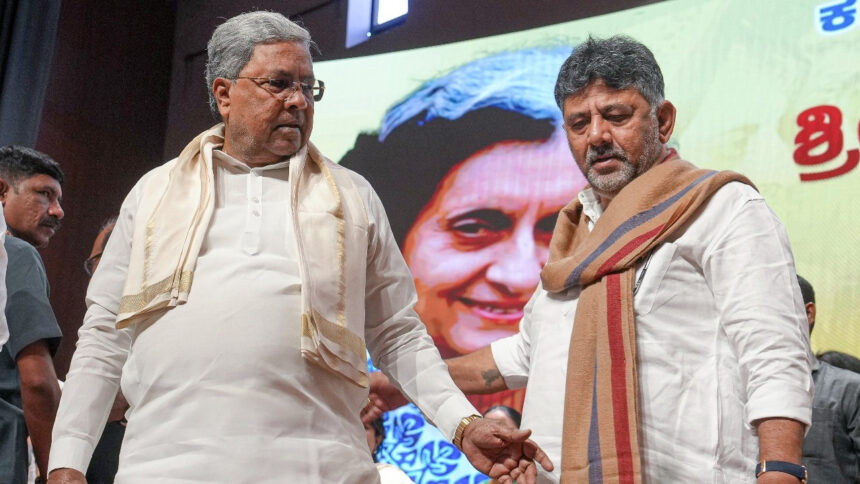
Karnataka’s political landscape has once again been thrust into the spotlight as the internal dynamics of the Congress government face heightened scrutiny and renewed debate over leadership succession. The ongoing tussle between Chief Minister Siddaramaiah and his deputy DK Shivakumar has captured widespread attention, coinciding with BJP’s latest efforts to leverage the situation for political gain. Amid reports of a power-sharing arrangement purportedly agreed upon by the Congress high command, discussions about a rotational chief ministership and the timing of any transfer of authority have dominated both political corridors and media narratives. Against this backdrop, the BJP has deployed a novel strategy using artificial intelligence to lampoon Shivakumar, portraying him in a digitally generated video as attempting to purchase a “chief minister’s chair” online only to be met with an “out-of-stock” notification, signaling the party’s sharp criticism of the Congress leadership’s indecision and internal discord.
The AI clip, released on the BJP’s official social media channels, particularly on X, was accompanied by captions mocking Shivakumar’s ambition and highlighting the ongoing uncertainty surrounding the leadership question in Karnataka. By turning a political debate into a digital spectacle, the BJP has aimed to capitalize on perceptions of instability within the Congress government, especially as the state approaches the midway point of its five-year legislative term. The video exemplifies the party’s innovative approach to political communication, combining contemporary technology with traditional opposition tactics to underscore perceived weaknesses in the rival camp. While the Congress leadership has maintained public composure, emphasizing that decisions on succession rest with the high command, the BJP’s messaging has intensified discussions around the deputy chief minister’s aspirations, the rotational formula allegedly agreed upon, and the broader implications for governance in Karnataka.
Leadership Speculations and Internal Power Dynamics
Since the Congress’s victory in the 2023 Karnataka assembly elections, speculation has persisted regarding a rotational arrangement between Chief Minister Siddaramaiah and his deputy DK Shivakumar. Reports indicate that this informal understanding, allegedly endorsed by the central leadership, envisioned Shivakumar taking over the chief ministerial post after two and a half years, midway through the current term. In recent months, the debate has intensified, with both leaders and their supporters subtly signaling positions while maintaining public restraint. Chief Minister Siddaramaiah has, on multiple occasions, hinted at possible cabinet reshuffles and administrative changes, while simultaneously asserting his commitment to completing the full five-year term, signaling a careful balancing act between addressing party demands and maintaining political stability.
Shivakumar’s camp, on the other hand, has reportedly been actively lobbying for an early resolution to the leadership question, both within Karnataka and in Delhi. Party insiders suggest that this push is motivated by concerns over timing and opportunity, as any delay in leadership transition could diminish the likelihood of Shivakumar ascending to the top post during the current tenure. The reported secret agreement, understood to involve a small group of senior party leaders, has remained largely confidential, leaving room for speculation and fueling narratives around potential intra-party tension. Despite these undercurrents, both leaders have publicly emphasized party unity and adherence to high command directives, underscoring the delicate nature of political maneuvering within the state Congress.
The BJP’s strategic AI video has intensified this narrative by satirizing Shivakumar’s ambitions. In the clip, Shivakumar is portrayed as attempting to place a chief minister’s chair into an online shopping cart, only for the system to indicate that the item is “out of stock.” This digital metaphor has been interpreted as a commentary on Shivakumar’s perceived inability to secure the chief ministership immediately and the complexities surrounding his political ascent. The use of artificial intelligence to craft politically resonant content demonstrates a shift in campaign tactics, combining humor, visual storytelling, and pointed political messaging to influence public perception and amplify existing controversies. The clip also coincides with broader discussions regarding the internal dynamics of the Congress, the role of party high command in leadership decisions, and the ongoing struggle to balance individual ambitions with collective party strategy.
BJP’s Political Messaging and Congress Response
The BJP’s deployment of AI-generated content is emblematic of its larger effort to highlight alleged dysfunction within the Congress party. By targeting Shivakumar directly, the party underscores perceptions of internal discord and leverages the public’s interest in political intrigue. Alongside the AI video, additional social media posts have drawn attention to broader criticisms of Congress governance, with language highlighting corruption and opportunistic practices within the party. BJP leaders argue that the ongoing tussle in Karnataka represents a microcosm of systemic weaknesses in Congress, framing the narrative in a manner that seeks to both entertain and politically influence viewers.
For the Congress, the leadership question is being carefully managed to minimize public fallout while navigating internal expectations. Chief Minister Siddaramaiah has repeatedly emphasized that ultimate authority rests with the party’s central leadership and that legislators’ opinions, while valuable, are secondary to high command decisions. Speaking to reporters, Siddaramaiah noted that legislators have the freedom to express their views and travel to Delhi to communicate with party authorities, but final resolutions on succession are the prerogative of senior leadership. By framing the matter in this way, Siddaramaiah seeks to project stability, reaffirm loyalty to party processes, and mitigate perceptions of division or competition that could be exploited by opposition forces.
Shivakumar, meanwhile, has maintained a low public profile on the matter, stressing the confidential nature of any internal agreement and the importance of acting in accordance with personal conscience. In his statements, Shivakumar avoided direct claims to the chief ministership, instead highlighting the collective responsibility of party members to maintain unity and support party operations. He emphasized that the Congress’s organizational strength relies on the commitment of its members and that any individual ambition must be balanced with broader considerations for party cohesion and effectiveness. This approach underscores the political sophistication of Shivakumar’s strategy, balancing personal aspiration with discretion to avoid alienating colleagues or creating unnecessary public controversy.
The interplay between Siddaramaiah’s measured public positioning and Shivakumar’s discreet approach has created a complex political environment, one that the BJP has sought to exploit through targeted messaging and satirical digital content. Analysts suggest that this strategy is designed not only to weaken Shivakumar’s perceived authority but also to influence public sentiment ahead of future political cycles, shaping narratives around leadership capability, internal cohesion, and governance effectiveness in Karnataka. The AI clip, while humorous in presentation, carries deeper political connotations, serving as a symbolic representation of the power struggle within Congress and a strategic tool for opposition leverage.
As Karnataka approaches the midpoint of the current legislative term, the succession debate is likely to remain a central political issue, with implications for governance, policy implementation, and public perception. The BJP’s interventions, coupled with ongoing speculation in media and party circles, highlight the fragility of political consensus within Congress and the challenges inherent in managing dual leadership ambitions. The high command’s eventual decisions on timing, succession, and cabinet reshuffles will not only determine the trajectory of individual political careers but also influence the broader political stability and party coherence within Karnataka.
The confluence of public speculation, internal lobbying, and digital political messaging reflects the modern complexities of Indian state-level politics, where leadership transitions are mediated through a combination of traditional negotiation, strategic communication, and technologically enabled influence. Observers note that the strategic timing of AI content, social media posts, and legislative lobbying can significantly shape political narratives, framing both aspirants and incumbents in ways that affect voter perception and party credibility. The Karnataka case exemplifies the intricate balancing act between ambition, discretion, and political messaging that defines contemporary state politics in India.
The BJP’s AI clip, while simple in execution, exemplifies a broader trend of using emerging technologies to create politically charged content that resonates with voters. By employing satire, digital animation, and commentary on leadership ambiguity, the party effectively channels public attention towards perceived vulnerabilities in its opponent’s ranks. Meanwhile, Congress leaders continue to emphasize procedural propriety, party unity, and adherence to high command directives, signaling a cautious yet deliberate approach to managing expectations, reducing internal friction, and maintaining governance focus.
This ongoing tussle between Siddaramaiah and Shivakumar, set against the backdrop of BJP’s digital interventions, underscores the strategic importance of timing, perception, and public communication in state politics. The outcomes of these maneuvers have the potential to influence not only the leadership structure within the Congress but also voter confidence, inter-party competition, and policy execution in Karnataka. Analysts suggest that careful management of succession plans, combined with strategic messaging and technological engagement by opposition parties, can shape political landscapes, affect electoral outcomes, and redefine narratives around party competence and leadership readiness.
Ultimately, Karnataka’s political scenario illustrates how internal party arrangements, digital campaigns, and leadership ambitions converge to create a complex web of influence, speculation, and public interest. The high command’s resolution of the rotational chief ministership question, the timing of cabinet reshuffles, and the management of public perception will determine the immediate and long-term implications for governance in the state. The BJP’s use of AI to satirize Shivakumar, along with ongoing internal lobbying within Congress, highlights the multifaceted nature of contemporary political contestation, blending traditional party mechanisms with modern digital strategies.
The political drama unfolding in Karnataka, therefore, is emblematic of broader trends in Indian politics, where leadership ambitions, factional negotiations, and technology-driven communication intersect to influence both intra-party dynamics and public narratives. As Siddaramaiah and Shivakumar navigate their respective roles, the BJP’s interventions continue to shape discourse, frame public perceptions, and maintain pressure on Congress leadership to address the ongoing ambiguity. The state’s voters, party members, and political analysts remain keenly attentive to these developments, aware that the outcomes could have lasting consequences for governance, political stability, and party credibility in Karnataka.
This episode reflects the evolving nature of political competition, where digital satire, internal negotiations, and media narratives form a critical part of the strategy employed by both ruling and opposition parties. The BJP’s AI clip, while humorous, is a potent example of leveraging technology to comment on leadership struggles, amplify public discourse, and potentially influence party decision-making. Meanwhile, Congress leaders continue to balance ambition with discretion, public communication with internal negotiation, and policy priorities with political strategy.
The Karnataka leadership tussle remains a focal point in contemporary political discourse, illustrating how ambition, technology, party dynamics, and strategic communication interact to shape governance outcomes and public perceptions in the state.