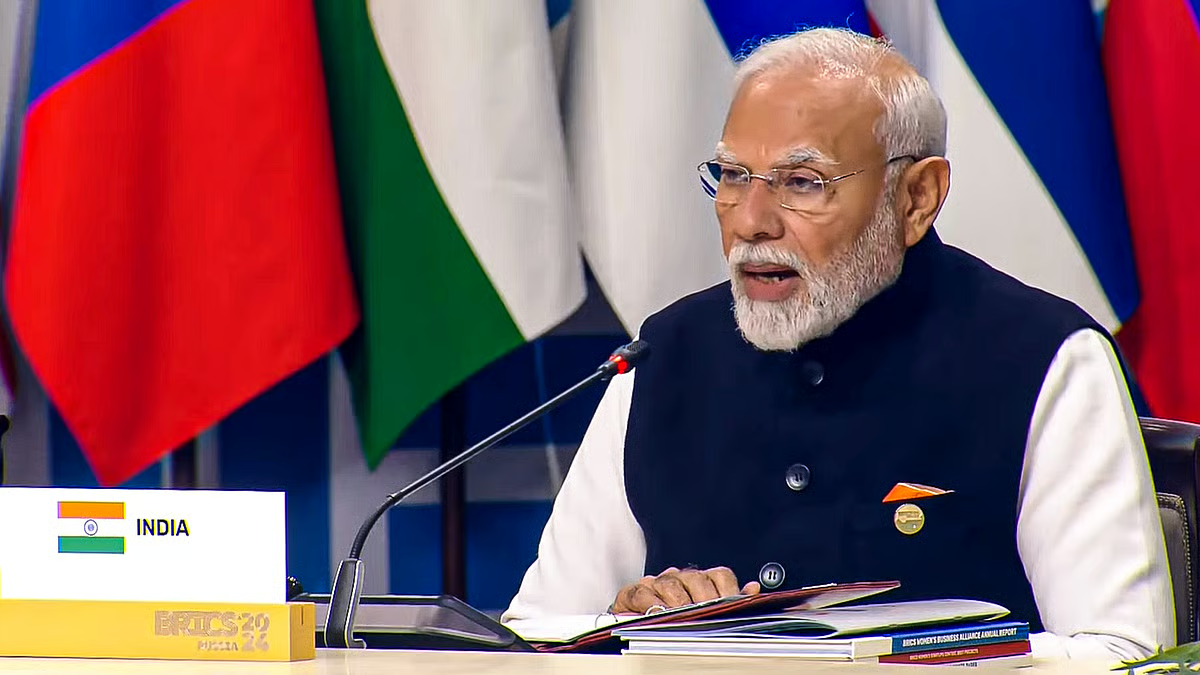
At the 25th Shanghai Cooperation Organisation (SCO) Heads of State Council Summit in Tianjin, Prime Minister Narendra Modi delivered a striking message that underscored India’s uncompromising position against terrorism. Speaking in the presence of Pakistani Prime Minister Shehbaz Sharif, PM Modi declared that terrorism remains not just a regional but a global challenge, and cautioned that “double standards” on the issue cannot be accepted. His remarks, laced with sharp references to India’s experiences with terror, including the recent Pahalgam attack, reflected New Delhi’s determination to rally international consensus on counter-terrorism within multilateral frameworks such as the SCO.
PM Modi’s sharp warning against terrorism and double standards
The Indian Prime Minister’s intervention at the plenary session carried the weight of India’s lived experience in combating terrorism for more than seven decades. The address was both a warning and a call for collective responsibility. He noted that terrorism does not merely destabilise one country but weakens the foundations of peace and security across the globe. PM Modi cited the April 22 terror attack in Pahalgam, Jammu and Kashmir, where 26 civilians lost their lives, describing it as a brutal assault that underscored the urgency of coordinated global action.
The Pahalgam attack, which Indian security agencies traced to groups with links across the border, brought into sharp relief the continuing menace of cross-border terrorism. PM Modi thanked friendly nations that stood with India in the aftermath of the incident, but at the same time underlined that expressions of sympathy alone would not suffice. He urged SCO members to act with clarity, consistency, and without succumbing to selective interpretations of terrorism.
The Prime Minister’s remarks assumed heightened significance as they came in the presence of Pakistan’s leader, Shehbaz Sharif. By making his statement in a forum where Islamabad was represented at the highest level, PM Modi not only highlighted India’s stance but also placed Pakistan under the scrutiny of other member states. India has consistently argued that Pakistan shelters and enables terror outfits that target Indian civilians and security personnel. The directness of PM Modi’s message, delivered in such a setting, reflected New Delhi’s readiness to confront the issue head-on rather than dilute its position in the name of diplomatic courtesy.
PM Modi reminded the SCO that terrorism cannot be compartmentalised into “good” and “bad” categories to suit political convenience. The Prime Minister cautioned that some states still apply differential standards, condemning some attacks while tacitly supporting groups when it suits their geopolitical aims. Such selective approaches, he insisted, weaken the international fight against terrorism. For India, the matter is not merely theoretical but an existential challenge that has claimed countless lives since independence.
He reaffirmed that India’s position against terror-financing remains uncompromising. Terror groups thrive on financial networks, whether through illicit trade, drug trafficking, or state sponsorship. PM Modi asserted that dismantling these networks is essential for any meaningful progress in combating terrorism. He emphasised that India has demonstrated leadership in disrupting such channels, including those linked to Al-Qaeda and its affiliates, and called upon SCO members to show equal determination.
The message was also aimed at underlining the interconnected nature of security, stability, and economic growth. PM Modi told the gathering that peace and security are the bedrock of progress. Without a stable environment, investments, innovation, and people-to-people exchanges cannot flourish. The SCO, with its focus on Eurasian cooperation in political, economic, and security spheres, is an appropriate forum to carry this agenda forward. PM Modi thus urged the organisation to live up to its responsibility and ensure that unity against terrorism remains a core commitment.
India’s response to Pahalgam attack and Operation Sindoor
The April 22 Pahalgam terror attack was one of the deadliest assaults on civilians in recent years. The attack left 26 people dead and shocked the nation with its brutality. Indian intelligence agencies traced its orchestration to groups operating with external support across the border. The attack reinforced India’s long-held view that terrorism in Jammu and Kashmir is sustained not merely by local grievances but by a cross-border infrastructure of training, funding, and ideological indoctrination.
India’s military response to the attack was swift and decisive. On May 7, less than three weeks after Pahalgam, the Indian armed forces launched “Operation Sindoor,” a carefully planned military strike targeting terrorist infrastructure in Pakistan and Pakistan-occupied Kashmir. The operation marked a significant escalation, with India employing drones, precision missiles, and coordinated ground intelligence to neutralise camps and facilities used by terror groups.
Operation Sindoor was not just a tactical retaliation but also a strategic signal. By extending the action across the Line of Control into PoK and Pakistan’s mainland, India demonstrated that its threshold of tolerance had shifted. The operation triggered a four-day military confrontation between India and Pakistan, with both sides engaging in drone and missile exchanges. For the Indian establishment, the action reaffirmed a doctrine of proactive measures rather than passive endurance in the face of repeated provocations.
The conflict eventually subsided after Pakistan’s Director General of Military Operations (DGMO) reached out to his Indian counterpart to seek a pause in hostilities. The outreach suggested the effectiveness of India’s calibrated escalation. Operation Sindoor inflicted significant damage on terrorist networks and sent a message that the Indian state would no longer hesitate to act across the border when civilian lives were targeted.
For PM Modi, therefore, the SCO Summit provided a global platform to contextualise India’s actions. By citing the Pahalgam attack in his speech, he linked India’s domestic counter-terror operations with broader international concerns. The message to SCO members was clear: terrorism is not a localised issue but one with transnational implications, requiring coordinated and uncompromising responses.
At the same time, India’s emphasis on terrorism at the SCO was not detached from broader geopolitical realities. With Russia’s President Vladimir Putin, China’s leadership, and Central Asian heads of state in attendance, PM Modi’s remarks were also a reminder that global security challenges cannot be effectively tackled without confronting the roots of extremism. India, by raising the issue forcefully, sought to galvanise the SCO into a more meaningful security platform rather than a grouping confined to economic or symbolic cooperation.
The Pahalgam attack and Operation Sindoor also highlight the evolving nature of India’s security calculus. In the past, New Delhi had often restricted itself to diplomatic protests and limited military responses. However, recent years have seen a transformation where the political leadership has demonstrated greater willingness to employ military instruments to deter terrorism. This shift reflects both domestic expectations and the larger belief that India, as a rising power, must project strength when its sovereignty and civilians are attacked.
PM Modi’s speech also touched on India’s historical struggle with terrorism. He reminded the audience that the country has endured seven decades of relentless attempts by terror groups to destabilise its social fabric and political stability. These decades have included large-scale insurgencies, urban attacks, targeted killings, and infiltration attempts across the border. By drawing this historical arc, PM Modi sought to emphasise that India’s demands for global solidarity against terrorism are rooted not in momentary grievances but in a long record of suffering and resilience.
The SCO itself has emerged as a significant platform where these concerns can be aired. Established in 2001 by China, Kazakhstan, Kyrgyzstan, Russia, Tajikistan, and Uzbekistan, the SCO expanded in 2017 to include India and Pakistan, while Iran and Belarus joined in 2023 and 2024 respectively. The grouping, originally conceived as a regional security mechanism, has steadily broadened its scope to cover economic cooperation and cultural exchanges. However, security remains central to its charter, and PM Modi’s emphasis on terrorism was a reminder of that foundational mission.
India has often found itself at odds with Pakistan within the SCO framework, with Islamabad seeking to raise the Kashmir issue or block India’s proposals. By delivering his message in the presence of Shehbaz Sharif, PM Modi reaffirmed that India would not shy away from asserting its concerns even in multilateral settings where Pakistan is represented. The approach underscores New Delhi’s strategic confidence and its readiness to engage directly rather than avoid contentious subjects.
For the SCO, PM Modi’s intervention carries implications for its credibility as a security organisation. If the grouping is to be taken seriously on global platforms, it cannot afford to appear divided or ambivalent on terrorism. India’s call for unity is thus not merely a national demand but also a test of the SCO’s effectiveness. The presence of leaders such as Vladimir Putin further highlighted that the summit is not a routine diplomatic gathering but a stage where global security narratives are shaped.