When two global stories unfold almost simultaneously, the connections are too significant to ignore. On one hand, U.S. President Donald Trump has doubled tariffs on Indian exports, raising them to fifty percent. On the other, Prime Minister Narendra Modi has just delivered a carefully crafted speech at the Shanghai Cooperation Organisation’s twenty-fifth summit in Tianjin. The two developments, one economic and the other diplomatic, speak to the same global reality. They highlight India’s difficult position in a world that is fragmenting into competing power centers and its attempt to balance immediate pain with long-term strategy.
The tariff announcement was a shock to exporters across India. The United States has traditionally been one of India’s largest markets for gems and jewelry, textiles, seafood, chemicals, and machinery. By doubling tariffs overnight, Trump made Indian products far more expensive in American shops. In practical terms, this has meant orders cancelled in Surat’s diamond workshops, idle looms in Tirupur’s textile factories, and fishing boats returning to harbors in Kerala and Andhra Pradesh without buyers for their catch. Analysts warn that India’s exports to the United States could decline by more than forty percent in the short term. For small and medium exporters, many of whom operate o
n thin margins, this is not just a matter of profits but of survival. The shock is not confined to numbers on a balance sheet. It translates into households struggling to make ends meet and communities that rely entirely on export industries suddenly thrown into uncertainty.
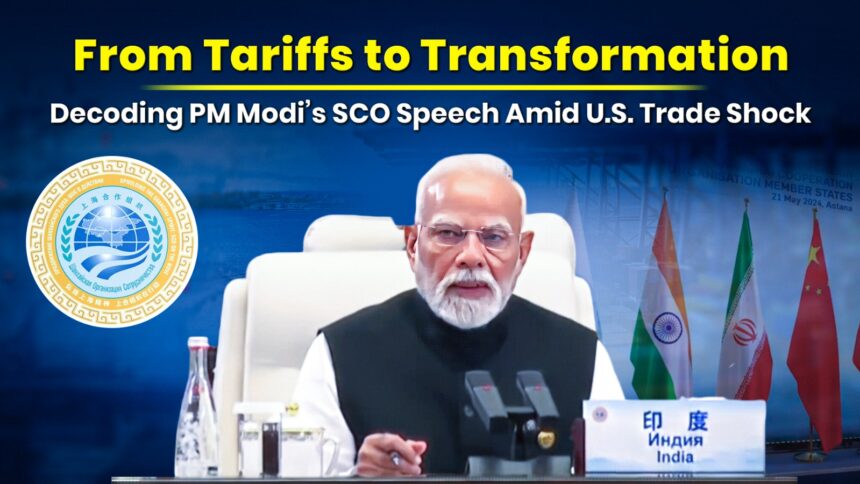
It is in this backdrop that PM Modi’s SCO speech must be understood. The Shanghai Cooperation Organisation is a Eurasian grouping dominated by China and Russia, with Central Asian states as important participants. PM Modi stood on the same stage as Xi Jinping and Vladimir Putin, and his presence itself was a signal. By speaking firmly at this platform just days after Washington raised tariffs, PM Modi was sending a message that India has other partnerships to cultivate. He outlined India’s role in the SCO through what he called three pillars: security, connectivity, and opportunity.
On security, PM Modi emphasized that peace and stability are prerequisites for development. He reminded the audience that India has endured four decades of terrorism and referred to the recent attack in Pahalgam as an example of the continuing human cost. He spoke about India’s leadership in SCO’s Regional Anti-Terrorist Structure and highlighted joint operations against Al Qaeda and related groups. His call was for a unified front with no tolerance for double standards. In other words, countries cannot selectively condemn terrorism in some places while quietly supporting it in others. For PM Modi, this was both a plea for cooperation and a rebuke to those who look the other way when terror is used as an instrument of statecraft.
The second pillar, connectivity, was framed in both practical and principled terms. PM Modi explained India’s ongoing work on the Chabahar Port in Iran and the International North-South Transport Corridor that could link Mumbai to Moscow. He stressed that genuine connectivity is not only about moving goods but about building trust and respect. He drew a clear line by insisting that any corridor must respect sovereignty and territorial integrity. His words carried an implicit critique of China’s Belt and Road Initiative, which runs through disputed territories in Kashmir without India’s consent. PM Modi’s argument was that bypassing sovereignty might create a road on the ground, but it simultaneously breaks bridges of trust.
Opportunity was the third pillar, and here PM Modi shifted focus from governments to people. He spoke of youth empowerment, digital inclusion, startups, and the shared Buddhist heritage of the region. He proposed the creation of a civilizational dialogue forum within the SCO where countries could share their ancient traditions, art, and literature. This was a soft power initiative that tied India’s modern innovation with its deep cultural roots. PM Modi’s suggestion was that the SCO should not remain a closed club of states but should become a living platform where ordinary people, young scientists, entrepreneurs, and artists could engage with each other.
The global reactions to this speech have been varied. In Beijing, the presence of PM Modi on stage was seen as a boost for Xi Jinping, who has sought to project the SCO as an alternative to Western-led forums. For Moscow, it was a much-needed reassurance that despite Western isolation, Russia still has important partners who will stand beside it publicly. In Washington, however, the optics were troubling. The same week that Trump raised tariffs to punish India for continuing to buy Russian oil, PM Modi was visibly sharing space with Putin and Xi. For many in the American establishment, this confirmed their fears that India was moving closer to Moscow and Beijing. In European capitals, the reaction was more nuanced, with policymakers supportive of India’s role as a multipolar actor but uneasy about the symbolism of overt partnership with Russia.
India’s reality is that it now walks a tightrope. The tariffs are painful. Exporters are hurting and jobs are at risk. Yet the SCO stage gave India a louder voice in global diplomacy, showing that it is not isolated and will not be boxed into one corner. In the short term, the country must cope with cancelled orders and disrupted supply chains. In the long term, there is the possibility of diversifying trade routes and markets, deepening ties with the Middle East, Central Asia, and Africa, and strengthening India’s role in the Global South.
The youth of India have a central role in this unfolding story. With the country already home to the third largest startup ecosystem in the world, there is enormous scope for entrepreneurs to use SCO platforms as a launchpad into new markets. Young scientists can collaborate with peers in fields ranging from artificial intelligence to renewable energy. Artists, historians, and students can participate in civilizational dialogues that connect the rich heritage of the Silk Road with India’s own traditions. PM Modi’s message was that this is not only about foreign ministers and diplomats but about the next generation of Indians stepping onto the world stage.
The conclusion is both sobering and hopeful. The tariffs are real and the economic pain is immediate, but PM Modi’s speech offers a longer vision. He framed India’s journey as one of reform, performance, and transformation. It is a journey where crisis is not seen as defeat but as a spur to rethink, diversify, and grow. The task ahead for India is to balance survival in the short term with leadership in the long term. For its youth, the challenge is to seize opportunities in science, startups, and cultural diplomacy.
In this sense, the story of tariffs and the SCO summit is not just about economic policy or diplomatic alignment. It is about how India defines its place in a changing world. From tariffs to transformation, the path will be difficult, but it may also be the very moment that pushes India to step into a new role as both a resilient nation and a shaper of global order.