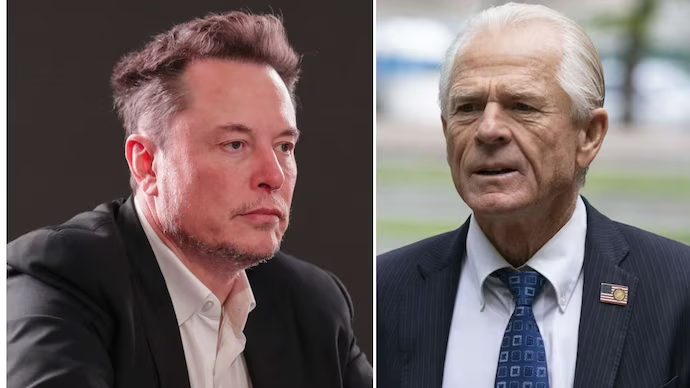
In the latest twist of political drama mixing trade tensions, social media battles, and global oil diplomacy, Donald Trump’s former trade aide Peter Navarro has reignited his war of words against Elon Elon Musk’s platform X after a post he made targeting India was fact-checked through the platform’s community notes system. Peter Navarro, who served as Senior Counselor for Trade and Manufacturing in the Donald Trump administration, has accused X of allowing “foreign interests” to masquerade as neutral observers while interfering in American politics and economics, a charge that has stirred both support and criticism online. His attack has once again brought India’s energy ties with Russia, America’s double standards in trade, and the role of social media platforms in shaping global discourse to the forefront of debate.
Peter Navarro’s Poll, Elon Musk’s Response, and the India Oil Debate
Peter Navarro’s latest salvo came after one of his posts targeting India’s purchase of Russian oil was flagged with a community note that provided additional context. In his original post, Peter Navarro had criticized India for increasing its oil imports from Russia after the Ukraine invasion, accusing New Delhi of profiteering at the expense of Ukrainians and American workers. “That crap note below is just that. Crap. India buys Russia oil solely to profiteer. It didn’t buy any before Russia invaded Ukraine. Indian government spin machine moving high tilt. Stop killing Ukrainians. Stop taking American jobs,” Navarro declared in a sharp message directed not only at India but also at Elon Musk, whom he accused of allowing “propaganda into people’s posts.”
This remark quickly attracted a fact-check from X’s community notes feature, which is designed to provide context and correction in posts flagged by users. The note accompanying Peter Navarro’s post pointed out that the United States and European countries continue to maintain significant levels of trade with Russia despite sanctions, importing billions worth of Russian goods each year, including critical commodities such as fertilizer and uranium that are essential for American agriculture and energy sectors. Another community note went further by underscoring that European nations too engage in substantial trade with Moscow, effectively calling out what many perceive as a double standard in Washington’s criticism of India.
Elon Musk himself responded directly to Peter Navarro’s complaint, writing, “On this platform, the people decide the narrative. You hear all sides of an argument. Community Notes corrects everyone, no exceptions. Notes, data, and code is public source. Grok provides further fact-checking.” With this statement, Elon Musk reinforced his vision of X as a platform where crowd-sourced corrections provide transparency and accountability, rather than leaving fact-checking solely in the hands of corporate or governmental authorities. His response, however, did little to pacify Peter Navarro.
Frustrated by what he sees as a deliberate attempt to undermine his argument, Peter Navarro launched a fresh attack by posting a poll on X. In it, he asked his followers whether the platform should allow posts “where foreign interests masquerade as objective observers and interfere with domestic U.S. economics and politics.” By framing his question in these terms, Peter Navarro sought to portray the community notes correction not as a neutral clarification but as the infiltration of foreign propaganda into America’s digital discourse.
This clash highlights not only Peter Navarro’s longstanding skepticism toward India’s trade practices but also his increasing hostility toward X, which he accuses of amplifying voices that weaken U.S. interests. The broader irony, however, is that the fact-checks against Peter Navarro’s post revealed uncomfortable truths about American trade practices, truths that may be inconvenient for his political narrative but difficult to dismiss.
Peter Navarro’s Longstanding Attacks on India and Tariff Politics
Peter Navarro’s criticism of India did not begin with this episode. As one of Trump’s fiercest trade warriors, he played a central role in shaping the former president’s protectionist policies, often singling out India as a country that exploited American markets. When Donald Trump imposed an additional 25 percent tariff on India for its purchase of Russian oil, Peter Navarro was one of the most vocal defenders of that policy. Since then, he has routinely used harsh language to describe New Delhi’s trade and energy choices.
He has previously referred to India as the “maharaja of tariffs,” a jab at what he perceives as the country’s high protective barriers that disadvantage U.S. exporters. In another remark, he called India a “laundromat for the Kremlin,” accusing it of helping Russia evade Western sanctions by buying discounted crude and refining it for sale in global markets. Such comments have not only strained the perception of U.S.-India economic relations but have also reinforced Peter Navarro’s image as a staunch critic of globalization who sees every trade imbalance as a threat to American workers.
In the current episode, Peter Navarro’s anger seems directed not only at India but at the very mechanism of accountability within X. By describing community notes as foreign propaganda, he is challenging the legitimacy of fact-checking itself. This stance is consistent with his broader political posture, which often dismisses external scrutiny as biased or manipulated. Yet, critics argue that his refusal to acknowledge America’s own trade with Russia undermines the moral clarity of his attack on India.
The context of India’s energy policy is more complex than Peter Navarro’s rhetoric allows. Following the Ukraine invasion, Western sanctions limited Russia’s access to traditional markets in Europe, prompting Moscow to sell crude at discounted rates to countries willing to buy. India, heavily dependent on imports to meet its energy needs, seized the opportunity to secure cheaper supplies. The move has been criticized by the U.S. and European leaders, but it has also been defended by Indian officials as a pragmatic decision aimed at protecting domestic consumers from high global prices.
Meanwhile, the United States itself has continued to import billions worth of Russian goods, even as it calls on others to reduce their ties. Fertilizers and uranium remain key imports because they are vital for America’s agricultural and nuclear sectors. This reality, highlighted in the community notes correcting Peter Navarro, underscores the difficulty of maintaining a consistent stance on sanctions when economic dependencies persist. For Peter Navarro, however, this complexity is often reduced to simple accusations of profiteering and betrayal.
The broader backdrop to this dispute is the shifting nature of global alliances and economic power. India, now one of the fastest-growing economies in the world, has become a central player in global energy markets. Its balancing act between buying Russian oil, engaging with the U.S. on strategic defense ties, and maintaining relations with Europe has given it leverage in international negotiations. For American policymakers like Peter Navarro, who see trade primarily through the lens of competition and tariffs, this balancing act looks like opportunism at America’s expense.
At the same time, the role of social media in amplifying or correcting these narratives cannot be ignored. Elon Musk’s emphasis on transparency and public participation in fact-checking is part of his larger vision for X, but it has placed him in conflict with political figures who prefer to control their messaging without interference. Peter Navarro’s fury over being corrected reflects the growing tension between political elites and digital platforms that no longer allow their claims to go unchallenged.
This confrontation over India’s oil imports and the role of community notes is thus more than a spat between Peter Navarro and Elon Musk. It is a window into how trade disputes, geopolitical alignments, and digital accountability intersect in today’s interconnected world. Peter Navarro’s accusations of “foreign interests masquerading” on X may resonate with some of his supporters, but the broader conversation reveals deeper contradictions in U.S. policy, where lofty rhetoric about sanctions often collides with the practical realities of economic interdependence.