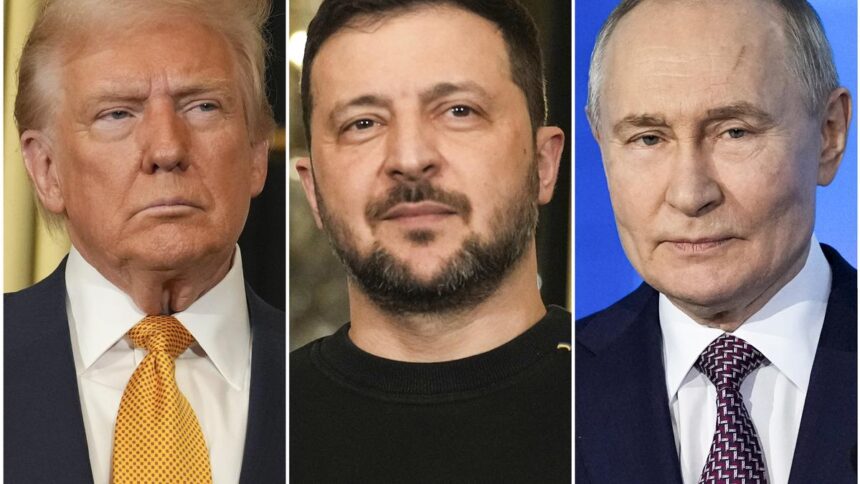
Ukrainian President Volodymyr Zelensky has openly backed the idea of the United States imposing tariffs on India for continuing energy deals with Russia, even as Prime Minister Narendra Modi intensifies New Delhi’s diplomatic outreach to help broker peace in the Ukraine war. The statement, made in an interview with ABC News, comes at a time when Washington is preparing to expand sanctions against Moscow and its allies, with India’s purchase of Russian oil emerging as a flashpoint in the geopolitical tussle.
Volodymyr Zelensky’s Backing for Tariffs and Donald Trump’s Escalating Sanctions Strategy
Volodymyr Zelensky was asked whether he believes Western sanctions against Russia have failed to achieve their intended effect, especially in light of the growing ties between Moscow and New Delhi, most recently on display at the Shanghai Cooperation Organisation (SCO) Summit. His response was emphatic. “I think the idea to put tariffs on the country continuing to make deals with Russia is the right idea,” he said, signaling his support for the controversial U.S. approach of using economic coercion to deter nations from maintaining close trade relations with Moscow.
The backdrop to Volodymyr Zelensky’s statement is a renewed push from Washington under the Donald Trump administration to tighten sanctions against Russia following the latest wave of military strikes on Ukrainian cities. President Donald Trump, fresh from a summit with Russian President Vladimir Putin in Alaska that yielded no major diplomatic breakthrough, declared that he is prepared to expand punitive measures against Moscow. Donald Trump’s team has framed these steps as necessary to maintain pressure on Russia while deterring third countries from undercutting the sanctions regime.
Kevin Hassett, the director of the National Economic Council, went further in drawing attention to India’s role. Speaking after the most recent Russian missile strikes, Hassett argued that Washington is determined to ensure sanctions are not only imposed but also enforced rigorously. “At the National Economic Council, we are responsible for making sure that sanctions get enforced and that people who are helping Russia with their war against Ukraine—for example, what India has been doing by buying Russian oil—that we’re ready to respond to them economically,” he said. His remarks hinted at the possibility of new economic measures aimed squarely at New Delhi, even as India attempts to portray itself as a neutral player advocating dialogue and peace.
Volodymyr Zelensky’s endorsement of tariffs reflects the Ukrainian government’s growing impatience with countries that continue to engage economically with Russia, despite the ongoing war. For Kyiv, every barrel of Russian oil sold abroad represents vital revenue that enables Moscow to sustain its military campaign. Tariffs or sanctions on third-party countries, from Volodymyr Zelensky’s perspective, are not merely punitive but essential to choking off Russia’s financial lifelines.
Yet this approach poses a delicate challenge for India, which has long defended its energy partnership with Russia as a matter of national interest and energy security. Since the Ukraine conflict erupted in February 2022, India has significantly increased its imports of discounted Russian crude, cushioning its economy from global oil price shocks. While the U.S. and European nations have pressed New Delhi to scale back, Indian officials have repeatedly emphasized that the country requires affordable energy to meet the needs of its 1.4 billion citizens and sustain economic growth.
India’s Balancing Act: Energy Interests and Peace Diplomacy
India’s predicament is complicated by its dual role as both an energy consumer with deep ties to Russia and as an emerging diplomatic player seeking to contribute to the resolution of the Ukraine conflict. Prime Minister Modi has sought to strike a careful balance, maintaining robust economic relations with Moscow while simultaneously expanding outreach to Kyiv and the West.
In recent weeks, this balancing act has become more pronounced. Modi held two separate conversations with Volodymyr Zelensky last month, during which he reiterated India’s long-standing position that the conflict must be resolved through dialogue and diplomacy. “I conveyed India’s consistent position on the need for an early and peaceful resolution of the conflict. India remains committed to making every possible contribution in this regard, as well as to further strengthening bilateral ties with Ukraine,” Modi said in a statement shared on X after one of the calls.
India has also expanded consultations with European leaders, underlining its desire to be viewed as part of the solution rather than the problem. Modi spoke with European Commission President Ursula von der Leyen, European Council chief Antonio Costa, and French President Emmanuel Macron about ways to end hostilities and create conditions for peace. These conversations were framed by New Delhi as evidence of its constructive role on the global stage, even as critics argue that India’s energy trade with Russia undermines such efforts.
External Affairs Minister S. Jaishankar reinforced this message during his recent talks with Ukrainian counterpart Andrii Sybiha. “India supports an early end to this conflict and the establishment of an enduring peace,” Jaishankar said, highlighting India’s readiness to engage at multiple levels to encourage de-escalation. However, behind the diplomatic rhetoric lies a hard reality: India’s purchase of Russian oil continues at a scale that draws scrutiny from Kyiv and Washington alike.
At the SCO Summit in China, Modi was seen alongside Russian President Vladimir Putin and Chinese President Xi Jinping, a visual that underscored India’s complex strategic positioning. While the optics of such encounters raise questions in Western capitals, New Delhi insists that participation in multilateral forums does not amount to endorsement of Moscow’s war. Instead, Indian officials frame their engagement as pragmatic diplomacy aimed at keeping open channels with all major powers, even those on opposing sides of the Ukraine conflict.
For Volodymyr Zelensky, however, these nuances matter less than the bottom line: Russia continues to fund its war machine through global energy sales, and countries that facilitate those sales, whether intentionally or not, bear some responsibility. His support for tariffs on India thus represents a blunt but calculated message that Kyiv expects more solidarity from nations claiming to support peace.
The Donald Trump administration, meanwhile, appears ready to test the limits of this message. Sanctions have long been a preferred tool of U.S. foreign policy, but targeting India—an increasingly important partner in Washington’s Indo-Pacific strategy—would carry significant diplomatic risks. The U.S. has invested heavily in strengthening ties with New Delhi as a counterbalance to China, and a tariff war could jeopardize cooperation on security, technology, and trade. Still, Hassett’s remarks suggest that the White House may believe the costs are worth bearing if they contribute to weakening Russia’s capacity to wage war.
India finds itself at the heart of this geopolitical storm, pulled in one direction by its reliance on Russian energy and historical ties with Moscow, and in another by its growing partnership with the United States and Europe. Modi’s recent outreach to Volodymyr Zelensky and European leaders reflects a recognition of this tension and a desire to mitigate the risks of being seen as too closely aligned with Russia. Yet, as long as India continues to import large volumes of Russian crude, the prospect of U.S. tariffs or other punitive measures remains on the table.
Volodymyr Zelensky’s remarks have brought this dilemma into sharper focus. By publicly endorsing the idea of targeting India economically, he has placed New Delhi in an uncomfortable spotlight. For the Ukrainian president, the calculation is straightforward: every additional measure that constrains Russia’s economic options increases the chances of reducing the intensity of the war. For India, however, the calculus is more complex, involving a delicate balance between domestic needs, strategic autonomy, and its aspirations for global influence.