The sixth day of the ongoing Budget Session of Parliament witnessed significant political drama and disruptions, particularly in the Lok Sabha where heated exchanges between the ruling Bharatiya Janata Party and the opposition Congress led to repeated adjournments. The session, which was expected to see detailed discussions on the Motion of Thanks to the President’s address, instead turned into a battleground of political accusations and protests. Amid loud sloganeering by opposition members, the Lower House struggled to conduct normal proceedings and eventually saw limited legislative work during the day. At the same time, the Rajya Sabha witnessed a notable moment when actor and politician Kamal Haasan delivered his maiden speech in the Upper House, drawing attention to issues of governance, democratic values and national progress. The day’s proceedings highlighted the ongoing political tensions between the ruling government and the opposition parties during the Budget Session.
Lok Sabha proceedings disrupted by opposition protests
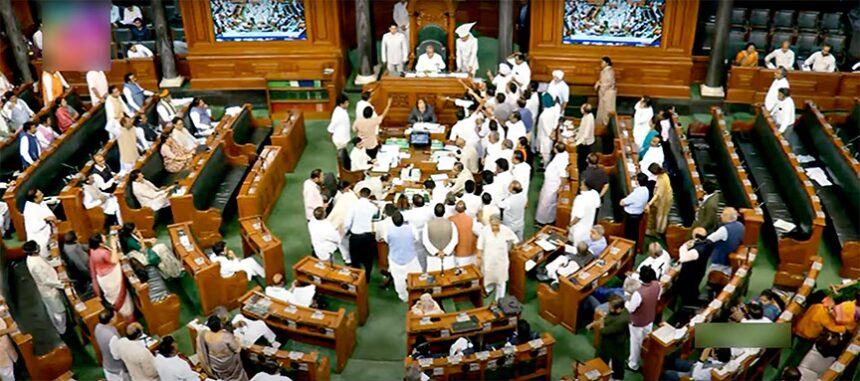
The Lok Sabha faced continuous disruptions as opposition members raised slogans and protested against various issues, forcing the Speaker to repeatedly intervene. Speaker Om Birla urged the protesting members to reflect on their actions and maintain decorum in the House. The protests came a day after eight Members of Parliament were suspended for throwing pieces of paper towards the Chair during earlier proceedings. The suspension had already escalated tensions between the ruling party and the opposition. On Wednesday, the situation remained tense as opposition MPs continued their demonstrations, accusing the government of suppressing debate on important national issues. The uproar prevented meaningful discussion on several legislative matters scheduled for the day. As a result, the House had to be adjourned multiple times due to the persistent disruptions. The incident reflects the growing political confrontation between the ruling coalition and opposition parties during the Budget Session, which is traditionally one of the most important parliamentary sittings of the year.
Debate over Motion of Thanks to President’s address
One of the major items on the parliamentary agenda was the Motion of Thanks to the President’s address, which traditionally provides an opportunity for members of Parliament to debate the government’s policies and priorities. However, the ongoing protests prevented detailed discussions on the motion in the Lok Sabha. Union Commerce Minister Piyush Goyal attempted to address the House regarding developments in the India–United States trade negotiations. Speaking amid continuous sloganeering from opposition benches, he stated that India had successfully protected the interests of its agriculture and dairy sectors during the discussions with the United States. He added that further meetings between the two countries would be held to finalise the draft agreement. Despite his attempt to brief the House, the persistent protests limited the scope of debate. Later in the day, Goyal also addressed the Rajya Sabha on the same subject, where the discussion continued with relatively less disruption. In the Upper House, Leader of the House J.P. Nadda described the President’s address as a reflection of India’s tradition combined with modern development.
Opposition leaders raise concerns in Rajya Sabha
The debate on the Motion of Thanks in the Rajya Sabha continued with contributions from leaders of both the ruling alliance and the opposition. Leader of the Opposition Mallikarjun Kharge delivered a detailed speech highlighting several issues that he believed were not addressed in the President’s address. He criticised the government on matters related to economic challenges, social policies and governance. Kharge also emphasised the need for broader discussions on national issues during the parliamentary session. His remarks were part of a broader strategy by opposition parties to highlight what they see as shortcomings in the government’s policies. The Rajya Sabha debate provided a platform for opposition leaders to articulate their concerns and demand greater accountability from the government. At the same time, members of the ruling coalition defended the government’s performance and highlighted achievements in infrastructure, economic reforms and international diplomacy.
Rahul Gandhi protests Speaker’s decision in Lok Sabha
Congress leader and Leader of the Opposition in the Lok Sabha Rahul Gandhi also became a focal point of the day’s developments after he wrote a letter to Speaker Om Birla expressing strong protest over not being allowed to speak in the House. Gandhi argued that the decision to prevent him from raising certain issues amounted to a serious concern for parliamentary democracy. In his letter, he referred to an earlier incident when he attempted to speak on matters related to national security and the India-China conflict of 2020 during the debate on the Motion of Thanks. According to Gandhi, the Speaker had asked him to authenticate a magazine article he intended to cite during his speech. Gandhi described the situation as a “blot on democracy,” claiming that opposition voices were being restricted in Parliament. The issue triggered sharp reactions from both the ruling party and opposition members, further intensifying political tensions inside the House.
Kamal Haasan delivers maiden speech in Rajya Sabha
While the Lok Sabha remained disrupted, the Rajya Sabha witnessed a significant moment as actor-turned-politician Kamal Haasan delivered his maiden speech after entering the Upper House. Haasan’s speech drew attention as he spoke about democratic values, governance and the importance of constructive debate in Parliament. He emphasised the need for political cooperation in addressing national challenges and urged members across party lines to work together for the country’s development. Haasan’s entry into parliamentary debates reflects the increasing participation of leaders from diverse professional backgrounds in Indian politics. His speech was widely noted by members of both the ruling coalition and opposition parties. The Budget Session of Parliament is expected to continue with further debates on economic policies, legislative proposals and national issues in the coming days. However, the events of Day 6 demonstrated that political confrontations and disruptions remain a major challenge in ensuring smooth parliamentary functioning.