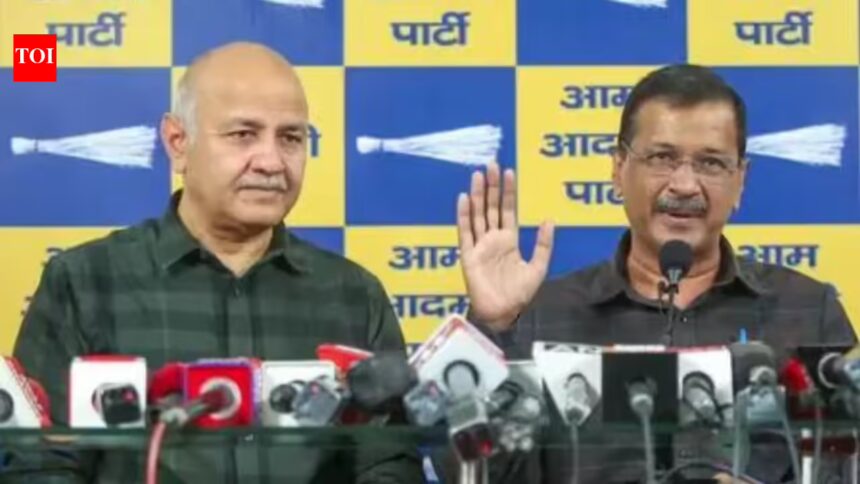
Aam Aadmi Party convener Arvind Kejriwal and senior party leader Manish Sisodia have approached the Supreme Court after the Delhi High Court rejected their request to transfer the hearing of the CBI’s petition in the Delhi excise policy case. The move comes just before the High Court is scheduled to hear the Central Bureau of Investigation’s challenge against the trial court order that discharged Kejriwal, Sisodia and several other accused in the case earlier this year. The development has drawn significant political attention as the excise policy case has been one of the most controversial investigations involving the Delhi government in recent years. According to party sources, the AAP leaders have decided to challenge the High Court’s administrative decision in the Supreme Court to ensure what they describe as a fair and impartial judicial hearing. The outcome of the Supreme Court proceedings could determine the next phase of the high-profile case that has dominated political debate in the national capital.
Delhi High Court refuses request to transfer case
The controversy began after Kejriwal, Sisodia and other accused submitted a representation to the Chief Justice of the Delhi High Court requesting that the CBI’s petition be transferred from the bench of Justice Swarana Kanta Sharma to another judge. The accused argued that the matter should be heard by a different bench to ensure neutrality in the proceedings. However, Delhi High Court Chief Justice D K Upadhyaya rejected the request on the administrative side. According to sources, the Chief Justice observed that Justice Swarana Kanta Sharma was hearing the matter strictly according to the roster allocation of the court. Since the case had been assigned to the judge through the established roster system, the Chief Justice concluded that there was no valid reason to transfer the matter. The decision effectively cleared the way for the hearing of the CBI’s petition before the same bench. Following this rejection, Kejriwal and Sisodia decided to approach the Supreme Court challenging the High Court’s refusal to transfer the case.
Why AAP leaders sought transfer of the hearing
In their earlier representation to the High Court, Kejriwal and other accused had raised concerns about the impartiality of the proceedings. They stated that they had a “grave, bona fide and reasonable apprehension” that the matter might not be heard with complete neutrality. Their concerns were reportedly triggered by observations made by the High Court during an earlier hearing of the CBI’s plea. During the proceedings, Justice Swarana Kanta Sharma had issued notice to all accused while observing that certain findings of the trial court appeared to be prima facie erroneous and required examination. According to the representation submitted by the accused, these observations were made at a preliminary stage without hearing the discharged individuals. The petition also pointed out that the High Court had stayed certain directions issued by the trial court against the investigating officer, including recommendations for departmental action. The accused argued that such relief granted at the initial stage strengthened their apprehension that the revision plea might not be heard with the required judicial detachment.
Background of the Delhi excise policy controversy
The Delhi excise policy case has been one of the most widely discussed legal and political controversies in recent years. The investigation relates to alleged irregularities in the implementation of the Delhi government’s excise policy. Central agencies including the Central Bureau of Investigation and the Enforcement Directorate have investigated allegations of corruption and procedural violations. In June 2024, Arvind Kejriwal was arrested in connection with the case and was later chargesheeted by the investigating agencies in July 2024. Manish Sisodia was also named among the accused. However, in February 2026, a special CBI court delivered a detailed order discharging Kejriwal, Sisodia, AAP Rajya Sabha MP Sanjay Singh and all other accused in the matter. The court concluded that the evidence presented was insufficient to frame charges. The order was widely seen as a major legal relief for the AAP leadership.
CBI challenges trial court discharge order
Following the discharge order, the Central Bureau of Investigation filed a petition in the Delhi High Court seeking to overturn the trial court’s decision. The agency argued that the trial court’s findings required reconsideration and that the evidence in the case needed to be examined more closely. The High Court subsequently issued notices to all 23 accused in the case. The CBI’s plea is scheduled to be heard before Justice Swarana Kanta Sharma. With Kejriwal and Sisodia now moving the Supreme Court against the High Court’s refusal to transfer the case, the legal battle surrounding the Delhi excise policy investigation has entered another significant phase. The Supreme Court’s response to the petition could influence the direction of the ongoing proceedings and determine how the case progresses in the coming months.