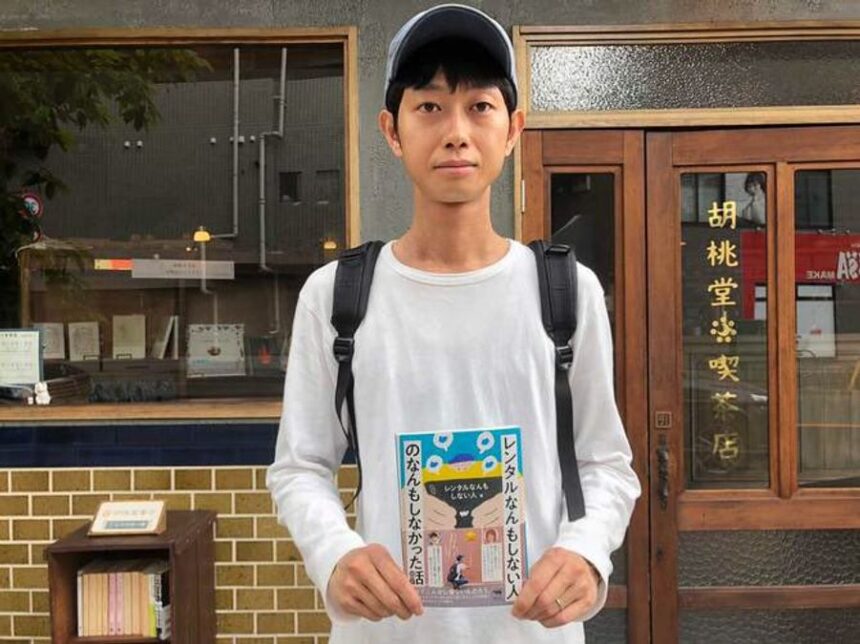
Shoji Morimoto, a 41-year-old Japanese man, has turned the art of “doing nothing” into a lucrative career, earning around $80,000 annually. His unique job began in 2018 after he was fired from his office job. His superior had criticized him for lacking initiative and for “not doing anything” of value. However, this critique unintentionally led Shoji Morimoto to his current career path. Known in Japan as the “rental do-nothing guy,” Shoji Morimoto now rents his time to individuals who simply need someone to accompany them or perform mundane tasks, often without any actual involvement.
Shoji Morimoto’s work is as diverse as it is unusual. His clients hire him for activities ranging from standing in line during extreme weather conditions, attending parties with strangers, or simply waiting for someone at the finish line of a marathon. In one notable case, Shoji Morimoto was hired to attend a concert in place of someone else who couldn’t make it. His role is straightforward: show up and do nothing — though there are clear boundaries, such as refraining from anything of a sexual nature.
Shoji Morimoto himself describes some of his more extreme tasks, including enduring hours of waiting under a hot sun or freezing temperatures, or standing alone on a stage in front of large crowds without performing any action. Despite these situations, he finds meaning in his work, viewing every experience as special and unique to the role he occupies. “No matter the misfortune, I feel it’s something special because of this job,” Shoji Morimoto told CNBC, reflecting on his unusual profession.
His longest job involved a 17-hour ride on the Yamanote Line, Japan’s famous circular railway, during which Shoji Morimoto made 13 loops from morning until the last train. Though some clients hire him simply for companionship during difficult times, he keeps his interactions minimal. He listens attentively but avoids playing the role of a therapist. Shoji Morimoto prides himself on offering only the simplest of responses and avoids engaging in deep conversations unless necessary.
Shoji Morimoto’s work model is simple: he receives about 1,000 requests per year, and the price for his services is determined by his clients. In the past, he charged a flat rate of between 10,000 yen and 30,000 yen ($65 to $195) for a two- to three-hour session. However, Shoji Morimoto recently introduced a “pay-as-you-wish” model, where clients decide what they want to pay for his time. He estimates that he earned around $80,000 last year through his unique line of work, though he emphasizes that his goal is not financial gain but rather to “simply live life and enjoy it.”
In an effort to experience his service firsthand, CNBC accompanied Shoji Morimoto on a visit to a piglet cafe in Tokyo, where customers interact with litters of piglets while sipping on drinks. The experience highlighted Shoji Morimoto’s value to his clients: he provides a social buffer for individuals who prefer to engage in activities without the pressure of maintaining a conversation. In this case, he offered the reassurance of company while his client interacted with the pigs, without feeling the need to converse.
Shoji Morimoto’s service taps into a broader trend in Japan, where rental services for temporary friends, boyfriends, or even family members are growing in popularity. As Japan faces an increasing number of socially isolated individuals, these services offer companionship without the complexities of traditional relationships. “This is a good match with the recent needs of Japanese people who don’t seek love or marriage but want someone to casually go on dates with or have dinner with,” said Ai Sakata, a consultant at the Nomura Research Institute.
While loneliness is one motivation for seeking out such services, experts and Shoji Morimoto himself suggest that social awkwardness plays a major role. Many people in Japan struggle with direct communication or confrontation, making it difficult to form traditional friendships. For these individuals, hiring someone like Shoji Morimoto is a way to avoid awkwardness and enjoy the presence of a companion without the pressure of forming a deeper connection. Shoji Morimoto himself recalls one instance in which a woman hired him to sit quietly in a cafe while she served divorce papers to her husband. His presence provided her with the emotional support she needed to face the difficult situation.
For Shoji Morimoto, his job is not just about earning money; it’s about finding joy in every moment. “There are many different favorite moments in this job, such as when I receive an offer message, when I meet a client, or when I accompany someone to an unknown place,” he said. “I feel happy in every moment.”
While Shoji Morimoto’s profession might seem strange to some, it’s a testament to the evolving nature of work and human interaction in a modern, fast-paced society. His ability to earn a comfortable living by simply being present offers a glimpse into the growing market for unique and unconventional services that meet the social needs of individuals in an increasingly disconnected world.