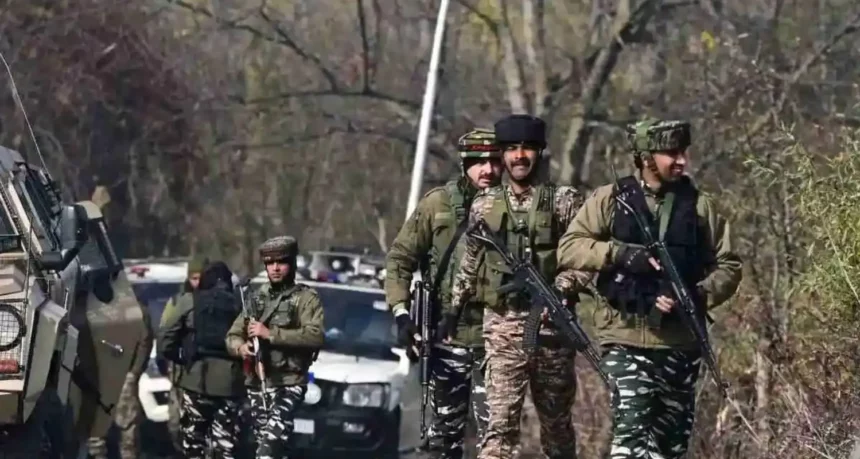
In a fierce gunbattle unfolding in the treacherous terrains of Jammu and Kashmir’s Dara region, three Pakistani terrorists linked to Lashkar-e-Taiba (LeT) were gunned down on Monday during a major anti-terror operation named “Operation Mahadev”. The intense firefight, led by the Indian Army’s Chinar Corps in collaboration with CRPF and J&K Police, marks a significant development amid heightened tensions following the deadly Pahalgam attack in April. While authorities have not confirmed any direct links between the neutralised militants and the Pahalgam incident, search efforts in the Dachigam-Harwan area had intensified over the past month due to intelligence inputs suggesting terrorist movement in the region.
High Alert in Rugged Terrain
The operation began early Monday morning in the Lidwas area near Dara, a remote and forested zone known for its rugged terrain and popular trekking trails. Security forces, acting on credible intelligence inputs about the presence of militants, launched a massive search operation. By 11 AM, contact had been established with the terrorists, sparking an intense exchange of fire. The Indian Army confirmed the neutralisation of three terrorists, all of whom were identified as Pakistani nationals affiliated with LeT.
The firefight occurred near the Harwan area close to Dachigam National Park, a sensitive zone lying just 20 km from Srinagar city. The army, in its official communication, mentioned, “Contact established in General Area Lidwas. Operation in progress,” highlighting that the action was still ongoing with reinforcements arriving on the ground. Drones were deployed for aerial surveillance to assist in the combing operations amid the challenging forest topography.
Security agencies had earlier intensified their presence in the region following a series of intelligence reports indicating that militants responsible for the April 22 Pahalgam attack—which claimed 26 lives—might have shifted their base toward the Dachigam-Harwan axis. Although the identity of the slain terrorists was confirmed by Srinagar SSP GV Sundeep Chakravarty, he clarified that investigators were still verifying their possible role in the Pahalgam assault.
Coordinated Security Action Amid Ongoing Threats
Operation Mahadev is the latest in a series of coordinated anti-terror efforts being carried out across Jammu and Kashmir as part of a broader strategy to root out cross-border militancy. Defence officials stated that the current offensive was part of a sustained operation that began over the past few weeks in response to increased terrorist activity in southern and central Kashmir.
Teams from the Army, CRPF, and Jammu and Kashmir Police were deployed jointly in the Mulnar and Lidwas areas, creating a robust security cordon to trap any fleeing militants. With the terrain offering natural cover to insurgents, the forces relied heavily on aerial reconnaissance and tactical movement. The encounter, which lasted several hours, underscored the operational challenges faced by security personnel in forested battle zones.
As reinforcements were rushed in to secure the perimeter and track down any remaining militants, the army maintained a high-alert status in adjoining regions. The fact that all three terrorists were of Pakistani origin further points to the continued threat of cross-border infiltration, despite diplomatic engagements and ceasefire agreements along the Line of Control (LoC).
Even as the search operation continues, the successful neutralisation of these three LeT operatives is being viewed as a tactical win by the security establishment. However, officials remain cautious, with one senior officer noting that while the immediate threat may have been neutralised, the broader challenge of infiltration and sleeper cells remains.
The high-profile nature of Operation Mahadev, coupled with its symbolic code name and the rugged location, has brought renewed national attention to the counterterror efforts in Kashmir. With each such encounter, the region’s fragile peace is tested, while security agencies continue to walk a tightrope between maintaining public safety and minimizing civilian disruptions.
Though no casualties were reported on the side of the security forces, the Indian Army has reiterated its commitment to eliminating threats in the region through continued surveillance, intelligence gathering, and surgical strikes. The operation also reinforces the importance of inter-agency coordination, especially in high-risk zones like Dachigam and Harwan.
The developments in the Dara forest are likely to lead to further scrutiny of infiltration routes and renewed efforts to dismantle the operational networks of Pakistan-based terror outfits operating in Jammu and Kashmir. With Operation Mahadev still underway, the coming days may bring more updates as the army sweeps the area for remaining threats.