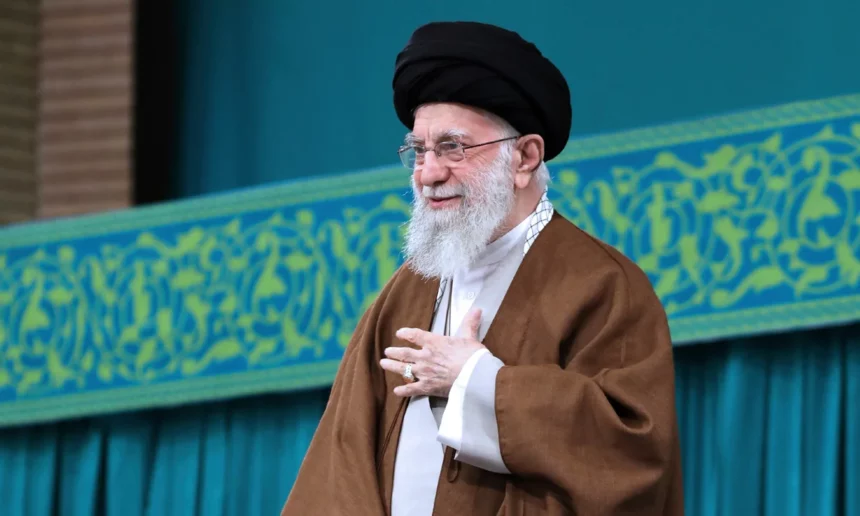
In a stark warning that signals intensifying hostility between Israel and Iran, Israeli Defense Minister Israel Katz has directly threatened Iranian Supreme Leader Ayatollah Ali Khamenei, stating that if Tehran continues to provoke Israel, the country would not hesitate to strike back—including targeting Khamenei personally. The bold statement was made during Katz’s recent visit to the Israeli Air Force’s Ramon Air Base, highlighting a moment of both military pride and grave international warning.
The statement comes on the heels of a fragile ceasefire agreement that ended a 12-day conflict between Iran and Israel last month. Katz’s remarks are being seen as Israel’s uncompromising posture against renewed threats, particularly after Khamenei’s recent inflammatory comments aimed at Israel and its alliance with the United States.
Katz Delivers Personal Warning to Khamenei
Defense Minister Israel Katz’s comments mark a new level of rhetoric in the already volatile Israel-Iran dynamic. Speaking at the Ramon Air Base, Katz said, “I want to convey a clear message to Khamenei the dictator — If you continue to threaten Israel, our long arm will again reach Tehran and with even greater force — and this time to you personally.” This warning signals a direct shift in tone from strategic deterrence to personal threat, emphasizing Israel’s readiness to escalate its response beyond military installations to high-level leadership if provoked.
Katz’s warning was framed within a broader context of Israeli military readiness and pride. Addressing Israeli Air Force personnel, and in the presence of Prime Minister Benjamin Netanyahu, Katz praised the fighter jet crews for their performance during the recent Operation Rising Lion. “You opened the skies to Tehran, struck repeatedly at the head of the Iranian octopus, and removed threats of annihilation,” he declared. His use of the term “Iranian octopus” harks back to a doctrine popularized by former Israeli Prime Minister Naftali Bennett, describing Iran as a central power projecting influence through proxy groups across the region.
Escalation in Words Reflects Deeper Strategic Rivalry
Katz’s comments follow earlier warnings and reveal the growing frustrations within the Israeli leadership regarding Iran’s aggressive posturing. Just last month, Katz had compared Khamenei to Saddam Hussein, threatening a similar fate if Iran continued its antagonistic approach. These threats are not isolated comments but part of a larger narrative coming out of Israel, which views Iran’s nuclear ambitions and regional influence as existential threats.
On Iran’s part, Supreme Leader Ali Khamenei has not held back either. Earlier this month, he referred to Israel as the United States’ “dog on a leash,” claiming that Iran was capable of delivering a heavier blow than it had during the latest war. His remarks seemed to frame Iran not just as a regional power, but as a nation ready to retaliate with significant force if attacked again.
The 12-day war, which began on June 13, was sparked by Israel’s preemptive strikes intended to derail Iran’s nuclear program. The conflict saw a fierce exchange of drone and missile attacks, with Israeli forces targeting high-level Iranian officials, nuclear scientists, and key infrastructure. Iran’s retaliation killed at least 28 people in Israel, according to official Israeli statements. Iranian authorities, however, reported that over 1,060 people—including senior military personnel and civilians—were killed in Israeli attacks.
Katz’s latest statement can thus be interpreted as a continuation of Israel’s strategy to maintain air and psychological superiority in the region. By signaling that even Iran’s highest leader is not beyond the reach of Israeli retaliation, the defense minister is reinforcing a message of deterrence that transcends conventional military threats.
Adding another layer to the message, Katz praised the performance of the Israeli military and commended the personnel involved in Operation Rising Lion for their success in neutralizing what he described as “the head of the Iranian octopus.” The metaphor is loaded with strategic implications: Iran, in this imagery, is not only seen as a threat but as a central command center from which multiple hostile entities across the Middle East operate, including Hezbollah in Lebanon, militias in Iraq, and groups in Syria and Gaza.
Katz’s words also reflect growing Israeli impatience with what it perceives as international leniency towards Iran. While the global community welcomed the ceasefire as a step towards de-escalation, Israeli officials, including Katz and Netanyahu, have repeatedly expressed skepticism about Iran’s intentions and future actions.
The political environment within Israel also plays a role in shaping these statements. Netanyahu’s government, known for its hardline stance on national security, is under domestic pressure to show strength after the recent conflict. Katz’s message serves as both a foreign policy statement and a domestic assurance that Israel remains vigilant and uncompromising in the face of external threats.
While there has been no immediate response from Tehran following Katz’s latest remarks, observers expect Iran to issue a strong rebuttal, potentially reigniting verbal hostilities that could destabilize the fragile calm in the region. With tensions already running high, the international community is watching closely, concerned that a single misstep could lead to a renewed cycle of violence.
For now, Katz’s words serve as a stark reminder of how personal and direct international conflict can become, especially in a region as combustible as the Middle East. Whether the message to Khamenei deters future aggression or escalates the animosity further remains to be seen, but the line has been drawn—clear, bold, and unmistakably personal.