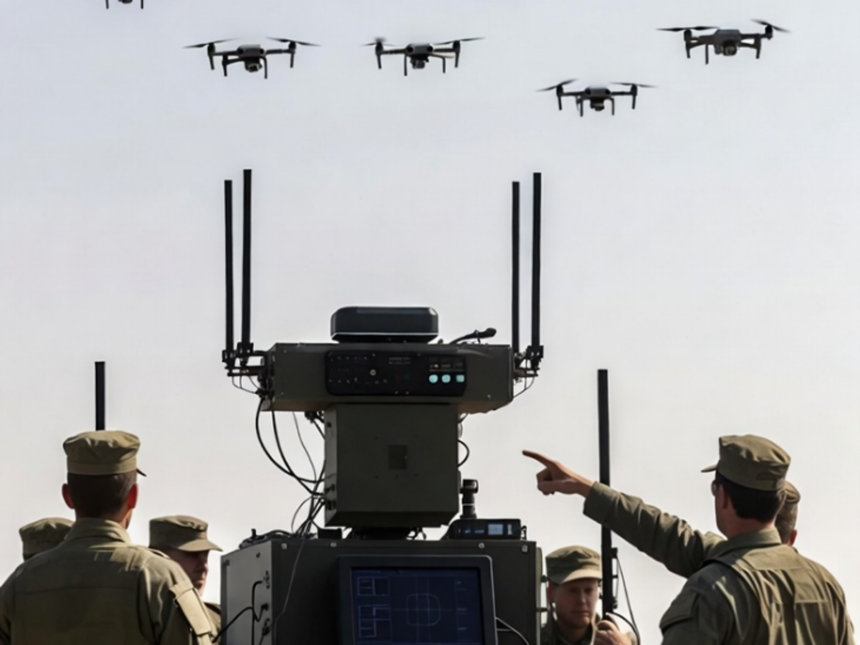
Pakistan has intensified counter-drone deployments along the Line of Control in Pakistan-Occupied Kashmir, reflecting deep unease within its military establishment following Indian strikes during Operation Sindoor. Intelligence assessments indicate that fresh counter-unmanned aerial system installations are being rushed into sensitive forward sectors opposite Rawalakot, Kotli, and Bhimber, signalling fears in Islamabad of a potential “Operation Sindoor 2.0.” The renewed build-up underscores how the brief but decisive May confrontation has altered Pakistan’s threat perception, compelling it to prioritise airspace surveillance, electronic warfare, and low-altitude air defence along its western front.
Indian military planners believe these moves are driven by Pakistan’s assessment that drones and loitering munitions played a crucial role in exposing vulnerabilities during Operation Sindoor. That operation, launched in response to the deadly Pahalgam terror attack, demonstrated India’s ability to combine precision strikes, intelligence dominance, and rapid escalation control. Although hostilities ended within days after Pakistan sought a ceasefire, the psychological impact of the strikes appears to have endured, shaping Pakistan’s current defensive posture along the LoC.
Expanding counter-drone deployments across sensitive LoC sectors
Intelligence inputs suggest that Pakistan has deployed more than 30 dedicated anti-drone units along the Line of Control, focusing on sectors that directly face Indian Army positions in Jammu and Kashmir. These deployments are reportedly being executed under the 12th Infantry Division, headquartered in Murree, and the 23rd Infantry Division, which oversees brigades along the Kotli–Bhimber axis. The concentration of assets in these formations highlights Pakistan’s concern over drone incursions and precision strikes in areas it considers operationally vulnerable.
Sector-wise, Rawalakot has emerged as a focal point for counter-drone activity. Assets here are primarily operated by the 2nd Azad Kashmir Brigade, which is responsible for areas opposite Indian positions in the Poonch sector. This region has historically seen frequent ceasefire violations and infiltration attempts, making it particularly sensitive in any escalation scenario. The reinforcement of counter-UAS capabilities in Rawalakot indicates Pakistan’s desire to deny India the tactical advantage of unmanned surveillance and strike platforms in this corridor.
In the Kotli sector, responsibility for counter-drone operations rests with the 3rd Azad Kashmir Brigade. This brigade’s area of operations faces Indian sectors in Rajouri, Poonch, Naushera, and Sunderbani, regions that witnessed heightened military activity during and after Operation Sindoor. Intelligence officials note that Pakistan’s deployments in Kotli are denser and more layered, suggesting that this axis is viewed as especially vulnerable to future Indian action.
The Bhimber sector, meanwhile, is being handled by the 7th Azad Kashmir Brigade. Bhimber’s proximity to key road networks and its strategic importance in any cross-LoC contingency have made it another priority area for Pakistan’s counter-drone push. Collectively, these deployments reflect a shift from a relatively reactive posture to a more structured, sector-wise approach to drone defence.
Along the LoC, Pakistan has inducted a mix of electronic and kinetic counter-UAS systems. One of the prominent systems reported to be in use is the Spider counter-UAS system. This system relies on passive radio-frequency detection and direction-finding techniques, allowing it to identify the presence and direction of drones without actively emitting signals that could be targeted. Pakistani claims suggest the Spider system can detect small loitering munitions as well as larger unmanned platforms at ranges of up to ten kilometres, although independent verification of these capabilities remains limited.
Complementing this is the Safrah anti-UAV jamming gun, a man-portable, shoulder-fired system designed for close-range defence. With an effective range of approximately 1.5 kilometres, the Safrah is intended to disrupt drone control links, video feeds, and GPS signals, forcing unmanned systems to lose navigation or crash. The portability of such jamming guns allows Pakistani units to deploy them flexibly along forward posts, addressing the perceived threat of low-cost, low-altitude drones.
Indian analysts note that while these systems can complicate drone operations, they also require trained operators, reliable power sources, and effective integration with broader surveillance networks. Any gaps in coordination or situational awareness could limit their effectiveness, particularly against swarming tactics or stealthier platforms.
Air defence layering, strategic anxieties, and post-Sindoor recalibration
Beyond electronic warfare and soft-kill measures, Pakistan has also pressed traditional air defence weapons into service to counter low-flying drones along the LoC. These include Oerlikon GDF 35 mm twin-barrel anti-aircraft guns, supported by radar guidance systems. Designed originally to counter aircraft and helicopters, these guns are now being adapted to engage slow, low-altitude aerial targets such as drones, reflecting a broader trend in modern conflict zones.
Additionally, Pakistan has deployed Anza Mk-II and Mk-III man-portable air defence systems. These shoulder-fired missiles are capable of engaging aerial targets at low altitudes and are being positioned as a last line of defence against drones that evade electronic countermeasures. The use of such kinetic systems indicates Pakistan’s recognition that no single solution is sufficient against unmanned threats, necessitating a layered approach combining detection, disruption, and destruction.
Sources familiar with the situation say these deployments underscore Pakistan’s unease over what it perceives as India’s increasingly assertive military posture along the western border. In recent months, India has conducted a series of integrated combat drills involving the Army, Navy, and Air Force, emphasising jointness, rapid mobilisation, and precision strike capabilities. From Islamabad’s perspective, these exercises reinforce concerns that India is refining options for swift, limited military action under a nuclear overhang.
Pakistan’s anxiety is also shaped by the way Operation Sindoor unfolded. Launched on May 7 in response to the Pahalgam terror attack that killed 26 tourists, the operation combined intelligence-driven targeting with precision strikes against terror camps and military infrastructure deep inside Pakistan. The strikes reportedly caught Pakistan off guard, exposing gaps in air defence readiness and response coordination. The fact that hostilities ended within three days, after Pakistan sought a ceasefire on May 10, has only reinforced the perception within its military that escalation control favoured India.
In response, Pakistan is reportedly exploring external procurement options to bolster its counter-drone and air defence capabilities. Talks are said to be underway with Turkey and China for new drones, sensors, and defensive systems. Turkey’s growing defence industry, particularly in unmanned systems, and China’s experience with integrated air defence networks make them attractive partners for Islamabad as it seeks to plug gaps exposed during Operation Sindoor.
Indian defence experts caution, however, that acquisitions alone may not fully address Pakistan’s challenges. Effective counter-drone operations require not just hardware, but also doctrinal clarity, robust command-and-control structures, and seamless integration across units. Moreover, the rapid evolution of drone technology means that defensive systems must continuously adapt to new threats, including autonomous navigation, encrypted communications, and swarm tactics.
From India’s standpoint, Pakistan’s current moves are seen less as a sign of deterrence and more as evidence of lingering insecurity. The deployment of extensive counter-drone assets along the LoC suggests that Islamabad remains preoccupied with the possibility of renewed Indian action, particularly in response to future terror attacks. Indian officials privately argue that this defensive scramble validates the effectiveness of Operation Sindoor in altering Pakistan’s cost-benefit calculations.
At the strategic level, the developments highlight how drones and counter-drone systems are reshaping the security dynamics along the Line of Control. What was once a domain dominated by artillery duels and small-arms fire is increasingly influenced by electronic warfare, surveillance technology, and unmanned platforms. Pakistan’s expanded counter-drone shield reflects an attempt to adapt to this new reality, even as India continues to invest in offensive and defensive capabilities of its own.
As tensions along the LoC remain fragile, both sides are closely watching each other’s deployments and doctrinal shifts. Pakistan’s reinforcement of counter-UAS systems is likely to be matched by Indian efforts to refine drone tactics, electronic counter-countermeasures, and integrated strike options. In this evolving contest, the shadow of Operation Sindoor looms large, shaping perceptions, preparations, and the strategic calculus on both sides of one of the world’s most militarised borders.