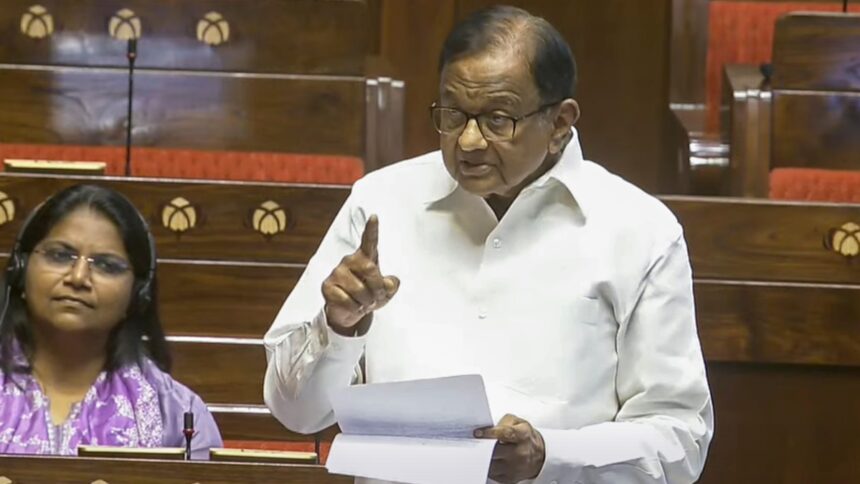
Former Finance Minister and senior Congress leader P Chidambaram has raised concerns over the potential economic repercussions of a tariff and trade war. He cautioned that India must align with global voices opposing such policies, as US President Donald Trump warned Prime Minister Narendra Modi about launching a reciprocal tariff war starting April 2. This could significantly impact global trade, Indian exports, and foreign investments.
Chidambaram also questioned the Indian government’s preparedness to respond to these challenges. He accused the government of failing to consult Parliament or opposition parties on the matter, highlighting concerns over its approach to international trade relations.
Initiating a discussion on the Finance Bill in the Rajya Sabha, P Chidambaram pointed out the recent reductions in customs duties on various goods, including motor vehicles and toys, announced in the Union Budget 2025-26. He argued that this shift in policy was not a result of a change in economic vision but was driven by external pressures, particularly what he termed as the “Trump Effect.” He alleged that the Modi government’s decision to lower duties was a reaction to the possibility of escalating trade tensions rather than a proactive economic measure.
P Chidambaram criticized the government’s approach to tariffs, calling them the “elephant in the room.” He warned that a trade war initiated by the US would have severe consequences, including reduced exports, declining foreign direct investment (FDI), increased inflation, and depreciation of the Indian currency. He urged India to collaborate with countries such as Canada, Britain, France, Germany, and Japan to prevent a full-scale trade war that could destabilize the global economy and disproportionately impact developing nations.
The Congress leader also targeted the government’s handling of domestic economic challenges, highlighting rising unemployment, inflation in essential sectors such as food, education, and healthcare, stagnant wages, declining consumption, and increasing household debt. He accused the Modi administration of implementing severe budget cuts in crucial areas like health, education, agriculture, rural development, and social welfare, further exacerbating economic hardships for the common people.
Earlier, Finance Minister Nirmala Sitharaman presented the Finance Bill 2025 in the Rajya Sabha for consideration. The bill had already been passed by the Lok Sabha on Tuesday. P Chidambaram’s remarks added to the ongoing debate about India’s economic policies, the government’s response to global trade challenges, and the potential ramifications of a tariff war on the country’s financial stability.
As global trade dynamics shift and economic uncertainties grow, the debate on tariffs and trade policies is expected to remain a crucial topic in Indian political and economic discourse. The opposition has demanded more transparency and dialogue on these issues, emphasizing the need for a well-considered strategy to navigate the complexities of international trade relations.