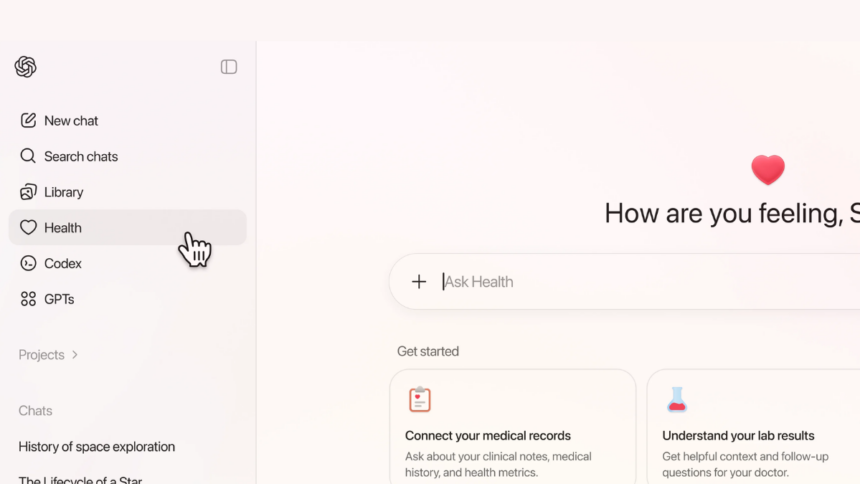
OpenAI has unveiled a major new health-focused capability within ChatGPT that allows users to connect their personal medical records and wellness app data directly to the artificial intelligence system, marking a significant expansion of AI’s role in everyday healthcare interactions. The feature, known as ChatGPT Health, is designed to help users better understand their health information, prepare for doctor visits, interpret medical documents, and receive general wellness guidance, while placing strong emphasis on privacy, security, and user control over sensitive data. The launch reflects the growing demand for AI-powered tools that can simplify complex health information and make personal healthcare management more accessible and intelligible.
Health-related questions already form a substantial portion of interactions on ChatGPT, ranging from understanding lab results to seeking guidance on nutrition, fitness, and insurance options. With ChatGPT Health, OpenAI aims to move beyond generic responses by allowing the system to consider user-provided medical context. By securely uploading medical records such as lab reports, discharge summaries, imaging notes, and long-term health histories, users can receive responses that are more relevant and tailored to their specific circumstances, while still stopping short of clinical diagnosis or treatment recommendations.
OpenAI has positioned the feature as a supportive tool that enhances health literacy rather than a replacement for professional medical care. The company stresses that ChatGPT Health is meant to complement interactions with doctors and healthcare providers, empowering individuals to ask better questions, understand medical terminology, and make more informed decisions. This approach reflects a broader shift in digital health, where technology increasingly acts as an intermediary helping patients navigate complex systems and information landscapes.
Integrating medical records and wellness data into everyday health conversations
One of the most notable aspects of ChatGPT Health is its ability to bring together fragmented health information that typically exists across multiple platforms. Many individuals manage their health through a combination of hospital portals, diagnostic lab systems, fitness trackers, nutrition apps, and wearable devices. This fragmentation often makes it difficult to see patterns or understand how lifestyle choices interact with medical conditions. ChatGPT Health addresses this challenge by allowing users to link supported wellness apps alongside uploaded medical records, creating a more unified view of personal health data.
Through these integrations, users can discuss trends in physical activity, sleep, diet, and other wellness metrics alongside clinical information such as blood test results or medication histories. For example, a user might ask how recent cholesterol levels relate to changes in diet or exercise, or seek clarification on how a lab value fits within a broader health context. By translating technical language into plain English, the AI aims to reduce confusion and anxiety that often accompany medical paperwork.
OpenAI has worked with clinicians and healthcare experts during the development of ChatGPT Health to shape guardrails around the system’s responses. The AI is designed to avoid providing diagnoses, prescribing medications, or offering treatment plans. Instead, it focuses on explanation, education, and preparation. Users can ask what certain medical terms mean, what questions might be useful to ask a doctor, or how to generally approach lifestyle improvements based on widely accepted health guidelines.
Privacy and data protection are central to the feature’s design, given the sensitivity of health information. OpenAI has stated that health conversations occur in a separate, protected environment within ChatGPT. Health data shared by users is not used to train or improve the company’s broader AI models, and users retain full control over their information, including the ability to disconnect apps or delete uploaded records at any time. These safeguards are intended to address widespread concerns about how personal health data might be stored, processed, or potentially misused by AI systems.
The rollout of ChatGPT Health is being phased, with availability expanding gradually across platforms such as web and mobile devices. OpenAI has indicated that access may vary by region due to differences in health data regulations and privacy laws. This cautious deployment reflects the complex legal and ethical landscape surrounding digital health tools, particularly when they intersect with artificial intelligence and large-scale data processing.
Broader implications for ai, regulation and the future of healthcare access
The introduction of ChatGPT Health highlights a larger transformation underway in healthcare, where artificial intelligence is increasingly embedded in consumer-facing tools. As AI systems become more capable of understanding context and processing diverse data types, their role is expanding from answering general questions to supporting daily decision-making in sensitive domains like health. This shift raises important questions about responsibility, trust, and oversight.
Regulators and policymakers around the world are closely watching how AI companies handle medical data and health-related interactions. While tools like ChatGPT Health promise greater accessibility and clarity, they also blur the line between informational assistance and medical advice. Ensuring that users clearly understand the limitations of AI-generated guidance is critical to preventing misuse or overreliance. OpenAI has emphasised that the health feature includes clear messaging reminding users that it is not a substitute for professional care.
There are also concerns about equity and access. On one hand, AI-powered health tools could help bridge gaps for people who struggle to access healthcare services, face language barriers, or find medical information intimidating. On the other hand, reliance on digital tools may disadvantage those without reliable internet access or digital literacy. How platforms like ChatGPT Health are adopted and integrated into healthcare systems will play a role in determining whether they reduce or widen existing inequalities.
From a technological perspective, the feature represents a step toward more personalised AI experiences built around user-owned data rather than generic training information. This model aligns with a growing emphasis on data portability and user consent, where individuals decide how and when their information is used. If successful, it could influence how other AI services approach sensitive data domains, including finance, education, and legal services.
The healthcare industry itself is likely to respond in varied ways. Some providers may see AI tools as valuable allies that improve patient understanding and engagement, leading to more productive clinical encounters. Others may worry about increased patient anxiety, misinterpretation of information, or additional workload resulting from AI-generated questions and concerns. Balancing innovation with practical clinical realities will be an ongoing challenge.
As artificial intelligence continues to evolve, features like ChatGPT Health illustrate how AI is moving closer to the personal and intimate aspects of daily life. The success of such tools will depend not only on technical accuracy but also on trust, transparency, and ethical design. By placing privacy controls and user choice at the centre of its health offering, OpenAI is attempting to navigate these complexities while expanding the scope of what conversational AI can do in the realm of personal health management.