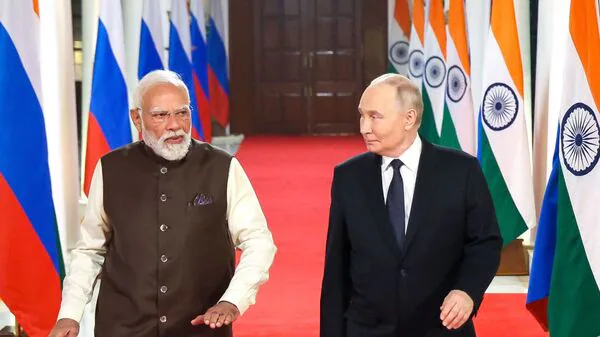
On December 5, 2025, Russian President Vladimir Putin arrived in New Delhi for a two-day state visit culminating in the 23rd annual India–Russia Annual Summit. The summit brings him face to face with Indian Prime Minister Narendra Modi at the historic Hyderabad House, with both leaders expected to hold intensive, wide-ranging talks aimed at reinforcing cooperation in trade, defence and energy — underscoring the enduring strategic partnership between the two nations even as global geopolitics evolves rapidly.
Expanding Trade and Energy Cooperation
The summit is widely seen as an opportunity to chart a roadmap for bilateral economic cooperation through 2030. India hopes to expand market access for its goods in Russia — from perishables and pharmaceuticals to agricultural and industrial products — in an attempt to narrow the trade deficit that has long favoured Russia. Accompanying President Putin is a large delegation of business and economic officials, reflecting Moscow’s clear commercial intent during this visit. Alongside trade, energy cooperation is set to occupy centre stage. Talks are expected to cover civil nuclear collaboration, long-term energy supply agreements, and broader sectoral cooperation including technology transfer and investments. This push for deeper economic and energy ties comes against a backdrop of changing global supply chains and shifting alliances — making the summit an important moment for both countries to reaffirm their economic interdependence.
Defence and Strategic Partnership Under Spotlight
Defence cooperation is another key pillar of the summit agenda. India and Russia are likely to discuss procurement of additional advanced air-defence systems and state-of-the-art military hardware. Among the anticipated items are more units of the S-400 missile system, along with discussions around possible purchases or cooperation on modern combat aircraft like the Sukhoi-57 fighter jet. Beyond hardware, the discussions are expected to pave the way for broader defence-industrial partnership, including maintenance, joint development, and technology sharing — reinforcing Russia’s longstanding role as a major arms supplier to India. In addition, strategic cooperation may extend to areas such as labour mobility, civil nuclear energy, Arctic shipbuilding, and infrastructure investment, reflecting a wide-ranging vision for long-term collaboration. As global pressure mounts on Russia following its conflict abroad, this summit could signify a reaffirmation of trust and shared interests between Moscow and New Delhi.