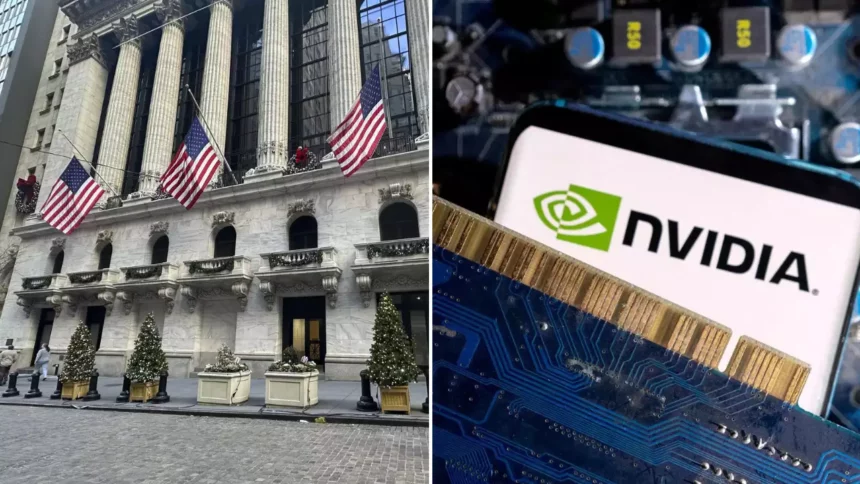
In a dramatic development that sent shockwaves through the global tech sector, Nvidia, the US chip-making giant, saw its market value plummet by nearly $600 billion on Monday, triggering a massive sell-off in tech stocks. The downturn followed the emergence of a Chinese generative AI model that poses a significant challenge to the dominance of American companies in the fast-expanding AI industry.
The new AI chatbot, developed by DeepSeek, a startup based in Hangzhou, China, has raised eyebrows with its impressive capabilities. Despite a fraction of the investment compared to US tech giants, the chatbot is reportedly on par with some of the most advanced AI systems developed in the United States. This development has set the stage for a potential reshaping of the AI landscape, with analysts suggesting that it could undermine the competitive advantage long held by American firms.
Shares of Nvidia, whose semiconductors are pivotal to powering the global AI industry, fell by nearly 17 percent on the Nasdaq stock exchange, wiping out a staggering $600 billion from its market capitalization. This steep decline in Nvidia’s stock was part of a broader rout in the tech sector, with the Nasdaq index closing down more than three percent. The news of DeepSeek’s AI model sparked fears of increased competition from China, which could disrupt the established market dynamics in AI development.
DeepSeek, which launched its chatbot on the Apple US App Store, claimed that it had developed the model with a modest budget of just $5.6 million. This is in stark contrast to the billions of dollars that US tech behemoths like Microsoft, Google, and Amazon have invested in AI development. The success of the DeepSeek chatbot in securing the top spot as the most highly-rated free app on the US App Store further fueled concerns that China’s AI capabilities might soon rival those of the US.
The rapid rise of DeepSeek has raised questions about whether China could outpace the US in the race to dominate AI, a technology seen as critical to future economic growth and innovation. Kathleen Brooks, research director at the trading platform XTB, remarked that “US tech dominance is being challenged by China” and that the focus is now on whether China can do it better, quicker, and more cost-effectively than the US. The potential for China to overtake the US in AI development has sparked a wave of skepticism and concern among investors, with some calling it a case of “shoot first, ask questions later.”
As the market reacted to the news, DeepSeek faced another setback when it reported large-scale cyberattacks targeting its platform. The startup announced that it would limit new user registrations in response to the malicious activities. Despite these challenges, the company’s rise has brought attention to China’s growing capabilities in the tech space, particularly in the realm of artificial intelligence.
In addition to Nvidia, shares of other US chipmakers, including Broadcom, took a hit, falling by 17.4 percent. The decline extended to other tech-related stocks, such as Dutch semiconductor equipment maker ASML, which saw a drop of 6.7 percent in its stock value. The broader sell-off in the tech sector was further compounded by the news that Constellation Energy, a company involved in building energy capacity for AI applications, had seen its stock plunge by more than 20 percent.
The turmoil in the tech market also coincided with concerns over the global economy. Investors are closely watching interest rate decisions from the US Federal Reserve and the European Central Bank, as well as inflation data from the United States. Despite the ongoing concerns over global trade and economic conditions, stocks had risen the previous week amid optimism that the new US administration, led by President Trump, would adopt a less confrontational stance on trade with China.
Trump’s recent announcement of a $500 billion venture to build AI infrastructure in the US, backed by SoftBank and OpenAI, has added another layer of complexity to the situation. However, SoftBank’s stock dropped by more than 8 percent in Tokyo following the news of the Chinese AI breakthrough. Other Japanese semiconductor companies, such as Advantest and Tokyo Electron, also saw their stock values decline, reflecting the broader global impact of the shifting tech landscape.
As investors digest the implications of DeepSeek’s rise and the increasing competition from China, it remains to be seen how the US and other Western tech firms will respond. The emergence of a low-cost, highly effective Chinese AI model signals a shift in the balance of power in the tech world, one that could have lasting consequences for the industry as a whole.
Meanwhile, markets around the world were unsettled. The US S&P 500 index fell by 1.5 percent, while the Dow Jones Industrial Average gained 0.7 percent. In Europe, major stock exchanges in Frankfurt and Paris closed in the red, and London’s stock market ended flat. Asian markets also experienced declines, with the Tokyo Nikkei 225 index falling by 0.9 percent, while the Hong Kong Hang Seng Index managed to edge up by 0.7 percent.
The economic and market implications of the rise of China’s DeepSeek AI are still unfolding, and the situation remains fluid as investors continue to monitor the rapidly changing tech landscape. With the growing influence of Chinese companies in cutting-edge technologies like AI, the global tech rivalry is set to intensify, and the future of AI development may no longer be the exclusive domain of the United States.