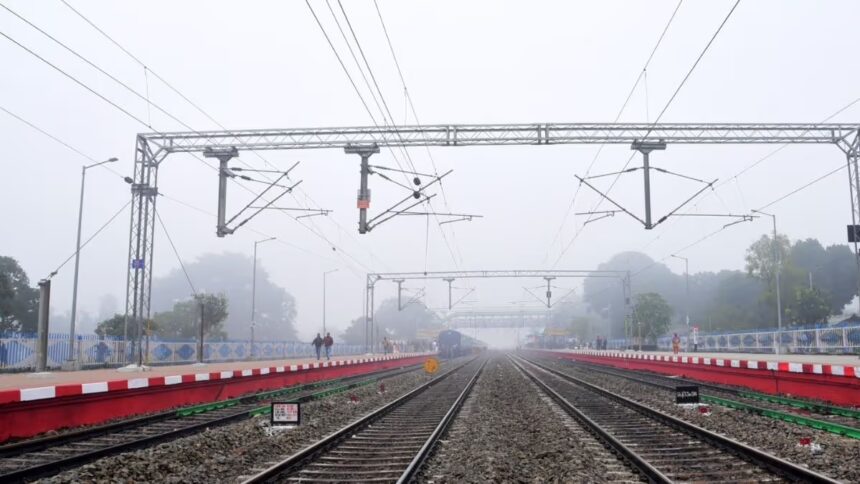
India’s railway electrification drive has seen remarkable progress in 2025, with the country moving closer to its goal of a fully electrified broad-gauge network. As of January 1 this year, 97.06% of the broad-gauge network had been electrified. By May, this figure rose to 98.88%, and by the end of July, coverage touched an impressive 99%.
Northeast India has been a major contributor to this progress, electrifying over 1,100 route kilometers (rkm) in just seven months. This achievement significantly reduces the region’s dependence on fossil fuels, lowers carbon emissions, and paves the way for a greener transport system. However, despite leading the push, Assam still holds the longest unelectrified rail network in the country, underscoring the final hurdles that remain.
Electrification Progress in Numbers
As of July 31, India’s total electrified route length reached 69,102 rkm. At the start of 2025, nearly 2,000 rkm nationwide were still unelectrified. By July’s end, that number had dropped sharply to 698 rkm, with Assam accounting for the largest share of the electrification efforts.
At the beginning of the year, Assam’s railway network spanned about 2,533 rkm, with 1,431 rkm electrified and 1,102 rkm pending. By July, the network had grown slightly to 2,578 rkm, with 2,309 rkm electrified and just 269 rkm awaiting completion.
Tripura has also made notable strides. Electrification in the state jumped from 55% at the end of 2024 to 100% in 2025. Of its 271 rkm, only 153 rkm were electrified last year; now, the entire network is fully powered.
Three northeastern states—Arunachal Pradesh, Tripura, and Mizoram—were among five states to achieve complete electrification this year, alongside Gujarat and West Bengal.
Sikkim is excluded from these calculations as it lacks railway connectivity. Manipur, which has a small section of completed railway, has suspended operations due to ongoing violence since 2023.
Zonal Achievements
In addition to state-level gains, railway zones have played a key role. Between January and May, both Western Railway (WR) and South Central Railway (SCR) achieved 100% electrification.
The Northeast Frontier Railway (NFR), which covers much of the Northeast, expanded electrified lines from 2,826 rkm in January to 3,802 rkm by May, and further to 3,927 rkm by July out of a total 4,196 rkm. NFR remains one of four zones still with unelectrified routes, alongside North Western Railway (93 rkm), Southern Railway (169 rkm), and South Western Railway (167 rkm).
Railway zones are administrative divisions of Indian Railways, designed for efficient project planning and execution, often covering multiple states and districts.
Why Some Routes Remain Pending ?
The railway ministry cites multiple challenges in completing the remaining 698 rkm. These include forest clearances, rights-of-way for transmission lines, utility shifting, statutory approvals, and difficult geological or topographical conditions. Law and order issues, as well as limited working months due to harsh climates, also slow progress.
* Many pending routes are in tough terrain. For example:
* Karnataka: Sakleshpur–Subramanya Road–Kabakaputtur line (103 km)
* Rajasthan: Dausa–Gangapur line
* Goa: Castle Rock–Kulem section
* Tamil Nadu: Triuturaipundi–Karaikudi via Pattukotai (117 rkm), Ramanathapuram–Rameswaram (52 rkm), and Chinnasalem–Porpadakurichi (14 rkm)
These projects may push the 100% target into next year.
The Case for Electrification
Rail electrification brings significant advantages: reduced diesel use, lower carbon emissions, higher haulage capacity, and faster train speeds. It also shortens travel time and boosts operational efficiency.
However, the “Mission 100% Electrification” project is challenging because it often requires electrifying lines that are already in operation, with work carried out alongside regular train services. This creates logistical and safety challenges.
To speed up progress, Indian Railways has integrated electrification into all doubling, new line, and gauge-conversion projects. Electrification is now done in parallel rather than after completion of civil works, cutting timelines considerably.
Northeast’s Role in India’s Green Rail Future
The Northeast’s performance in 2025 stands out for both its scale and speed. The electrification of more than 1,100 rkm in seven months demonstrates how quickly infrastructure can change with focused planning and execution. For Assam, while the remaining 269 rkm is still the largest unfinished stretch in the country, its rapid progress this year suggests that completion is within reach.
For states like Tripura, the shift to 100% electrification marks a transformation in connectivity, enabling faster, cleaner, and more efficient train operations. Similarly, smaller northeastern states achieving full coverage highlight the potential for targeted investment to yield quick results.
Although only a small fraction of the network remains unelectrified, the final push may be the hardest. Many of the remaining routes traverse hilly, forested, or politically sensitive regions, where engineering, environmental, and security issues converge.
Once completed, India will join a select group of nations with a fully electrified broad-gauge network, reinforcing its commitment to sustainable infrastructure and reducing dependence on fossil fuels. For the Northeast, this year’s achievements signal a future where geography no longer limits connectivity and economic opportunity. In the words of railway officials, the journey is not over—but the finish line is now in sight.