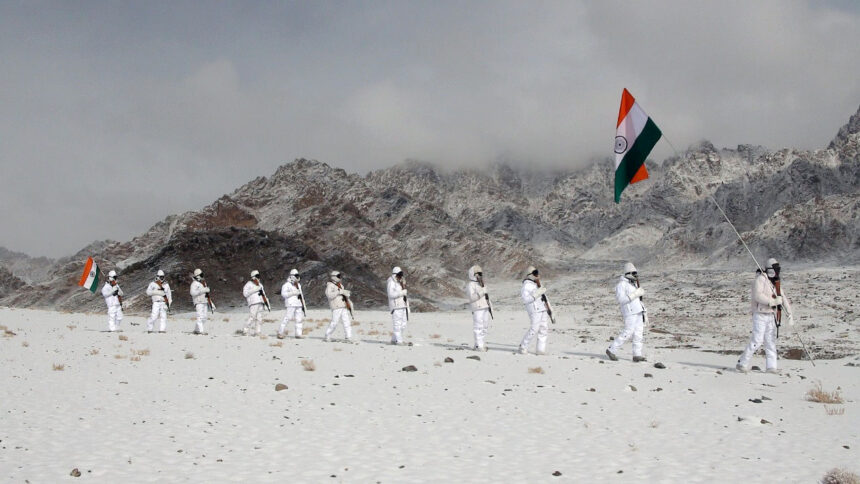
After decades of operating in some of the harshest environments in the world, Indian soldiers stationed at the India-China Line of Actual Control (LAC) — from Ladakh in the west to Arunachal Pradesh in the east — will finally see a major upgrade in their living and working conditions.
The government has begun moving forward with an ambitious plan to construct modern, climate-resilient Border Outposts (BOPs) for the Indo-Tibetan Border Police (ITBP), the central armed police force responsible for guarding the LAC. These outposts are being designed to withstand the extreme cold, high-altitude conditions, and logistical challenges that define India’s Himalayan frontier with China, where temperatures can plunge to minus 45°C during winters and the altitude can reach nearly 19,000 feet above sea level.
Government Document Reveals Blueprint for Extreme-Climate BOPs
CNN-News18 has accessed an official government document detailing the plan. According to the report, the ITBP intends to engage a professional consultant — at an estimated cost of ₹1.25 crore — to design a new standard Border Outpost tailored for extreme climatic and high-altitude regions.
The ITBP currently serves in some of the most challenging terrain in India, across Ladakh, Himachal Pradesh, Uttarakhand, Sikkim, and Arunachal Pradesh. Many of its posts are in areas that are snowbound for months, with sub-zero temperatures and difficult access routes. The document states that climate-resilient infrastructure is no longer optional — it’s essential for maintaining operational readiness, safeguarding the health of personnel, and ensuring rapid deployment capabilities.
The idea is simple but transformative:
* Improve living conditions in inhospitable terrain.
* Enhance operational efficiency and readiness.
* Reduce dependence on fossil fuels through renewable energy.
* Speed up construction despite difficult access.
Features of the New Border Outposts
The upcoming BOPs will be a significant step up from existing facilities. They will integrate Heating, Ventilation, and Air Conditioning (HVAC) systems to maintain comfortable temperatures year-round, regardless of external weather extremes. To reduce reliance on diesel generators — which are expensive to operate and logistically difficult to supply in remote areas — the outposts will incorporate renewable energy sources such as solar and wind power.
The modern construction methodology will focus on rapid assembly and lightweight, durable materials that can be transported easily to remote, high-altitude zones where road access is limited or nonexistent. Many ITBP BOPs are currently located in places accessible only by foot trails, requiring men and supplies to be carried over long distances in difficult terrain.
Addressing Unique High-Altitude Challenges
The document notes several persistent issues faced by troops:
Water Freezing: In most high-altitude BOPs, water freezes in pipelines during winter, disrupting basic daily activities.
Lack of Road Connectivity: Some posts have no motorable road access, forcing personnel to trek for hours — or even days — with supplies.
Heavy Snowfall and Seismic Risks: Outposts must withstand snow loads and be resilient to earthquakes common in Himalayan regions.
To counter these problems, the design will include sub-ground bunkers and utility areas. These underground spaces will provide natural insulation against extreme cold and improve structural stability to withstand heavy snowfall and potential seismic shocks.
Scale of Deployment
ITBP’s BOPs are organized into two broad categories:
Company-level posts: Designed to house an authorised strength of about 128 personnel.
Platoon-level posts: Smaller units accommodating about 40 personnel.
The new climate-resilient design will cater to both scales, ensuring that regardless of size, each BOP will provide adequate living and operational facilities.
A Long-Needed Upgrade in Harsh Conditions
Serving at the LAC is not like being posted to an ordinary military or police station. ITBP jawans operate at altitudes between 9,000 feet and 18,800 feet in extreme conditions where the oxygen is thin, the weather is unpredictable, and the isolation is total.
In many locations, the temperature stays below freezing for months, dropping to -45°C during peak winter. Snowstorms and blizzards are common, making movement and logistics extremely challenging. Even simple tasks, like cooking or bathing, can become exhausting chores without proper facilities.
Up to now, many posts have relied on makeshift heating solutions, limited insulation, and diesel-powered generators. Not only are these insufficient for comfort, but they also increase health risks such as frostbite and respiratory illnesses.
Strategic Importance After Doklam and Galwan
India’s renewed emphasis on LAC infrastructure comes against the backdrop of heightened tensions with China. The Doklam standoff in 2017 and the Galwan Valley clash in 2020 were stark reminders of the importance of maintaining strong, well-supplied positions along the border.
Since these incidents, India has accelerated the construction of roads, bridges, and forward bases to improve mobility and operational readiness. The climate-resilient BOP initiative is a continuation of this strategy — focusing not just on mobility but also on sustained troop presence in forward areas.
Why Climate-Resilient BOPs Matter
Operational Efficiency: Comfortable and well-equipped posts reduce fatigue, allowing jawans to perform their duties more effectively in high-stress environments.
Rapid Deployment: Modern designs can be built quickly, enabling faster expansion or reinforcement of border defenses.
Reduced Environmental Impact: Renewable energy reduces reliance on fossil fuels, cutting down on both costs and environmental damage.
Troop Welfare: Better living conditions help maintain morale during long, isolated deployments.
Construction Challenges Ahead
While the plans are ambitious, implementation will not be without challenges. Transporting construction materials to heights of 18,000 feet often requires airlifting by helicopters or mule caravans. Weather windows for construction are short — sometimes just a few months in a year before heavy snow closes the passes.
Additionally, maintaining equipment like solar panels or wind turbines in extreme cold and high winds will require careful engineering and regular maintenance.
A Model for Future Border Infrastructure
If successful, the climate-resilient BOP design could become a template for all future high-altitude infrastructure in India, not just for the ITBP but also for the Army and other agencies operating in mountainous terrain.
It could also serve as a model for disaster relief camps, research stations, and other remote outposts where reliable shelter and energy supply are critical. With the consultant soon to be appointed, the first phase will involve design finalization, followed by pilot construction at select sites. Once tested and refined, the model can be rolled out to other locations along the LAC in a phased manner.
For the jawans who have spent winters in temporary shelters battling extreme cold, these new outposts represent not just an upgrade in infrastructure but also a long-overdue acknowledgment of their service in one of the world’s toughest postings.
As the government document makes clear, this is not merely a construction project — it is an investment in national security, troop welfare, and long-term sustainability at India’s most sensitive frontier.