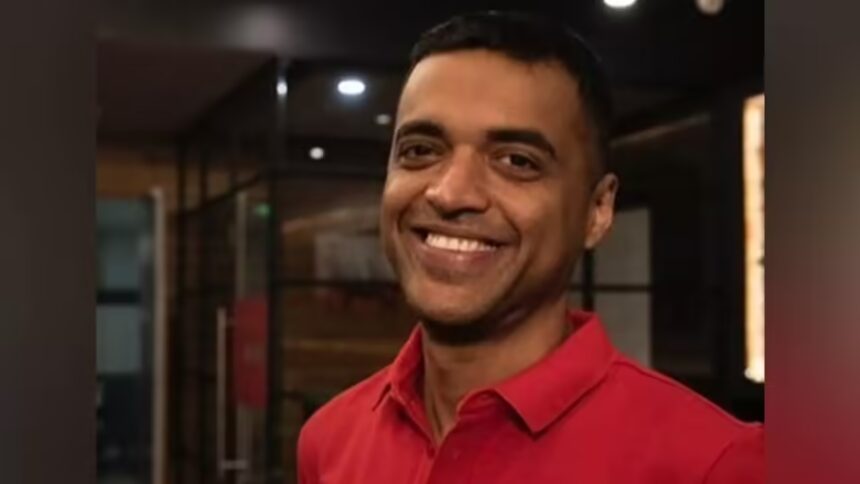
After nearly two decades at the forefront of one of India’s most transformative consumer internet companies, Zomato founder Deepinder Goyal has decided to step down as chief executive officer, marking a significant leadership transition at Eternal, the parent company of Zomato and Blinkit. The move signals a strategic shift as the group doubles down on quick commerce, a segment that has rapidly emerged as its biggest growth and revenue driver, while Goyal prepares to focus on broader entrepreneurial and research-driven pursuits beyond the company’s core businesses.
Leadership transition at Eternal reflects strategic pivot toward quick commerce
Deepinder Goyal’s decision to step aside as CEO brings to a close an 18-year journey that began in 2008, when he launched Zomato as a simple restaurant discovery platform. Over the years, the company evolved into a dominant force in India’s food delivery ecosystem, fundamentally reshaping how urban consumers accessed meals and how restaurants reached customers. Under Goyal’s leadership, Zomato navigated intense competition, shifting business models, regulatory scrutiny and changing consumer behaviour, eventually culminating in a landmark stock market listing in 2021 that cemented its status as one of India’s most successful technology unicorns.
The leadership baton will now pass to Albinder Dhindsa, the head of Blinkit, Zomato’s fast-growing quick commerce arm. Dhindsa’s elevation reflects the growing importance of instant delivery within Eternal’s broader strategy. Since Zomato acquired Blinkit in 2022, the business has scaled rapidly, emerging as the company’s largest revenue contributor and a central pillar of its future ambitions. Eternal was rebranded from Zomato to reflect this broader identity, with Blinkit playing a defining role in the group’s evolution from a food delivery company into a diversified consumer commerce platform.
Dhindsa takes charge at a time when competition in India’s instant delivery market is intensifying. Eternal is locked in a fierce battle with rivals such as Swiggy and major global players, including Amazon, as companies race to capture a greater share of the estimated $11.5 billion quick commerce market. The sector, driven by consumers’ growing preference for speed and convenience, has become one of the most contested arenas in India’s digital economy, demanding relentless execution, operational discipline and strategic clarity.
For Dhindsa, the appointment marks a full-circle moment. Before founding Blinkit in 2014, he had spent more than two years leading Zomato’s international operations, gaining firsthand experience of scaling the business across diverse markets. His entrepreneurial journey with Blinkit, which he built independently before its acquisition by Zomato, has been closely watched in the industry. Under his leadership, Blinkit navigated a challenging path from acquisition to breakeven, a milestone that Goyal himself acknowledged as a testament to Dhindsa’s execution capabilities.
Goyal will remain closely associated with the company as vice chairman, ensuring continuity at the board level even as day-to-day leadership transitions to Dhindsa. In a letter addressed to shareholders, Goyal explained that while he still has the bandwidth to continue contributing to Eternal, the responsibilities and expectations that come with leading a publicly listed company in India demand singular focus. He described his decision as a conscious choice to allow the company to be led by someone fully immersed in its operational priorities, while he redirects his energy toward exploration and experimentation beyond Eternal’s core businesses.
Goyal’s legacy, future ambitions and the growing dominance of Blinkit
Deepinder Goyal’s tenure at Zomato and Eternal is widely regarded as one of the defining entrepreneurial stories of India’s startup ecosystem. From its early days as a niche restaurant information service to its emergence as a household name synonymous with food delivery, Zomato played a pivotal role in transforming dining habits across the country. What was once seen as an urban convenience gradually evolved into a cultural phenomenon, extending its reach into smaller cities and contributing to the rapid expansion of India’s gig economy by creating opportunities for delivery partners at scale.
At the same time, the company’s growth was not without controversy. Zomato faced criticism over aggressive discounting practices, concerns related to driver safety and working conditions, and policy decisions such as the proposed launch of a vegetarian-only delivery fleet, which sparked public debate. Navigating these challenges required balancing growth ambitions with regulatory expectations, public perception and the realities of operating at scale in a diverse and price-sensitive market.
Despite these hurdles, Eternal’s market performance has remained strong. The company’s shares have more than doubled since its stock market debut, giving it a valuation of around $15 billion. This growth has been driven in large part by Blinkit’s rapid expansion and improving financial performance. In its most recent results, Eternal reported a sharp 73 percent jump in quarterly profit, while Blinkit posted adjusted core earnings of 40 million rupees, a significant turnaround from the substantial loss it had recorded in the previous quarter. These figures underscore the growing contribution of quick commerce to the group’s overall financial health.
In his communication to shareholders, Goyal made it clear that Blinkit would remain Dhindsa’s top priority even as he takes on the broader CEO role. He openly acknowledged that Blinkit’s journey from acquisition to breakeven was achieved under Dhindsa’s leadership and praised his ability to execute at scale, stating that Dhindsa’s operational strengths surpass his own. Such a public endorsement highlights the confidence the founder has in his successor and reinforces the strategic importance of Blinkit within Eternal’s future roadmap.
Industry observers view the leadership change as a strong signal of where the company believes the next phase of growth lies. Brand strategy experts have noted that appointing the CEO from Blinkit is a clear indication that quick commerce has moved from being an experimental add-on to becoming the core differentiator for Eternal. Instant delivery, with its promise of speed and convenience, is increasingly seen as the “rainmaker” in India’s digital commerce landscape, capable of driving higher engagement, repeat usage and long-term customer loyalty.
For Goyal personally, stepping down as CEO opens the door to a diverse set of interests and ventures that extend beyond food and commerce. He has already invested $25 million through his research group, Continue Research, to explore areas related to human biology and longevity, signalling a growing interest in scientific and health-focused innovation. In addition, he has founded LAT Aerospace, a venture aimed at developing low-cost regional and short-haul aircraft tailored for India and other emerging markets. These initiatives reflect a broader vision that combines technology, research and infrastructure to address long-term challenges and opportunities.
Goyal has repeatedly articulated his ambition for Eternal to become India’s most valuable company, a goal that continues to shape the group’s strategic direction even as he steps back from the CEO role. By entrusting leadership to Dhindsa at this juncture, he appears to be prioritising execution and operational focus during a period of intense competition and rapid market evolution. The move also highlights a maturing startup ecosystem, where founders increasingly recognise the value of professionalised leadership structures as companies scale and diversify.
As Albinder Dhindsa assumes the role of CEO, the market will be watching closely to see how Eternal balances its core food delivery business with the fast-growing quick commerce segment, while fending off competition from both domestic rivals and global giants. The leadership transition marks not just a change at the top, but a defining moment in the company’s evolution, reflecting how consumer expectations, technology and competitive dynamics are reshaping India’s digital economy in real time.