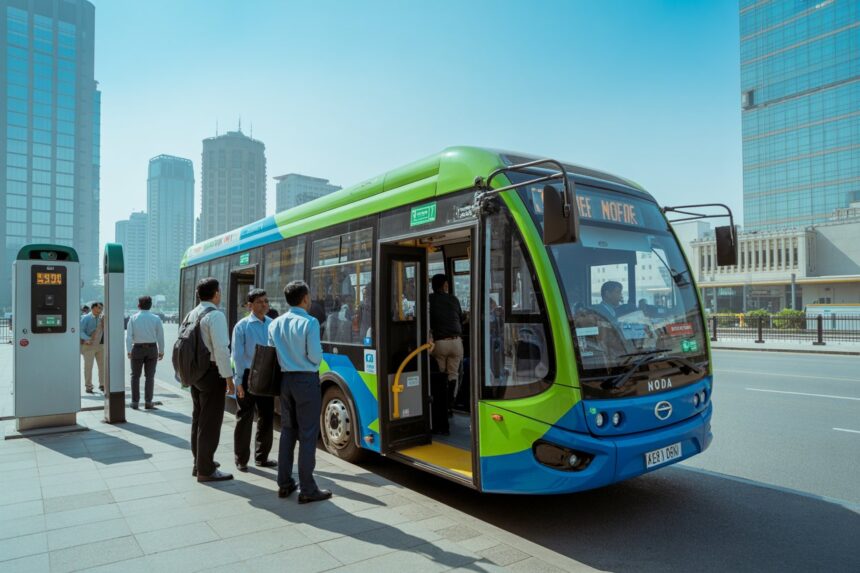
Noida Authority has partnered with UPSRTC to introduce 50 city buses across major routes, aiming to improve connectivity, reduce congestion, and enhance public transport facilities.
The Noida Authority has taken a significant step toward strengthening urban mobility by coordinating with the Uttar Pradesh State Road Transport Corporation (UPSRTC) to introduce 50 city buses across key routes in the region. This initiative is aimed at providing seamless, affordable, and efficient transportation for residents while reducing dependency on private vehicles and easing traffic congestion. The decision reflects a broader push toward improving public infrastructure and promoting sustainable transit solutions in the rapidly growing Noida and Greater Noida areas.
Four Key Routes Identified for Operations
The newly introduced buses will operate on four major routes, strategically connecting important residential, commercial, and industrial hubs. The starting point for all routes will be Sector-90 depot and Botanical Garden. From there, buses will run towards Greater Noida West (Gaur Chowk, Ek Murti), Jewar Airport, Sector-62, and Phase-2 industrial area extending up to Surajpur Collectorate in Greater Noida.
These routes have been carefully selected to cover high-demand corridors, ensuring that commuters from different parts of Noida and adjoining areas have access to reliable public transport. The connectivity between Botanical Garden Metro Station and these destinations is expected to significantly improve daily commuting convenience.
Infrastructure and Facilities at Sector-90 Depot
To support the operation of these buses, the Noida Authority will develop comprehensive infrastructure at the Sector-90 depot. This will include a dedicated bus depot, electric charging points, maintenance and service stations, as well as facilities for drivers and conductors.
A total of 20 charging stations will be स्थापित at the depot, enabling the charging of all 50 buses. Additionally, four opportunity charging stations will be set up at the Botanical Garden bus stand, allowing up to eight buses to be charged simultaneously. This infrastructure will ensure smooth and uninterrupted operations of the electric bus fleet.
UPSRTC to Manage Operations and Ticketing
The operation of the buses will be handled by UPSRTC, which will run services at its निर्धारित fare structure. The financial gap, known as Viability Gap Funding (VGF), will be borne by the Noida Authority to ensure that services remain economically viable while keeping fares affordable for commuters.
Officials also highlighted that e-charging points have already been developed at Morna bus depot, further strengthening the supporting infrastructure for electric bus operations in the region.
Improved Connectivity and Reduced Traffic Congestion
The introduction of these buses is expected to significantly enhance connectivity for Noida residents. Key areas such as Botanical Garden Metro Station, Sector-62, Greater Noida West, Jewar Airport, Phase-2 industrial zone, and Surajpur Collectorate will be directly linked through this service.
By providing a reliable and efficient alternative to private vehicles, the initiative is likely to reduce the number of smaller vehicles on roads, thereby easing traffic congestion. This will not only improve travel time but also contribute to lowering pollution levels in the region.
A Step Towards Sustainable Urban Transport
This move aligns with the broader vision of promoting sustainable and eco-friendly transportation systems. The deployment of electric buses, supported by modern charging infrastructure, reflects a commitment to reducing carbon emissions and building a greener urban environment.
With better connectivity, improved infrastructure, and a focus on sustainability, the initiative is set to transform public transportation in Noida, making daily commuting more convenient and efficient for thousands of residents.