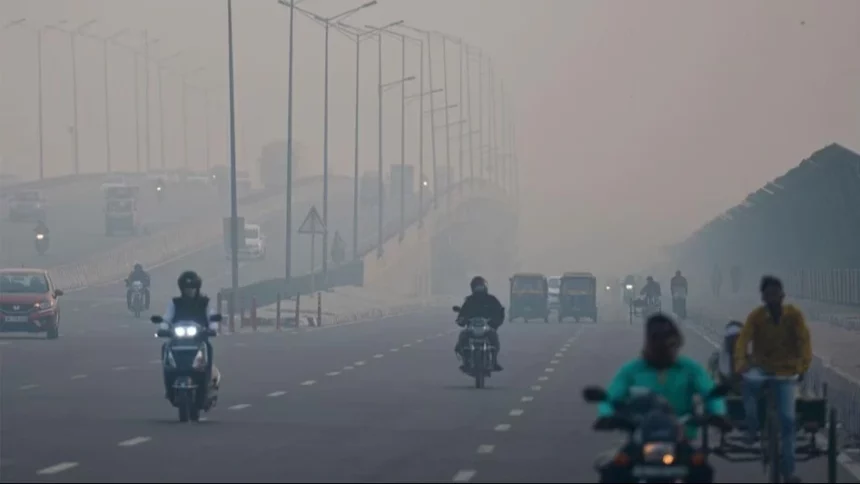
The alarming rise in pollution levels across Noida has once again pushed the city into the national spotlight, with its air quality plunging into the severe category despite continuous fines and enforcement drives by the pollution control authorities. Residents have been forced to breathe toxic air for days, and the city has now emerged as India’s third most polluted urban centre, exposing critical gaps in enforcement, urban planning, and dust-management mechanisms across construction and civic works. The worsening air quality has intensified public distress, raised health concerns for vulnerable groups, and amplified the debate around governance failures at the local level.
Noida Records Hazardous Air Quality as Enforcement Measures Show Little Impact
Throughout Thursday, Noida recorded an Air Quality Index (AQI) of 408, marking the city’s entry into the severe pollution bracket where prolonged exposure can cause acute respiratory distress even in healthy adults. What makes the situation more worrying is the fact that despite repeated penalties, monitoring drives, and warnings issued by the Pollution Control Board, conditions are not improving on the ground. Instead, layers of smog continue to envelope the city from early morning to late night, severely reducing visibility and exposing lakhs of people to air that is dangerous even for short-term exposure.
According to the latest figures, Greater Noida registered an AQI of 380, while Noida at 408 became India’s third most polluted city of the day. Only Ghaziabad (430) and Baghpat (428) recorded worse pollution levels than Noida, further underlining that the entire western Uttar Pradesh belt is sinking into hazardous air conditions. The severe pollution levels have been accompanied by a dense haze, which has added to road-safety concerns, disruptions in public movement, and a rising number of respiratory complaints being reported in hospitals and clinics.
What is particularly concerning for environmental experts is that the pollution is not limited to vehicular emissions or industrial activities. A major contributor continues to be unregulated construction works, road-digging, unpaved surfaces, and the careless stockpiling of loose soil across multiple sectors. Inspections conducted by the Pollution Control Board revealed that across several parts of Noida, heaps of soil were lying openly on roadside spaces despite strict prohibitory orders. These sites remained uncovered, generating dust clouds that quickly mixed with the stagnant winter air and worsened the overall pollution load.
On Thursday, authorities imposed fines totalling ₹7.3 lakh on different agencies, contractors, and construction sites for violations ranging from open storage of soil, improper handling of debris, and inadequate dust-suppression arrangements. However, despite these monetary penalties, the persistent non-compliance reflects a deeper administrative challenge—either the deterrence is insufficient or the monitoring is irregular, allowing violators to continue operations with minor interruptions. As a result, residents continue to live amid deteriorating air, with children, senior citizens, and asthma patients most severely affected.
Environmental specialists argue that the situation demands more than financial penalties. They point to structural issues such as inadequately paved internal roads, broken side lanes, and ongoing public-utility work—especially for underground cable-laying and sewage pipelines—that remain incomplete for months. These disruptions create an unending cycle of dust production. The lack of stringent timelines for contractors, coupled with the absence of protective coverings, ensures dust remains one of the city’s biggest pollutants.
Several locations across Noida, including sectors 29, 28, 41, 62, 74, 115, and the stretch approaching the Sarfabad village, were found violating construction norms. Photographs and reports from these areas indicated that soil was left uncovered, trucks were operating without tarpaulin covers, and construction material was placed directly on main roads or service lanes. Even some projects under the Noida Authority itself were found violating norms, showing that the problem extends beyond private builders and contractors into the civic system.
Multiple Violations Found Across Noida as Dust Sources Multiply
Environmental inspectors discovered a range of violations contributing to the deteriorating air quality. In Sector-14, loose soil generated from underground cable work was found stored openly next to the main road. Despite repeated directions to the electricity department to ensure covering of the dugout areas, the soil remained exposed, leading to a fine of ₹50,000. In Sector-49, near the Hanuman Murti zone, pipeline-related digging created large piles of earth that were left uncovered on roadside spaces, again leading to a penalty of ₹50,000.
Further violations were detected in Sector-41, where sewer line installation work had left the service road layered with loose dust and debris. Construction norms dictate that such sites must be covered with green nets and sprayed regularly with water to suppress dust formation. Instead, the area remained entirely exposed to moving vehicles and pedestrian activity, prompting a fine of ₹30,000.
Another significant violation was recorded near Cleo County in Sector-121, where open soil from pipeline installation work had been left unattended, attracting a ₹50,000 fine. Even more alarming was the situation in Sector-74 and the adjoining Sarfabad village corridor, where construction material and loose soil were seen lying openly on land managed by the Noida Authority itself. Authorities imposed a fine of ₹50,000 in this case, but the incident raised serious concerns about enforcement within government-managed projects.
The largest penalty of the day—₹5 lakh—was issued for violations on the stretch connecting Sarfabad to Sector-115. This road, which is undergoing redevelopment, had extensive construction material lying in the open without any protective measures, creating a massive dust problem for the surrounding residential neighbourhoods. Residents have repeatedly complained about burning eyes, persistent cough, and difficulty breathing, especially during early morning and evening hours when pollution levels peak due to atmospheric inversion.
While authorities continue to conduct drives, the core problem remains the absence of consistent oversight. Dust suppression requires a combination of mechanised road sweepers, daily water sprinkling, proper covering of dump sites, and ensuring that vehicles transporting construction material comply with safety norms. In Noida, however, these systems operate inconsistently, often depending on individual enforcement teams rather than city-wide strategic planning.
Another challenge complicating the city’s pollution crisis is the meteorological condition. Winter air in northern India tends to trap pollutants close to the ground due to low wind speed and temperature inversion. This means that even small amounts of dust or emissions can accumulate rapidly. However, in Noida’s case, the scale of pollution suggests that the problem is far bigger than seasonal weather. It points to systemic negligence that has allowed dust-producing activities to run unchecked for months.
Health concerns have risen sharply across the city. Doctors report a spike in respiratory cases, especially among elderly residents and children. Many people are experiencing aggravated asthma, itchy throat, wheezing, and chest tightness. Schools and colleges have also raised concerns, with several institutions urging parents to minimise outdoor exposure for students. Residents have started relying more on indoor air purifiers, yet even these cannot fully protect against prolonged exposure to hazardous air.
The pollution crisis has also impacted outdoor workers such as construction labourers, delivery personnel, traffic police, and street vendors who spend long hours outside. Without protective equipment or masks, they remain highly vulnerable to long-term respiratory illnesses. Medical experts warn that repeated exposure to severe air quality can increase risks of lung infections, chronic bronchitis, and in some cases even long-term cardiac complications.
Despite these concerns, civic agencies continue struggling to achieve visible improvement. The repeated imposition of fines without behaviour change from agencies, contractors, and builders indicates a failure of systemic enforcement. Experts have long argued that Noida requires a centralised dust-management policy with real-time monitoring, mechanised cleaning systems, strong accountability, and transparent penalisation that goes beyond financial penalties to include work stoppage orders and blacklisting of habitual violators.
The continuing crisis demonstrates that without strict compliance, consistent monitoring, and structural reforms, the city will remain trapped in cycles of toxic air every winter. Residents now look toward stronger administrative intervention as pollution continues to choke the city’s skyline and its lungs.