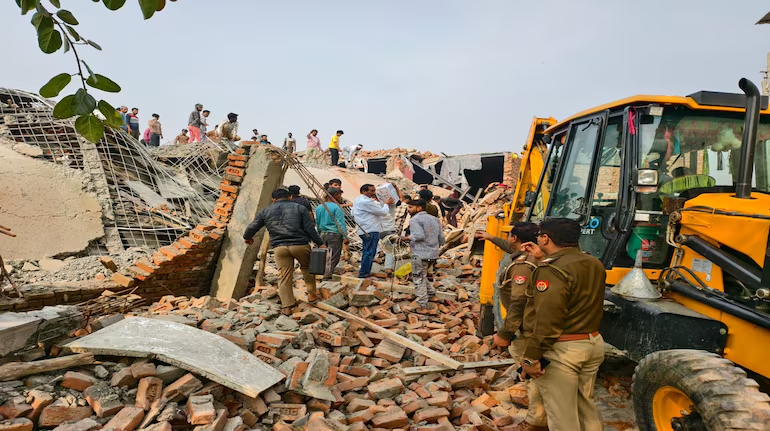
A devastating building collapse in Noida’s Nagla Hukum Singh village has led to the death of four labourers, exposed layers of illegal construction activity, and triggered a massive police investigation after the house owner’s entire family fled the village. The incident occurred during the removal of shuttering at an under-construction structure, raising serious questions about the quality of materials used, the absence of safety measures, and the growing trend of unauthorized constructions on land earmarked for the aviation department. Police have now arrested the shuttering contractor while multiple teams continue searching for the absconding house owner, his wife, and their son.
Collapse Claims Four Lives and Sparks Criminal Case Against House Owner in Illegal Construction Zone
Chaos swept through the village on Wednesday when the three-storey under-construction house suddenly gave way, burying several workers under a mountain of concrete, iron bars, and debris. Eyewitnesses recount that the labourers were working beneath the freshly laid lintel when the structure began shaking and collapsed without warning, leaving no time for escape. The crash reverberated through the narrow lanes of Nagla Hukum Singh, drawing villagers, police teams, and rescue personnel from nearby stations.
When police and emergency responders arrived at the scene, they immediately began digging through the rubble with mechanical tools, earth-movers, and cutting equipment. Four workers were eventually recovered, but none survived. Their bodies were pulled out one by one as grieving relatives gathered around the site, some fainting in shock while others broke down helplessly. The police identified the deceased workers and informed their families, all of whom were daily-wage earners working under harsh conditions with little or no safety gear.
During the initial inspection, it became clear that the building had been constructed using low-quality materials not compliant with structural norms. The concrete was poorly cured, the iron rods appeared thinner than standard, and the shuttering had been removed prematurely, severely weakening the slab. Police officers and district engineers noted several visible irregularities, suggesting that the construction had violated multiple safety provisions.
As the investigation progressed, the house owner, Mahavir Singh, along with his wife Rajbala and son Gaurav, disappeared from the village shortly after the collapse. Their sudden disappearance confirmed suspicions that they were directly involved in illegal construction practices that led to the tragedy. With mounting evidence and testimonies from surviving labourers, the Rabupura Police registered a case of culpable homicide not amounting to murder against the absconding trio. Multiple police teams have been deployed to search nearby towns and districts in an effort to locate them, but early attempts yielded no results.
Authorities emphasized that the structure was being built on land owned by the civil aviation department, which falls under a strict no-construction zone due to ongoing development for the Jewar International Airport. Any form of construction on this land is a violation of acquisition rules. Yet, despite written notices and a previously registered FIR in October, the family continued building the house clandestinely, allegedly with the intention of unlawfully increasing the built-up area to claim higher compensation once the land was formally acquired.
During site assessment, police and administrative officers met several villagers who admitted that the owner had been warned multiple times about the ban on construction. However, he allegedly ignored all warnings and instructed workers to complete the building at the earliest, even if it meant compromising structural safety. Officers from the SDM office stated that the construction appeared rushed, executed without any registered engineer, and relied heavily on low-quality material to cut costs.
The police also recorded statements from workers who survived the incident. They explained that they were employed on daily wages and had no protective equipment such as helmets, gloves, or boots. They described the construction as unsafe, with shaky scaffolding and improperly fixed shuttering. Their testimonies reinforced the suspicion that the crash was not an accident but a fatal outcome of negligence accelerated by the owner’s attempt to profit unlawfully from the land acquisition scheme.
Meanwhile, administrative documents revealed that the local revenue department had earlier filed complaints against around 90 villagers, including Mahavir and his family, for unauthorized construction. Given that the land belongs to the aviation department, officers had explicitly directed the Rabupura Police to stop all such activities. Still, lax enforcement allowed multiple illegal structures to rise uncontrollably, creating a dangerous pattern that eventually resulted in the fatal incident.
Shuttering Contractor Arrested as Investigation Expands Into Safety Violations and Material Failure
During the investigation, the name of shuttering contractor Manoj Maheshwari from Jewar surfaced repeatedly in witness testimonies and material records. Manoj had been hired to install and remove the shuttering at the Mahavir household’s construction site. Officials found that the shuttering was removed far earlier than safety standards permit, reducing the lintel’s strength and triggering the collapse. Acting on these findings, police conducted a dedicated operation and arrested Manoj from the Faleda Cut area on Thursday afternoon.
Police officials pointed out that while the primary responsibility lies with the house owner, the shuttering contractor bears criminal liability for removing support structures prematurely and failing to ensure safe working conditions for labourers. Manoj is now being questioned about whether he was aware of the ban on construction, whether he reported structural concerns to the owner, and whether he knowingly compromised shuttering standards to save time or labour costs.
Early interrogation reports suggest that Manoj admitted to removing the shuttering but claimed he was acting under pressure from the house owner, who allegedly demanded that the work be completed quickly before authorities could intervene. Manoj reportedly told investigators that he knew the slab needed more curing time but was instructed to go ahead regardless. Police are now cross-checking these statements with technical assessments to determine if financial motives influenced such reckless decisions.
Simultaneously, the Tehsil administration has submitted two formal complaints to the police department alleging that individuals were intentionally constructing illegal buildings on the aviation department’s land to cause financial loss to the state government. The letters emphasize that the constructions were not accidental or informal but deliberately carried out with full knowledge that the land was reserved for a major public infrastructure project.
Revenue officials, including the local Lekhpal, Pratyush Pathak, have also filed separate complaints naming Mahavir Singh and multiple others responsible for illegal construction. They reported that the family had been repeatedly warned, yet they continued to build using sub-standard materials despite safety notices and legal action. The complaints highlight that such actions are not only illegal but also dangerous, especially when construction is executed without proper supervision and with the intent of evading government regulations.
Administrative officers insist that the incident exposes a much larger pattern of unauthorized construction that has been increasing in villages affected by the Jewar Airport expansion. Many landowners have been rushing to build additional structures in hopes of increasing compensation, often employing unskilled labour and ignoring engineering protocols. Authorities say the Nagla Hukum Singh collapse must be treated as a wake-up call, prompting stricter monitoring and immediate action against violators.
District engineers will now conduct detailed structural analysis of the collapsed building, including core testing of concrete samples, inspection of reinforcement bars, and examination of curing duration. The forensic findings will help determine the exact technical cause of the collapse and will play a crucial role in the prosecution of the accused.
The incident has sparked widespread concern among labour organizations as well. Worker groups have demanded accountability, claiming that labourers in such illegal construction projects are routinely forced to work without safety equipment, written contracts, or basic protection. The deaths of the four workers, they argue, highlight systemic exploitation that continues in rural construction zones where oversight remains weak.
Police teams continue to conduct raids across multiple locations in Uttar Pradesh to track down the absconding house owner and his family. Officers have warned that strict legal action will be taken against anyone providing shelter or assistance to the fugitives. The administration is also planning a broader crackdown on illegal construction and has directed teams to dismantle structures built in restricted zones.