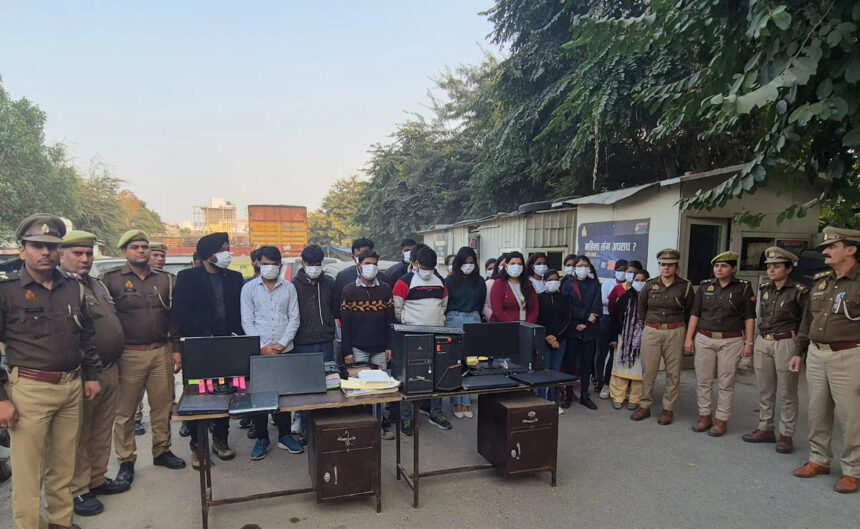
In a significant breakthrough against organized financial fraud, Noida Police has dismantled a fake call center operation that had defrauded more than 200 unsuspecting job seekers. The arrest of three key members of the network, who allegedly provided bank account details to the center owners and facilitated large-scale monetary deception, highlights the city’s ongoing commitment to tackling digital and financial crimes. This case underscores the sophisticated methods employed by fraudsters to exploit unemployed individuals, promising employment opportunities as bait to extract substantial sums from their victims. Authorities recovered mobile phones, debit cards, SIM cards, checkbooks, and other instruments used in these illicit operations, signaling an end to a well-coordinated scam that had preyed on vulnerable sections of society.
Network of Fraud and the Modus Operandi of the Accused
The arrested individuals, identified as Vishal Raghav from Aligarh, Amir Usmani from Sector-16, Vasundhara, and Varun Kumar from Laxmi Nagar, Delhi, were integral members of a network that operated under the guise of job placement services. Investigations revealed that they collaborated closely with the center owners, Anuj Kumar and Romesh, providing sensitive banking information, including account numbers, pre-activated SIM cards, debit and credit card details, and checkbooks. These details were then exploited to siphon money from victims who were lured with promises of lucrative employment opportunities.
The fraudulent operation was highly organized, with distinct roles assigned to each participant. Vishal, for example, maintained physical control over bank passbooks, checkbooks, debit and credit cards, using them to withdraw money and channel a portion as commission to Anuj and Romesh. Amir and Varun facilitated the collection of bank accounts and SIM card information and were responsible for registering job seekers at the fake center, extracting processing fees under the pretense of securing employment. Varun also operated an independent call center, further expanding the fraudulent network’s reach and victim base.
The scale of deception was substantial. Over 200 job seekers had been lured and manipulated into transferring funds or providing sensitive financial information. The call center operation leveraged the hopes and vulnerabilities of unemployed individuals, turning aspirations for employment into a mechanism for extracting money. The method was both psychological and procedural: victims were approached with credible-sounding offers, required to pay processing fees, and deceived with the promise of job placements, creating a sense of urgency and legitimacy that masked the fraudulent nature of the operation.
Investigators discovered that the call center maintained detailed records of transactions, registered victim information meticulously, and coordinated withdrawals through controlled accounts. The offenders utilized prepaid SIM cards and dummy identities to obscure their movements and avoid detection. Each layer of the operation was designed to create the appearance of legitimacy while simultaneously ensuring that the victims’ financial information could be misappropriated efficiently. In addition to direct monetary fraud, the center engaged in identity manipulation, sometimes using stolen documents or personal details of job seekers to establish fake employment accounts, thereby expanding the scope of their deception.
Police discovered the sophisticated manner in which digital and physical instruments were combined to facilitate the scam. Mobile phones and SIM cards were not only communication tools but also instruments for verification, transaction initiation, and coordination between the network members. Checkbooks and debit cards were systematically controlled to ensure consistent cash flows, with some funds siphoned off directly to the center owners while the remainder was used to sustain the daily operations of the fraudulent enterprise. The operation displayed high levels of coordination, planning, and technical knowledge, making it one of the more complex call center frauds investigated in recent months.
The investigation further revealed that the scammers employed a mixture of digital and psychological tactics to maintain control over victims. Automated calls, follow-up messages, and threatening communications were used to pressure individuals into compliance. Victims were often convinced that failure to pay processing fees or provide financial information would result in the loss of promised employment opportunities. In many cases, they were subjected to intimidation and manipulation, including the presentation of fake government or corporate communications to establish authenticity. This approach ensured a continuous inflow of victims while minimizing immediate suspicion or resistance.
Arrests, Recovery, and Implications for Cybercrime Prevention
The arrests of Vishal, Amir, and Varun marked a pivotal point in the investigation. These three were directly responsible for facilitating the flow of bank account information and coordinating financial transfers. By seizing seven mobile phones, four debit cards, three SIM cards, a passbook, a FINO Combo bank kit, four fake joining letters, three official stamps, and a checkbook, the police disrupted the network’s operations and prevented further exploitation of additional victims. The items recovered were central to the call center’s functioning, used both for processing fraudulent transactions and maintaining the illusion of a legitimate employment agency.
The apprehension of these individuals also shed light on the broader criminal structure. The central figures, Anuj Kumar and Romesh, were the masterminds, orchestrating the operations and relying on members like Vishal, Amir, and Varun to provide logistical and operational support. Through meticulous planning, they were able to maintain the appearance of a legitimate enterprise, allowing the scheme to continue undetected for months. The arrests demonstrated the importance of law enforcement in penetrating complex networks and identifying not only the visible participants but also those operating behind the scenes.
This case also underscored the importance of proactive policing in cybercrime and financial fraud. Beyond physical arrests, investigators employed digital forensics, transaction tracking, and telecom monitoring to map the full extent of the network. By analyzing the flow of money, the coordination of SIM cards, and the movement of digital communications, police were able to reconstruct the fraudulent activity and pinpoint the individuals responsible. This multifaceted approach ensured that both direct perpetrators and supporting actors could be held accountable.
The financial impact of the scam, while significant, extended beyond the immediate losses. The psychological effect on victims—who were misled into believing they had legitimate employment opportunities—was substantial. Many of the defrauded individuals faced financial distress due to upfront payments, EMIs, or personal savings that had been transferred under false pretenses. The timely intervention by police prevented further financial damage and sent a strong deterrent message to other potential fraudsters operating similar networks in the region.
Moreover, the operation highlighted the intersection of unemployment and vulnerability to fraud. The call center specifically targeted unemployed individuals, understanding that the promise of a secure job would lower resistance to financial exploitation. This insight guided police to prioritize education and awareness campaigns alongside enforcement. By analyzing victim profiles, investigators identified patterns of susceptibility and began outreach efforts to educate the community about common scams, verification techniques, and steps to protect sensitive financial and personal information.
The arrests also had operational consequences for the broader criminal network. The seizure of key communication tools, financial instruments, and fraudulent documentation disrupted the center’s ability to operate, essentially dismantling a well-established pipeline for new victims. Investigators recognized that dismantling such a network required not just physical arrests but also the neutralization of the infrastructure that enabled the scam. This included deactivating SIM cards, freezing fraudulent bank accounts, and recovering documentation that could have been used to perpetuate further fraud.
As the investigation progressed, police discovered that the network was not limited to a single city. Members of the gang were active across multiple states, sharing resources and coordinating operations to maximize their reach. This realization prompted inter-state cooperation and intelligence sharing, ensuring that the crackdown had a wider impact than just the immediate arrests in Noida. Authorities were able to trace transaction flows, identify connected actors, and prevent similar scams from taking root in neighboring regions.
The case also emphasized the role of technology in both facilitating and combating fraud. While the perpetrators used digital tools to execute scams, law enforcement leveraged digital forensics, financial tracking algorithms, and data analytics to identify vulnerabilities, trace illegal flows, and predict potential targets. This technological parity was crucial in breaking down a sophisticated criminal operation and ensuring accountability for multiple actors involved in the scheme.
Community involvement emerged as another key element in the investigation. Tips from affected individuals, reports from banks and financial institutions, and vigilance by local residents provided leads that allowed police to act swiftly. Public awareness campaigns, both online and offline, were reinforced to prevent similar scams, highlighting the critical role of citizen participation in curbing cyber-enabled financial fraud. Educational outreach, advisory notices, and informational campaigns formed an essential complement to enforcement, ensuring that the broader community was equipped to recognize and resist fraudulent schemes.
By integrating enforcement, technology, and community engagement, Noida Police not only disrupted a major fraudulent operation but also set a precedent for future interventions in similar cases. The arrests of Vishal, Amir, and Varun illustrated how targeting operational enablers of a criminal network could significantly weaken the overarching scheme, even before the apprehension of central masterminds like Anuj Kumar and Romesh. This approach reinforced a strategic understanding of fraud networks, emphasizing the importance of addressing both infrastructure and personnel in comprehensive crime prevention strategies.
The fallout from the operation has prompted discussions on policy and preventive measures, particularly regarding employment-related fraud. Recognizing the nexus between unemployment, financial vulnerability, and susceptibility to scams, authorities have begun designing awareness campaigns targeting students, fresh graduates, and unemployed individuals. These campaigns emphasize verification of job offers, skepticism toward upfront fees, and caution when providing banking information to unfamiliar entities.
Law enforcement also initiated steps to coordinate with banks and financial institutions, establishing rapid-response mechanisms for detecting unusual transactions linked to fake employment schemes. Alerts, monitoring of suspicious accounts, and collaboration with telecom operators for SIM and IMEI tracking form part of the preventive architecture that emerged from this investigation. Such systemic measures aim to prevent recurrence, ensuring that perpetrators cannot easily reconstruct similar networks or exploit new victims.
Through these efforts, Noida Police demonstrated a multidimensional approach to combating call center fraud, combining tactical arrests, forensic investigation, financial recovery, infrastructure disruption, victim assistance, community outreach, and preventive policy development. The success of this operation not only alleviated immediate financial harm but also contributed to broader public confidence in law enforcement’s ability to tackle complex, technologically enabled crimes.
The arrests of the three members are only part of a continuing investigation aimed at apprehending additional operatives within the network. Police continue to map the hierarchy, identify supporting members, and trace financial and digital pathways to ensure the dismantling of all operational nodes. The ongoing investigation seeks to prevent reconstitution of the network and to provide lessons for proactive enforcement in future fraud prevention.