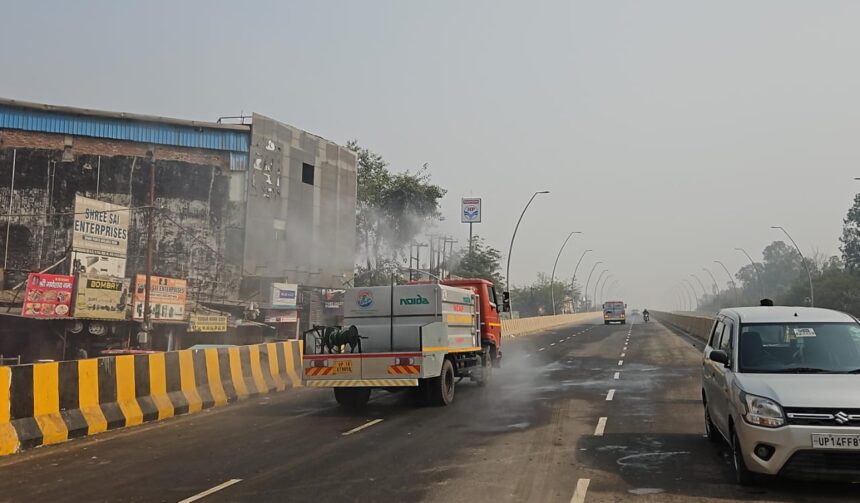
The Noida Authority has opened the newly constructed six-lane elevated corridor between the Aghapur Petrol Pump and the Noida Special Economic Zone for trial use, marking the completion of one of the region’s most significant infrastructure projects aimed at easing severe congestion on the city’s busiest traffic spine. Spanning 4.5 kilometres with a project cost of ₹608.08 crore, the elevated road has been developed along the crucial DSC Road, which connects high-density residential pockets and major industrial clusters across Noida and Greater Noida. The opening, effective 18 November 2025, follows months of accelerated work and consistent monitoring under the leadership of Noida Authority CEO Dr. Lokesh M., who personally intervened to restore momentum on a project that had experienced delays after July 2023. The trial run marks the beginning of a transformative shift in the region’s internal connectivity framework, promising smoother traffic flow and reduced travel time for thousands of daily commuters.
A Renewed Push Transforms a Delayed Project into a Rapidly Executed Urban Corridor
When construction of the elevated road began in 2020, the corridor was envisioned as a long-term solution to chronic congestion on DSC Road, one of Noida’s most overburdened traffic arteries. For years, this stretch has served as a lifeline connecting Greater Noida, Dadri, Surajpur and densely populated Noida sectors such as Sadarpur, Chhalera, Aghapur, Baraula, Salarpur, and Mangol. It also supports seamless movement to some of the region’s most active industrial and residential sectors, including Sectors 40, 41, 43, 47, 48, 49, 82, 88, 101, 106, 107, 110 and Phase 2. Heavy traffic from these clusters had routinely resulted in long, unpredictable jams, especially during peak office hours and industrial shift changes.
Although the project made rapid headway during its initial phases, its pace slowed considerably after mid-2023, primarily due to administrative transitions, contractual realignments and logistical bottlenecks. By early 2024, the construction delays had created public frustration, with commuters continuing to face prolonged bottlenecks at key merging points. Once Dr. Lokesh M. assumed charge as CEO of the Noida Authority, the project was elevated to priority status. His strategic oversight included weekly site inspections, revised timelines for contractors and coordination with utility service teams to expedite shifting work that had previously stalled construction progress. This renewed administrative energy helped streamline operations, clear technical obstacles and restore full construction speed through 2024 and 2025.
The final months leading to completion saw accelerated work on finishing layers, installation of crash barriers, lighting systems, expansion joints and surveillance infrastructure. The Noida Authority also coordinated with traffic police to plan diversions and signage for the smooth commencement of the trial run phase. On 18 November 2025, the elevated road was formally opened for public trial usage, marking the first opportunity for commuters to experience the advantages of the newly created corridor.
The Authority emphasised that the trial phase will allow engineers and traffic experts to monitor structural behaviour, expansion joints, load distribution patterns, peak-hour dynamics and safety responses under real traffic conditions. Any corrective or refinement measures will be implemented during this period before the corridor is officially inaugurated for full operational use. The Authority is confident that the completed infrastructure will significantly reduce congestion on the ground-level DSC Road, which has long struggled with mixing of local and long-distance traffic, slow-moving commercial vehicles and frequent stoppages caused by intersections and dense settlement areas.
A Strategic Link Designed to Reshape Daily Connectivity Across Noida and Greater Noida
The six-lane elevated corridor is not merely a transport facility; it is a critical mobility intervention that aligns with the urban expansion trajectory of Noida and Greater Noida. As new housing sectors continue to populate and more industries enter the region, the load on DSC Road has grown exponentially. The corridor’s design aims to separate long-distance or through-traffic from local movement, creating a dedicated high-speed channel for commuters travelling between major nodes without interruption.
The 4.5-kilometre structure, built at a cost exceeding ₹608 crore, represents one of Noida’s largest standalone mobility investments in recent years. Engineers designed the alignment to bypass traffic choke points, minimise impact on existing residential areas and integrate with future mobility solutions planned for the region, including the proposed Phase-3 metro link and expressway connectivity upgrades. The project team incorporated high-grade materials for durability, advanced load-bearing technologies and improved drainage systems to ensure safety and structural efficiency during monsoon periods.
With the commencement of trial usage, thousands of vehicles that previously navigated narrow, signal-heavy or congested stretches of DSC Road now have access to a seamless elevated span. This is expected to reduce peak-hour travel time between the Aghapur petrol pump and NSEZ by nearly 40–50 percent. The Noida Authority also expects this corridor to absorb a major portion of intercity movement between residential and industrial hubs, freeing ground roads for safer and smoother local movement by two-wheelers, non-motorised vehicles and feeder transport services.
Traffic engineers believe that over the next several months, the elevated road will create a measurable decline in air pollution along the corridor due to a reduction in idling time, excessive braking, and prolonged congestion. Local residents have long demanded such interventions, especially in pockets such as Salarpur, Baraula and Chhalera, where daily gridlocks often extended deep into internal lanes, affecting both mobility and the local environment.
The Authority is also working on synchronising feeder routes, pedestrian underpasses and last-mile improvements in the surrounding sectors to ensure that the elevated road functions as part of an interconnected mobility ecosystem rather than as a standalone project. Plans are underway to redesign certain merging points, update signal cycles, and introduce new signage to reduce confusion during peak hours. Officials noted that public cooperation will be essential in this transitional period as drivers adapt to new movement patterns and revised circulation rules.
The Noida Authority has indicated that after the completion of the trial phase—expected to last several weeks—the elevated corridor will be formally inaugurated and dedicated for uninterrupted public use. Feedback from daily commuters, transport agencies and engineering teams during the trial period will shape final adjustments and operational guidelines. Early responses from motorists using the route on the opening day reflected optimism, with many reporting noticeably smoother movement and reduced congestion compared to the ground-level DSC Road.