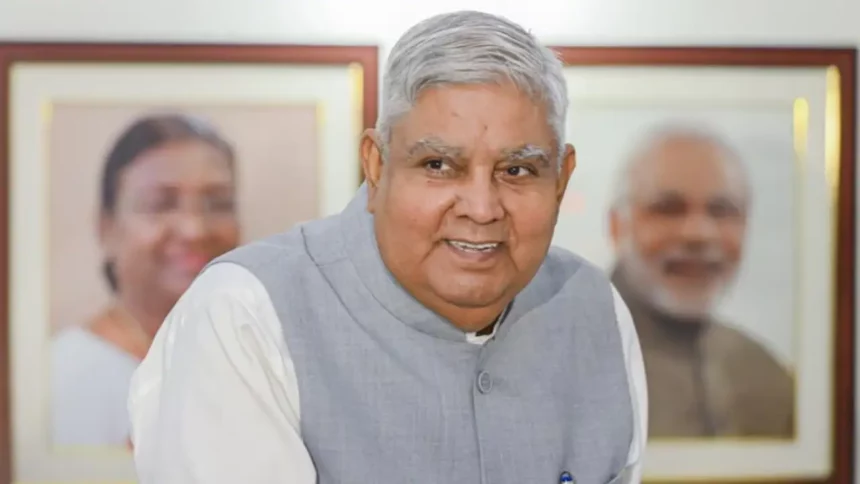
The sudden resignation of Vice President Jagdeep Dhankhar due to health concerns has set off a flurry of discussions in political circles, with leaders and parties now preparing for an election that, according to the Constitution, must be conducted as soon as possible to fill the second-highest constitutional office in the country. While the official election notification is still awaited, several prominent names have started circulating as potential successors, shaping an important moment in Indian politics amid the current volatile landscape.
Jagdeep Dhankhar’s resignation, which came as a surprise to many in the government, has forced political strategists to rework equations and prepare for a vice-presidential election that may influence the balance of power in the Rajya Sabha and beyond. As the discussions continue, three names—Bihar Chief Minister Nitish Kumar, Jammu and Kashmir Lieutenant Governor Manoj Sinha, and Delhi Lieutenant Governor VK Saxena—have emerged as potential frontrunners, each bringing distinct political and administrative backgrounds to the race.
Nitish Kumar’s Candidacy Draws Attention
Among the names floating in the corridors of power, Bihar Chief Minister Nitish Kumar stands out for his experience and ability to navigate coalition politics. With decades of political experience, Kumar has held positions as a Union Minister and has led Bihar through multiple terms as Chief Minister, displaying political flexibility and administrative focus.
His potential move to the Vice President’s office would mark a significant shift in Bihar’s political landscape while allowing the central government to recalibrate its approach toward the state ahead of the upcoming Lok Sabha elections. For Nitish Kumar, who has maintained a pragmatic stance in his alliances, the Vice President’s role would provide a platform for a national position while potentially ensuring political stability in Bihar through a carefully managed succession plan.
VK Saxena and Manoj Sinha Also in Consideration
VK Saxena, currently serving as Delhi’s Lieutenant Governor, has been in his position for three years and has played a prominent role in shaping the administrative framework in the capital. His tenure has seen multiple standoffs with the Aam Aadmi Party (AAP) government, with Saxena often blocking policy moves related to appointments and the functioning of the Delhi Jal Board, creating a perception of a parallel authority within the city administration.
Saxena’s potential elevation to the Vice President’s post is seen by some within the party as a reward for his administrative stance and a move to place a politically loyal figure in a significant constitutional position. A former corporate leader, Saxena’s approach has been marked by assertive decision-making and close alignment with the central government’s perspectives on Delhi’s governance, a factor that could work in his favor during the selection process.
Manoj Sinha, the Lieutenant Governor of Jammu and Kashmir, is another strong contender. With his five-year term set to conclude on August 6, the timing aligns perfectly for a transition to the Vice President’s role. Sinha, a seasoned BJP leader from Uttar Pradesh and a former junior railway minister, is credited by his supporters for bringing relative stability to Jammu and Kashmir following the abrogation of Article 370, despite the complex challenges of governance in the region.
However, his tenure has not been without controversy, with the recent Pahalgam terror attack, which claimed the lives of 25 tourists and a pony operator, casting a shadow over the administration’s security management. Even so, Sinha’s overall track record and loyalty to the party’s objectives could position him strongly in the vice-presidential race, with many within the BJP seeing his potential elevation as recognition for his efforts in a sensitive region.
The Road Ahead for the Vice Presidential Election
According to constitutional provisions, the election to the Vice President’s post must be conducted promptly in case of a vacancy, a clause that now necessitates swift action from the Election Commission. The Vice President, who also serves as the Chairperson of the Rajya Sabha, plays a crucial role in legislative management and maintaining order within the upper house, making the selection a significant decision for the ruling government and the opposition alike.
While the BJP and its allies are expected to field a candidate with administrative experience and loyalty to the party’s vision, the opposition may use the election to test its unity and strategy ahead of the 2025 general elections. The evolving political landscape, marked by regional alliances and shifting loyalties, makes the vice-presidential election a critical test of strength for all stakeholders involved.
As discussions continue within party corridors and informal talks shape strategies, the emergence of Nitish Kumar, Manoj Sinha, and VK Saxena as the leading contenders underscores the party’s emphasis on a blend of administrative experience, political acumen, and loyalty to the central government’s policies. The coming weeks will determine who among these leaders will step into the constitutional role, shaping the dynamics of India’s parliamentary proceedings and its political course as the nation heads into a crucial electoral phase.