In a striking display of political camaraderie, Bihar Chief Minister Nitish Kumar publicly lauded Prime Minister Narendra Modi during his visit to Purnea, eastern Bihar, marking a milestone in the state’s development story. PM Modi inaugurated projects worth ₹36,000 crore, including the first-ever airport in the Seemanchal region, a politically sensitive area that has historically lagged in infrastructure development. Nitish Kumar, who once criticized PM Modi fiercely, called upon the crowd to give the Prime Minister a standing ovation, highlighting the central government’s instrumental role in transforming Bihar’s development landscape. This event not only showcased Bihar’s recent infrastructural growth but also underlined the strategic political alignment between the JD(U) and BJP ahead of crucial elections.
Purnea Inaugurations and Development Milestones
Prime Minister Modi’s visit to Purnea was marked by high anticipation, as the region has long been considered a development backwater. The inauguration ceremony encompassed projects totaling ₹36,000 crore, aimed at boosting connectivity, infrastructure, and public services. The centerpiece of this announcement was the establishment of the first airport in Seemanchal, a move expected to significantly enhance trade, tourism, and economic integration in the eastern parts of Bihar. Local officials emphasized that the airport would also facilitate faster transportation of goods and improve emergency connectivity in a region prone to natural calamities.
Beyond the airport, several other projects were unveiled, ranging from highways and bridges to healthcare and educational facilities. These initiatives reflect the BJP-led central government’s commitment to improving the socio-economic conditions in Bihar, particularly in areas that had historically been neglected. The projects are part of a broader plan to stimulate regional development and create job opportunities for local youth, ensuring inclusive growth across the state.
During his address, PM Modi underscored the importance of these projects for Bihar’s future, emphasizing that the central government has consistently worked to ensure development reaches every corner of the country. The Prime Minister’s remarks focused on the transformative impact of infrastructure investment and economic initiatives, linking them directly to Bihar’s long-term prosperity and the well-being of its citizens. His speech reinforced the narrative of decisive governance and sustained development as key pillars of his administration’s agenda.
Nitish Kumar’s Standing Ovation and Political Significance
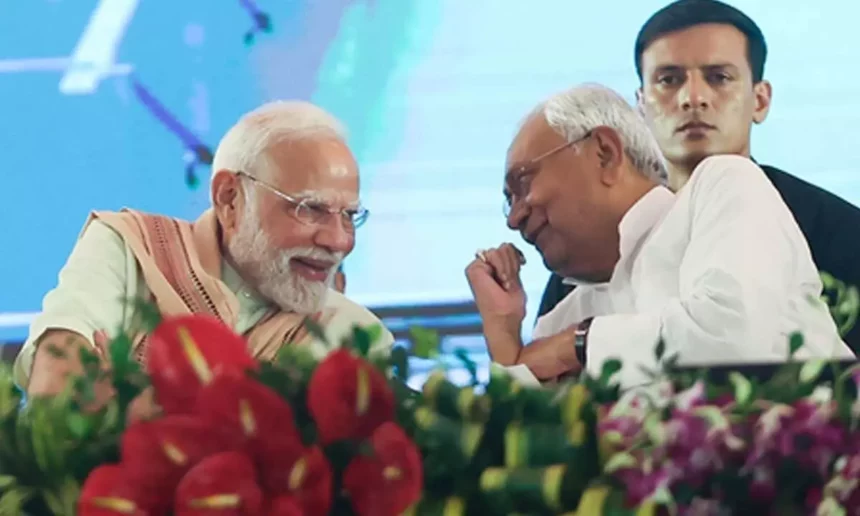
In a moment that captured media attention nationwide, Chief Minister Nitish Kumar, who had previously been a vocal critic of Narendra Modi, asked the gathering in Purnea to give the Prime Minister a standing ovation. Addressing the crowd, Nitish Kumar said, “He has done so much for Bihar. Please stand up and greet him. Why are you all sitting?” The crowd responded enthusiastically, applauding the Prime Minister as he bowed with folded hands.
Nitish Kumar used this platform not only to praise Modi but also to highlight the cooperative dynamic between the state and central governments. He stressed that Bihar’s development trajectory had accelerated with the support of the central government, contrasting it with the perceived stagnation during previous administrations. “Before our government was formed on November 24, 2005, there was nothing in Bihar. The previous government did nothing. After we came, continuous work was done,” he said, without explicitly naming his political rivals, in a clear reference to the Rashtriya Janata Dal’s tenure.
This event also had deeper political undertones. Nitish Kumar’s JD(U) remains a crucial ally of the BJP at the center, and its support was instrumental in the formation of PM Modi 3.0 government after the BJP fell short of a majority in the Lok Sabha elections last year. Historically, Nitish Kumar has navigated complex political terrain, having walked out of the NDA in 2013 over the BJP’s choice of PM Modi as its prime ministerial candidate, only to later reconcile and resume alliance ties. Over the past decade, Nitish Kumar has demonstrated a pattern of political flexibility, balancing ideological considerations with pragmatic governance needs.
By publicly applauding PM Modi in Purnea, Nitish Kumar not only signaled alignment with the central leadership but also sought to strengthen his political standing ahead of upcoming elections. The event underscored the JD(U)’s strategic positioning, combining governance achievements with electoral optics to consolidate voter support. The standing ovation served as both a symbolic and practical endorsement, projecting unity and shared developmental vision between state and central authorities.
Bridging Regional Disparities and Strategic Development
Seemanchal, the region hosting these projects, has long been considered politically sensitive and economically underdeveloped. The inauguration of the airport, along with associated infrastructure projects, represents a targeted effort to bridge regional disparities and provide equitable access to economic opportunities. Experts argue that such initiatives are likely to improve local livelihoods, attract investment, and foster greater political stability by demonstrating the tangible benefits of governance.
Additionally, the development push aligns with broader objectives of economic integration and connectivity. Highways, transportation networks, and public service facilities unveiled alongside the airport are designed to facilitate seamless movement of people and goods, reduce regional isolation, and integrate Seemanchal into Bihar’s larger economic framework. By investing in infrastructure, the central and state governments are addressing long-standing developmental gaps that had constrained the region’s growth potential.
Politically, the announcement carries implications for voter sentiment. Bihar has historically witnessed intense electoral competition, with development projects serving as a significant determinant of public perception. By visibly linking central investment to state progress, the BJP and JD(U) aim to reinforce narratives of effective governance, accountability, and proactive leadership. Nitish Kumar’s public acknowledgment of PM Modi’s role reinforces the perception of collaborative governance, contrasting with previous periods characterized by limited central engagement.